




What to Do If Your Instrument Arrives Damaged
7th Sep 2026
Table of Contents
- Immediate Steps When Your Instrument Arrives Damaged
- How to Document Shipping Damage for Insurance Claims
- Instrument-Specific Inspection Checklist
- Contacting the Seller and Australian Consumer Law Damaged Goods Rights
- Returning Damaged Musical Instruments to Retailer: Refund or Replacement
- Handling Courier Disputes and Insurance Claims
- Preventing Future Damage: Packaging and Delivery Tips
- Frequently Asked Questions
Last Updated: September 7, 2026
Few moments are more deflating than watching a courier deliver a long-awaited instrument, only to discover the box is crushed, dented, or torn. Knowing what to do if instrument arrives damaged can mean the difference between a quick replacement and a lengthy dispute. This guide from Muzic Man, a leading online music equipment retailer in Robina, Queensland, walks you through the exact steps to protect your rights.
Australian law offers strong protections for online purchases. Your first actions after delivery set the foundation for a successful claim.
Immediate Steps When Your Instrument Arrives Damaged
The moment you spot visible damage to the outer packaging, respond immediately. Do not accept the delivery without noting the issue, or if the damage is severe, consider refusing the parcel outright. When you accept it, photograph the exterior packaging from every angle before opening the box.
Here is the exact sequence to follow, whether you are dealing with Australia Post, Startrack, Toll, or a courier like CouriersPlease:
-
Check the driver's handheld device. Couriers in Australia are required to record delivery exceptions. If you point out visible damage at the door, ask the driver to mark the consignment as "damaged on arrival" or "refused due to damage" on their scanner. This creates an immediate electronic record that is far harder to dispute later than a verbal comment.
-
Refuse the parcel only if the damage is catastrophic. If the box is crushed to the point where the instrument is clearly compromised (e.g., a neck visibly poking through the cardboard), you can refuse the delivery entirely. The parcel will be returned to the sender, and the retailer will need to lodge a claim with the carrier. Refusing delivery can slow the replacement process, as the retailer must wait for the return to reach their warehouse. If the damage is moderate or uncertain, accept the parcel but annotate the delivery receipt with "accepted subject to internal damage inspection" if the driver allows it.
-
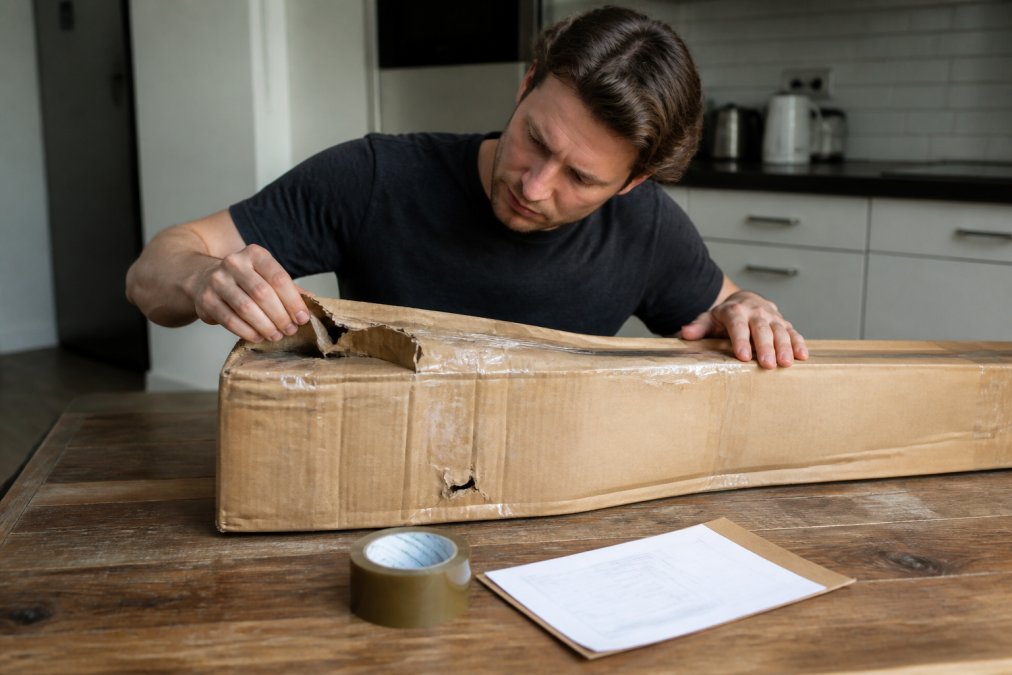
Photograph the exterior before opening. Take wide shots of all six sides of the box, plus close-ups of any dents, punctures, or crush marks. Include the delivery label and the consignment note number in at least one photo. This links the damage to your specific shipment.
-
Open the box on camera. Set up your phone on a stable surface and record a continuous video of the unboxing. Show the sealed box, cut the tape, and reveal the instrument in one take. Do not edit the video. This is the single most persuasive piece of evidence you can provide to a retailer or tribunal.
-
Keep every piece of packing material. Do not discard the box, foam, bubble wrap, or the instrument's own case until the claim is fully resolved. Under the Australian Consumer Law, the retailer bears responsibility for the goods until they reach you in acceptable condition. The packaging is physical evidence of how the instrument was handled in transit. If the box shows no external damage but the instrument is cracked, the packaging may reveal inadequate internal bracing, shifting liability to the seller for poor packing rather than the courier for rough handling.
-
Check the time window. Most Australian retailers require notification of damage within 24 to 48 hours of delivery. Some courier companies, including Australia Post, require claims within 14 days, but the retailer's own policy may be shorter. Check the seller's return policy immediately. If you are outside the window, you lose significant leverage, even though your statutory rights under the Australian Consumer Law do not have a fixed notification deadline for major failures.
If the instrument has suffered structural damage, such as a cracked neck or a crushed body, stop handling it immediately to prevent further harm and preserve the evidence.
How to Document Shipping Damage for Insurance Claims
Proper documentation is the backbone of any successful claim. You need photographic evidence showing the condition of the packaging, the instrument, and the correlation between the two.
Take wide-angle shots of the box showing overall condition, then close-ups of any dents, punctures, or crush marks. Capture the delivery receipt and shipping labels in the same frame where possible to link the evidence to your specific parcel.
A common mistake is discarding the packaging before taking photos. The box tells the story of how the instrument was handled, and without it, your claim loses significant weight.
Instrument-Specific Inspection Checklist
Different instruments have different vulnerabilities. This checklist guides your inspection systematically.
For guitars and stringed instruments, check the neck for any visible bowing or twisting, and run your hand along the fretboard edges to feel for lifting frets. Examine the headstock closely, as this area is prone to snapping during rough handling. Look at the body for cracks in the finish, particularly around the neck joint and the bridge.
For keyboards and digital pianos, test every key across the full range for responsiveness and check the power supply and all input ports. For brass and woodwind instruments, look for dents in the tubing or bell, and test that all slides and valves move freely. Whatever the instrument, play it if possible to confirm the sound quality is unaffected.
| Instrument Type | Critical Areas to Check | Common Transit Damage |
|---|---|---|
| Guitar / Bass | Neck, headstock, fretboard, body joints | Cracks, snapped headstock, lifted frets |
| Keyboard / Piano | Keys, power supply, ports, casing | Broken keys, loose internal components |
| Brass / Woodwind | Tubing, slides, valves, bell | Dents, bent slides, stuck valves |
| Drum Kit | Shells, rims, tension rods | Cracked shells, warped rims |
Contacting the Seller and Australian Consumer Law Damaged Goods Rights
After documenting the damage, contact the seller immediately with your photos and a clear description of the problem. Australian Consumer Law damaged goods protections sit at the heart of your rights here. Under the Australian Consumer Law guidelines, goods must be of acceptable quality, which includes being free from defects and safe to use, and they must match their description.
When an instrument arrives damaged, this typically constitutes a major failure under the law, because a damaged instrument is not something a reasonable consumer would have accepted. This means you are entitled to choose between a refund or a replacement, at your discretion.
The retailer cannot simply redirect you to the courier. Your contract is with the seller, and they are responsible for the goods until they reach you in acceptable condition. State this clearly and politely in your first communication.
Returning Damaged Musical Instruments to Retailer: Refund or Replacement
Returning damaged musical instruments to a retailer is straightforward when you know your rights. Because the damage represents a major failure, you can request a full refund or a replacement, and the retailer must cover the return cost.
Before sending anything back, confirm the return process in writing. Ask for a prepaid shipping label and keep the tracking number. Returning damaged musical instruments to a retailer should never cost you money out of pocket when the damage occurred in transit.
A reputable retailer will handle this process smoothly. Proper documentation and clear communication resolve most damage claims quickly. Act fast and provide clear photographic evidence.
Handling Courier Disputes and Insurance Claims
Sometimes the seller and courier dispute liability. The retailer should pursue the shipping carrier on your behalf, since their contract is with the courier, not yours.
Who is liable under Australian Consumer Law?
Your contract is with the seller, not the courier. Under the Australian Consumer Law, the retailer is responsible for ensuring goods arrive in acceptable quality. If the instrument arrives damaged, the retailer cannot simply redirect you to the courier. The retailer must provide a remedy, a refund, repair, or replacement, and then pursue the courier themselves under their own shipping contract.
What if the retailer blames the courier?
If the retailer insists the damage is the courier's fault and refuses to act, you have several escalation paths:
-
Lodge a formal complaint with the retailer's internal dispute resolution team. Most large Australian retailers have a dedicated complaints process. Put your complaint in writing, attach your photographic evidence and the unboxing video, and state you are seeking a remedy under the Australian Consumer Law for a major failure.
-
Contact the courier directly, but only as a secondary step. Courier companies in Australia have their own claims processes. Australia Post, for example, requires the sender (the retailer) to lodge a claim, but you can still contact them to request a reference number and confirm the claim status. Toll and Startrack have similar sender-based claim models. Be prepared for them to tell you to go back to the retailer, that is normal.
-
Escalate to the Australian Financial Complaints Authority (AFCA), only if you paid by credit card and the card provider is a member. AFCA handles complaints about financial services, including credit card chargebacks. If the retailer refuses to resolve the issue and you paid by credit card, you may be able to lodge a chargeback dispute with your bank. The bank will investigate and may reverse the payment if the goods were not delivered in acceptable condition.
-
Lodge a complaint with the Office of Fair Trading in your state. In Queensland, this is the Office of Fair Trading (OFT). The OFT can mediate disputes between consumers and businesses. They cannot force a refund, but their involvement often pressures a retailer to resolve the matter quickly.
-
Apply to the Queensland Civil and Administrative Tribunal (QCAT). For claims up to $25,000, QCAT can hear consumer disputes under the Australian Consumer Law (qcat.qld.gov.au). The application fee is currently around $100, and the process is designed for self-represented parties. QCAT orders are legally binding.
What about shipping insurance?
Shipping insurance is a separate layer of protection the seller may have purchased, or that you may have been offered at checkout. Most courier contracts include a base level of liability (often around $50 to $100), far below the value of most instruments (accc.gov.au). If the seller purchased additional transit insurance, the claim is handled between seller and insurer. If you purchased insurance yourself, you may need to lodge the claim directly with the insurer.
A common pattern is that the retailer's insurance covers the damage, but the retailer must lodge the claim within the courier's time limit, often 14 days from delivery. This is another reason to report damage immediately. If the retailer delays, they may lose their own coverage.
Keeping a paper trail
Keep every email, receipt, and tracking record organised in one place. A clear paper trail showing your time-sensitive notification and photographic evidence makes your position significantly stronger if the dispute escalates. Save screenshots of the retailer's return policy and any chat transcripts. If you speak to anyone on the phone, follow up with an email summarising the discussion.
A unique angle: the Queensland-specific path
If you are in Queensland, you have a distinct advantage: QCAT has a fast-track process for consumer disputes under $25,000. You can lodge your application online, and the tribunal will schedule a hearing. This is often faster and cheaper than pursuing a claim through a lawyer or the federal court system.
Preventing Future Damage: Packaging and Delivery Tips
While you cannot control how a courier handles a parcel, you can choose retailers who package instruments properly.
A properly packed instrument should have a hard case or substantial internal padding, with the instrument secured so it cannot shift during transit. The outer box should be rigid and appropriately sized, with sufficient void fill to absorb impacts. If buying from a physical store near you, such as the Muzic Man shop in Robina, you can inspect the instrument in person and take it home yourself, eliminating courier damage risk entirely.
When ordering online, check that the retailer has a clear damaged goods policy before you purchase. Look for explicit statements about who bears responsibility for transit damage and what the claim process involves.
Dealing with a damaged delivery is never pleasant, but knowing your rights and following a clear process turns a stressful situation into a manageable one. Document everything, act quickly, and remember that returning damaged musical instruments to a retailer is your right under Australian Consumer Law when the goods arrive in less than acceptable condition.
Frequently Asked Questions
Who is responsible for shipping damage: the courier or the retailer?
Under Australian Consumer Law, the retailer is responsible for goods that arrive damaged, even if the damage happened during transit. This is because the product was not delivered in a satisfactory condition and did not match the description. You have the right to a repair, replacement, or refund from the seller. The retailer can then pursue a claim against the courier themselves. Contact the store directly rather than trying to negotiate with the delivery company on your own.
Do I need to keep the original packaging if my instrument arrives damaged?
Yes, keep the original packaging, including any foam, cardboard inserts, and the outer shipping box. This packaging serves as crucial evidence for your insurance claim and for returning the damaged musical instrument to the retailer. Photograph the box before you remove the instrument, showing any dents, tears, or crush marks. Store the packaging and the damaged instrument together until your claim is resolved, as the retailer or courier may need to inspect them.
What are my rights under Australian Consumer Law for damaged goods?
Australian Consumer Law gives you a right to a remedy when goods arrive damaged. A damaged instrument is considered a major failure, as it would not have been bought if you had known about the damage. You can choose between a full refund or a replacement. The retailer must cover any reasonable costs you incur to return the item, such as postage. You have these rights regardless of the store's own return policy, and they apply whether you bought the item online or in a physical store.
How long do I have to report damage to my instrument after delivery?
Report damage as soon as you discover it, and ideally within 24 to 48 hours of delivery. While Australian Consumer Law does not set a specific time limit for reporting damaged goods, waiting too long can make it harder to prove the damage happened in transit. For insurance claims, time-sensitive notification is often a condition of coverage. Check the delivery receipt and the retailer's terms, but the best practice is to photograph the packaging immediately and contact the seller the same day.