




Beginner Guitar Quality Check Guide 2026
1st Sep 2026
Table of Contents
- What Makes a Quality Beginner Guitar
- How to Check Guitar Action Height
- Inspecting the Neck and Fretboard
- Beginner Guitar Setup Checklist
- Acoustic vs Electric Guitar Differences for Beginners
- Australian Consumer Law Guitar Warranty
- Testing Playability and Sound Quality
- Conclusion
- Frequently Asked Questions
Last Updated: September 1, 2026
What Makes a Quality Beginner Guitar
A quality beginner guitar balances playability, durability, and sound in a way that encourages practice rather than frustration. The difference between a guitar that inspires daily playing and one that collects dust comes down to three factors: how easy it is to play, how well it stays in tune, and whether the build quality suggests it will last beyond the first year.
The most common mistake beginners make is treating all entry-level guitars as equivalent. A poorly constructed beginner guitar can have action so high it causes finger pain, frets so uneven they buzz unpredictably, or a neck that warps within months. These issues actively discourage practice. A quality beginner instrument feels responsive under your fingers and rewards consistent playing with audible improvement.
At Muzic Man, the guitars we stock for beginners are selected specifically because they deliver playability without the premium price tag of professional instruments. They've passed basic quality checks: the fretboard is properly finished, the tuning pegs hold their position, and the neck relief sits within acceptable tolerances.
When evaluating a beginner guitar, focus on three areas: the structural integrity of the neck and fretboard, the height and consistency of the action, and the overall finish quality. Each directly affects how the instrument feels and sounds.
How to Check Guitar Action Height
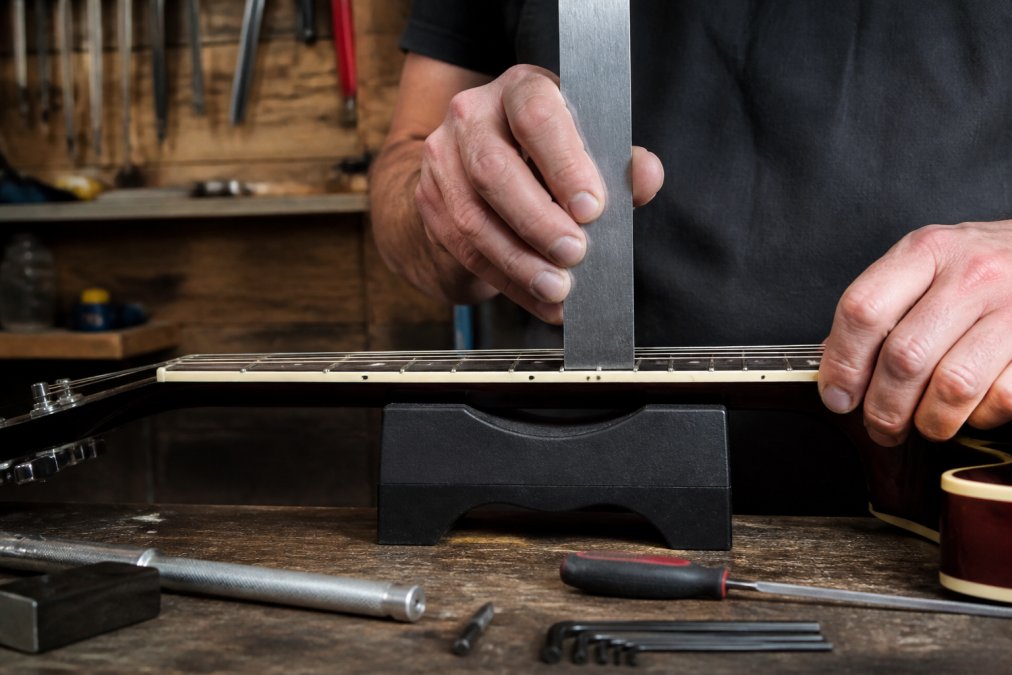
Action is the distance between the strings and the fretboard, measured typically at the 12th fret. This measurement directly determines how much finger pressure you need to produce a clean note. Low action feels effortless; high action requires significant finger strength and can cause hand fatigue.
For beginners, action height matters more than almost any other specification. The ideal range for a beginner acoustic guitar sits around 2.0-2.5mm on the bass side (low E string) and 1.8-2.3mm on the treble side (high E string). For electric guitars, slightly lower action, around 1.5-2.0mm on the bass side, is typical and playable.
Why Action Matters for Playability
High action creates an immediate barrier to learning. Your fingers have to press harder to make contact, which causes pain that discourages daily practice. Many students quit within the first month not because they lack talent, but because their fingers hurt too much to practice comfortably.
Conversely, action that's too low introduces fret buzz. When strings vibrate against the frets instead of ringing cleanly, the instrument sounds cheap and uncontrolled. The sweet spot is where strings ring cleanly with moderate finger pressure, enough to encourage practice without causing pain.
Measuring Action at the 12th Fret
To measure action properly, you'll need a straightedge, a feeler gauge or capo, and a quiet moment to focus.
Place the straightedge flat across the frets, running from the first fret to the last fret on the fretboard. This shows you the neck's overall relief. A small amount of relief is normal and necessary; too much creates high action at the middle frets.
Once you've assessed neck relief, measure the gap at the 12th fret specifically. Place a feeler gauge or thin ruler under the string at the 12th fret and measure the space between the string and the top of the fret. Do this for both the bass strings (low E, A, D) and treble strings (G, B, high E). If the bass side sits above 2.5mm or the treble side above 2.3mm, the action is likely too high for comfortable beginner practice. If either measurement is below 1.5mm, watch for fret buzz during play.
Inspecting the Neck and Fretboard
The neck is the foundation of playability. A warped or twisted neck makes consistent playing nearly impossible. Before purchasing any beginner guitar, inspect the neck carefully for structural issues.

Checking for Fret Buzz and Neck Relief
Start by sighting down the fretboard from the headstock toward the body. A properly constructed neck should show a very slight forward bow. This forward bow is called neck relief, and it's essential for buzz-free playability.
If the fretboard looks perfectly straight, there may not be enough relief, and you'll hear fret buzz. If the bow is pronounced, visibly curved like a banana, there's excessive relief, and action will be too high. The ideal neck relief is barely visible to the eye.
To test for fret buzz, hold the guitar in playing position and press the first fret and the last fret simultaneously with one hand. With your other hand, pluck each open string. If you hear a buzzing or rattling sound rather than a clean ring, fret buzz is present. This indicates either insufficient neck relief, uneven frets, or action that's too low.
Run your finger along the fretboard, feeling for any frets that seem to stick out. A properly crowned fretboard should feel smooth, with no individual frets protruding.
Assessing Fretboard Condition
Examine the fretboard's finish and material. Quality beginner guitars typically use rosewood, ebony, or composite fretboards. Look for cracks, chips, or deep gouges in the fretboard. Minor surface wear is normal on used instruments, but structural damage suggests the instrument has been neglected.
Check that the frets themselves are level and evenly spaced. The frets should appear to form a straight line when viewed from the side. If some frets appear higher or lower than others, the fretboard may have warped.
The nut, the small piece at the headstock end where the strings pass, should be properly fitted and show no cracks. The nut's grooves should be smooth and properly sized for each string. If you notice the strings catching or making unusual sounds as you tune, the nut may need attention.
Beginner Guitar Setup Checklist
A proper setup is the bridge between a raw instrument and one that's genuinely playable. Before purchasing a beginner guitar, confirm that it's been set up or budget for setup costs. A professional setup typically includes action adjustment, truss rod evaluation, nut and bridge inspection, and intonation checking.
Use this checklist to assess whether a guitar is ready to play or needs professional attention:
- Action measured: Bass side 2.0-2.5mm, treble side 1.8-2.3mm at the 12th fret
- Neck relief assessed: Slight forward bow visible when sighting down the fretboard; no excessive curve or straightness
- Fret buzz test: No buzzing or rattling when strings are plucked open; clean ring on all strings
- Tuning stability: Guitar holds tuning for at least 30 minutes after initial tuning
- Nut condition: No cracks; string grooves are smooth and properly sized
- Bridge secure: Bridge is firmly seated and shows no cracks or separation from the body
- Intonation check: Open strings are in tune; fretted notes (especially at the 12th fret) are in tune when compared to a tuner
- Fretboard finish: No deep cracks or structural damage; surface is clean and well-maintained
- Hardware functioning: Tuning pegs turn smoothly; bridge pins (if applicable) seat properly
If more than two items on this checklist show issues, the guitar likely needs professional setup before it's suitable for serious practice. Many retailers, including Muzic Man, can arrange professional setup or recommend trusted technicians in your area.
Acoustic vs Electric Guitar Differences for Beginners
The choice between acoustic and electric affects not just sound, but playability, comfort, and the type of practice that feels rewarding.
Acoustic guitars produce sound through the resonance of the wooden body. They're louder and more self-contained, requiring no amplifier. The larger body and wider neck spacing make them slightly more challenging for beginners with smaller hands, and the higher string tension means action is typically higher than electric guitars.
Electric guitars have thinner bodies and narrower necks, making them more comfortable for smaller hands. The strings are lighter gauge, requiring less finger pressure. Electric guitars can be played quietly through headphones, which appeals to beginners concerned about disturbing others. The thinner strings and lower action make electric guitars technically easier to play.
The trade-off is that electric guitars require an amplifier and cable, adding to the initial cost. For beginners deciding between the two, consider your living situation, your hand size, and the style of music that motivates you. If you're drawn to rock, blues, or metal, electric guitar's lower action will feel more natural. If you prefer folk, singer-songwriter, or classical styles, acoustic guitar is the traditional choice.
Both acoustic and electric guitars should be assessed using the same standards: proper action height, neck relief, fret condition, and intonation.
Australian Consumer Law Guitar Warranty
When purchasing a beginner guitar in Australia, you're protected by the Australian Consumer Law, which applies to all goods sold to consumers (accc.gov.au). This law guarantees that goods are of acceptable quality, fit for purpose, and as described. For guitars, this means the instrument should be free from defects and suitable for playing when you purchase it.
Acceptable quality for a beginner guitar means it should be playable without immediate need for expensive repairs. If a guitar arrives with fret buzz that makes it unplayable, a warped neck, or hardware that doesn't function, these are breaches of the acceptable quality guarantee. You're entitled to a refund, replacement, or repair at no cost.
The Australian Consumer Law also provides protection for a reasonable period after purchase, typically up to several years for durable goods like guitars. If a structural defect appears within this period, you may be entitled to repair or replacement even if the manufacturer's warranty has expired.
When purchasing from Muzic Man or any retailer, keep your receipt and documentation. If you discover a defect, contact the retailer promptly with photos or video evidence. Most reputable retailers will arrange repair or replacement without requiring formal legal action. For complex disputes, you can contact the Australian Consumer and Competition Commission (ACCC) for guidance on your rights.
Testing Playability and Sound Quality
Before committing to a purchase, spend time actually playing the guitar. A beginner guitar quality check isn't complete without hands-on assessment. If you're buying online, this is where return policies become crucial.
When testing playability, focus on comfort and responsiveness. Play open strings to ensure they ring cleanly without buzz. Play simple chord shapes (like Em or Am) and listen for any strings that don't ring clearly. Play notes up the fretboard to ensure the frets are even and the instrument feels consistent across the entire neck.
For sound quality, listen for clarity and sustain. A quality beginner acoustic should produce a warm, resonant tone when strummed. An electric guitar through an amplifier should respond cleanly to both soft and aggressive playing.
Pay attention to how the guitar feels in your hands. Is the neck comfortable? Do your fingers have enough space between strings? These comfort factors directly influence whether you'll practice consistently.
If you're purchasing online and can't test the instrument before delivery, choose a retailer with a clear return policy. Muzic Man offers Australia-wide shipping and accepts returns within a specified period if the instrument doesn't meet your expectations.
Conclusion
A quality beginner guitar quality check comes down to assessing four fundamentals: action height that encourages practice, a neck with proper relief that supports buzz-free playability, a fretboard and frets in good condition, and hardware that functions reliably. These factors determine whether the instrument feels responsive and rewarding.
The most valuable thing you can do before purchasing is to physically inspect and play the guitar. If you're buying online, choose a retailer like Muzic Man that stands behind its instruments with clear return policies and Australia-wide shipping. Our range of beginner guitars has been selected specifically for playability and durability, and our team can help you find an instrument that matches your budget and learning style. Start your musical journey with an instrument that feels good to play, it makes all the difference in whether practice becomes a daily habit.
Frequently Asked Questions
How can I tell if a guitar is good quality before buying?
Check the action height, fretboard condition, and neck alignment. Play each string individually to listen for fret buzz. Inspect the bridge, saddle, and tuning pegs for damage. Feel how the neck fits your hand and test playability across all frets. A quality beginner guitar should have consistent intonation, smooth fretboard, and no visible cracks or warping. If buying online, request detailed photos or video demonstrations before purchase.
What are the most common defects to look for in a beginner guitar?
Watch for fret buzz (rattling sound when strings vibrate), high action that makes playing painful, neck warping or relief issues, and loose tuning pegs that won't hold pitch. Check the bridge for separation from the body, cracks in the finish, and binding damage. Inspect the nut width and saddle for wear or chips. Play open strings and barre chords to detect buzzing. These defects affect playability and can be expensive to repair professionally.
What should a beginner guitarist know about beginner guitar setup checklist before purchasing?
A proper setup includes correct action height, truss rod adjustment for neck relief, bridge and saddle alignment, and tuning peg functionality. Before buying, verify the guitar has been professionally set up or budget for setup costs with a luthier. Check that string gauge is appropriate for beginners (usually 0.09 to 0.046 for electric, heavier for acoustic). Confirm the nut width suits your hand size and fretboard feels smooth. Ask the retailer if setup is included or if it's an additional cost.
What consumer guarantees apply to beginner guitars under Australian Consumer Law?
Under Australian Consumer Law, musical instruments must be of acceptable quality, fit for purpose, and as described. Retailers must provide a remedy if the guitar fails within a reasonable timeframe. You're entitled to repair, replacement, or refund if the instrument has a major fault. Minor issues may only warrant repair. Keep your receipt and documentation. If purchasing online, check the retailer's return policy, as it may offer additional protections beyond statutory guarantees.
Does the setup of a beginner guitar affect its playability?
Yes, significantly. Action height, truss rod tension, and bridge alignment directly impact how easy or difficult the guitar is to play. High action causes finger pain and fatigue. Fret buzz from incorrect neck relief ruins tone quality. Poor intonation makes the guitar sound out of tune no matter how well you play. A properly set-up beginner guitar with correct action and neck relief is far more enjoyable to learn on and helps prevent frustration and hand injury.
Should I buy a used or new beginner guitar?
New guitars offer warranty protection and the assurance of proper setup from the manufacturer. Used guitars can offer value but require careful inspection for hidden damage, wear, and setup issues. If buying used, have a luthier inspect it before purchase. Check the fretboard for deep wear, the neck for warping, and the bridge for separation. Verify all tuning pegs function smoothly. New beginner guitars from reputable brands often include a hardshell case or gig bag and come with setup guarantees.
What's the difference between acoustic and electric guitars for beginners?
Acoustic guitars have thicker strings and higher action, requiring more finger strength but offering louder volume without amplification. Electric guitars have thinner strings, lower action, and easier playability, but require an amplifier. Acoustic guitars suit fingerstyle and folk music; electric guitars suit rock and blues. For beginners with weak fingers, electric guitars are often easier to learn on. Consider the music style you want to play and whether you prefer portability or volume.
This article was written using GrandRanker