


How to Use Professional PA Systems for Gigs
Posted by Editorial Team on 28th Oct 2026
Last Updated: October 27, 2026
Quick Summary
Professional PA systems matter for gigs because they keep a live mix clean and push sound to the back of the room when the band gets loud. A cheap practice amp distorts the moment the drummer counts in, while a proper system gives each input its own level and headroom.
- Count every mic and instrument, and always keep two spare channels free for guests.
- Buy for the biggest room you actually play, not the one you dream about.
- Use two speakers on stands for rooms up to 50 people, and two mains plus a sub for 50 to 150.
- Set up in a fixed order: speakers first, then cables, inputs, faders and sound check.
- Never plug or unplug cables with the system powered up, as that pop can take out a driver.
Table of Contents
- Why Professional PA Systems Matter for Live Gigs
- How to Choose a PA System for a Band
- PA Speaker Coverage for Audience Size
- Your Live Sound Equipment Checklist
- Setting Up a PA System for a Gig
- Common PA Mistakes That Ruin Live Sound
- Get Your PA System Ready at Muzic Man
- Frequently Asked Questions
Why Professional PA Systems Matter for Live Gigs
Professional PA systems are the difference between a gig that lands and one that falls flat. They handle the full range of a live mix, push clean sound to the back of the room, and hold up under the pressure of a real show. This guide explains why they matter and how to get yours right.
Here is the core problem. A vocal mic through a cheap practice amp will distort the moment the drummer counts in. The singer pushes harder to hear themselves. The mix turns to mud. That is not a talent issue. It is a gear issue.
A proper system separates the jobs. It gives each input its own path, its own level, and its own headroom. So when the band gets loud, the sound stays clean.
Why does that matter so much for gigs? Because live sound is unforgiving. A recording can be fixed later. A gig cannot.
Watch out: the most common failure is underpowering the speakers. When an amp runs out of clean power, it clips, and clipped signal is what damages drivers (Speaker Damage). Buying more speaker than amp is safer than the reverse.
If you want to see what amplifier power looks like in practice, a PA amplifier can illustrate the kind of headroom a live rig needs.
How to Choose a PA System for a Band
Choosing a PA system for a band comes down to three numbers: how many inputs you need, how much room you are filling, and how much you can carry. Get those right and the rest follows.
Start with inputs. Count every mic and instrument that needs to go through the system.
- Vocal mics: usually two to four
- Acoustic guitar or keys: one to two
- Backing tracks or laptop: one to two
- Spare channels for guests: always keep two free
Then match power to the room. A small pub gig needs far less than an outdoor stage. Buy for the biggest room you actually play, not the one you dream about.
Portability matters more than most guides admit. A system you dread loading into the car will sit in the garage.
Powered speakers save you a separate amp and simplify setup. Passive speakers plus a power amp give more flexibility if you plan to grow.
If you are weighing up powered options, a powered speaker can be a useful reference point for specs and features.
Best for: bands playing pubs, clubs and function rooms. Skip if: you only ever play one fixed venue with a house system.
PA Speaker Coverage for Audience Size
PA speaker coverage for audience size is the rule most new bands ignore. Put simply, coverage is how evenly sound reaches every listener in the room. Get it wrong and the front row is deafened while the back hears mush.
The practical rule is simple. One speaker per side for narrow rooms. Add more cabinets for wide or deep spaces. Point them slightly inward so the coverage patterns overlap in the middle.
Height matters too. Get speakers up near ear level of the standing crowd. Speakers on the floor lose clarity fast.
- Small room, up to 50 people: two speakers on stands
- Mid room, 50 to 150 people: two mains plus a sub
- Large or outdoor space: multiple cabinets and delayed speakers
Subwoofers add low end, but only if the room can handle it. In a small tiled room, a sub can turn the mix to sludge.
Match your speaker setup to the size of the room you are playing.
| Room size | Audience | Speaker setup |
|---|---|---|
| Small room | Up to 50 people | Two speakers on stands |
| Mid room | 50 to 150 people | Two mains plus a sub |
| Large or outdoor space | Larger crowds | Multiple cabinets and delayed speakers |
Your Live Sound Equipment Checklist
A live sound equipment checklist saves you from the panic of a missing cable ten minutes before doors. Pack the same way every time and you will never improvise.
- Mixer with enough channels
- Powered speakers or amp plus passive speakers
- Speaker stands and safety pins
- Microphones and clips
- Mic cables, checked for crackle
- DI boxes for keys and acoustic
- Power leads and a power board
- Spare batteries for anything wireless
- Gaffer tape for cable runs
- Headphones for checking the mix
The item most people forget is the spare. A spare cable, a spare mic, a spare battery. Something will fail. Plan for it.
Setting Up a PA System for a Gig
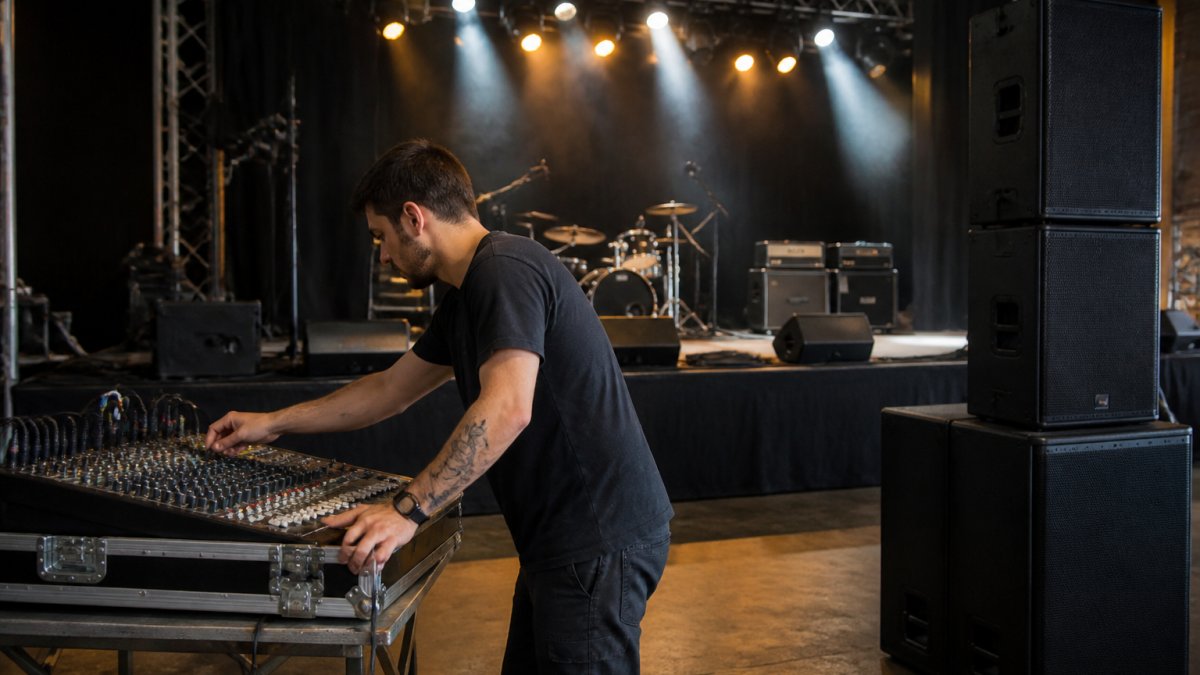
Setting up a PA system for a gig follows a fixed order, and the order matters. Do it the same way every time and setup gets faster and safer.
- Place the speakers first, on stands, angled toward the crowd.
- Run cables from the stage to the mixer, taped down where people walk.
- Connect inputs one at a time and label them.
- Set all faders low, then bring up the main volume gradually.
- Sound check each channel with the actual performer, not a stand-in.
Do the sound check with the band playing at full gig volume. A quiet check tells you nothing about how the system behaves when the drummer gets excited.
Watch out: never plug or unplug cables with the system powered up. That pop can take out a driver.
Common PA Mistakes That Ruin Live Sound
Most live sound disasters are self-inflicted, and nearly all of them are avoidable. Here are some common mistakes.
Mistake one: mixing from behind the speakers. You cannot hear what the crowd hears from the stage. Walk the room during sound check.
Mistake two: too much low end. Bass builds up in corners and small rooms. Cut it before you add it.
Mistake three: feedback ignored until it howls. Ring out the mics before the show. Move mics behind the speakers, not in front.
Mistake four: no headroom. If everything is turned to ten, there is nowhere to go when the singer needs more.
Mistake five: skipping the sound check. It feels like a waste of time until the first song falls apart.
A common mistake is blaming the gear for a bad mix. In practice, placement and gain structure fix most problems.
Get Your PA System Ready at Muzic Man
Building a reliable live rig starts with the right gear and honest advice. Muzic Man stocks many high quality branded musical instruments and supplies, with Australia-wide shipping and a physical shop for hands-on help.
You can browse our range online or get in touch with our team if you are unsure what suits your band. If you want to know who you are buying from, read about us and why we do this.
Get started with Muzic Man and get your live sound sorted before the next gig.
Frequently Asked Questions
Why do musicians need a PA system for gigs?
A PA system amplifies vocals and instruments so the whole audience hears a balanced mix. Without one, vocals get lost behind drums and guitars, especially in larger rooms. Professional PA systems also give you control over volume, EQ and feedback, which makes performances clearer and more reliable. For any gig beyond a tiny acoustic set, a PA is essential gear.
What size PA system do I need for my audience?
Match speaker coverage to the room and crowd. Check speaker dispersion angles so sound reaches the back of the room evenly.
Should I hire or buy a PA system for gigs?
Buying makes sense if you gig regularly, want consistent sound and can store and transport the gear. Hiring suits one-off events or when you need a larger system than you own.
Can a professional PA system make vocals clearer in a live mix?
Use a dedicated vocal microphone, apply high-pass filtering and set gain staging correctly. Positioning speakers in front of the microphones and avoiding excessive volume also reduce feedback, keeping vocals crisp and intelligible for the audience.