


Are Budget Guitars Worth the Money?
Posted by Editorial Team on 27th Oct 2026
Last Updated: October 26, 2026
Quick Summary
Yes, budget guitars are worth the money, but only when the individual instrument is sound and someone checks the setup before it leaves the shop. A cheap guitar that plays well is a genuine instrument, while one with high action and sharp fret ends ends up unplayed.
- Budget guitars split into three tiers: entry under $300, mid-budget $300-$700, and upper-budget $700-$1,200.
- The biggest difference between entry and mid-budget is quality control, which translates directly into playability.
- A professional setup costs $80-$150 and is the highest-value spend on any budget instrument.
- A realistic first-year total for a mid-budget electric setup lands between $600 and $1,400.
- Buy new for your first instrument, then consider used once you know what a good setup feels like.
Table of Contents
- Are Budget Guitars Worth the Money? The Short Answer
- Cheap Guitar vs Expensive Guitar: What Actually Changes
- Budget Tiers Compared: What You Get at Each Price Point
- Guitar Setup for Beginners: Why It Decides Whether a Cheap Guitar Feels Good
- New vs Used Guitar for Beginners: Which Is the Better First Buy?
- Best Budget Guitars for Beginners Australia: What to Look For
- The Total Cost of Ownership: Amp, Setup, Maintenance and Resale
- Try Before You Buy at Our Gold Coast Shop
- Frequently Asked Questions
Are Budget Guitars Worth the Money? The Short Answer
Yes, budget guitars are worth the money, but only when the individual instrument is sound and someone checks the setup before it leaves the shop.
Here at Muzic Man, we sell guitars across the full price spectrum from our Robina store and ship Australia-wide. The difference is rarely the price tag.
Below, we break down what actually changes as the price climbs, how to inspect a cheap guitar before you pay, and what the first year of ownership really costs.
Cheap Guitar vs Expensive Guitar: What Actually Changes
The cheap guitar vs expensive guitar gap comes down to four things: materials, hardware, fretwork, and the amount of hand-finishing each instrument receives. Sound quality is further down that list than most buyers expect.
Where the Money Goes: Materials, Hardware and Fretwork
A premium model pays for solid tonewoods instead of laminates, better tuners that hold pitch, a properly cut nut, and fretwork that has been levelled, crowned and polished by hand. On a cheap guitar, those same jobs are done fast or skipped.
None of that is mysterious. It is labour. The question is whether the shortcuts matter for how you play.
Can a Budget Guitar Sound as Good as an Expensive One?
Often, yes, especially amplified. Richard White notes in his essay on guitar pricing that guitars can be exceptional at any price point, so an expensive instrument is not automatically better than a cheap one.
Pickups and amp do more for amplified tone than the wood ever will. Where budget guitars fall short is unplugged resonance and long-term tuning stability, and both are fixable or livable at beginner level.
If you want the deeper cost-versus-quality breakdown, our guide on whether expensive instruments are worth buying covers resale value and diminishing returns in detail.
Budget Tiers Compared: What You Get at Each Price Point
Budget guitars split into three practical tiers, and each one buys you a different kind of certainty rather than a different kind of sound. The mistake most buyers make is treating "budget" as one category. In reality, the jump from the entry tier to the mid-budget tier changes what you can expect from the instrument far more than the jump from mid-budget to upper-budget.
| Tier | Typical AUD price band (new) | What You Typically Get | Main Trade-off | Best For |
|---|---|---|---|---|
| Entry | Under $300 | Laminate body, basic hardware, minimal factory setup, unbranded tuners | Almost always needs a professional setup to play well; fret ends may need filing | Trying guitar with low commitment |
| Mid-budget | $300-$700 | Solid top on acoustics or better electronics on electrics, branded tuners, better nut material | Still benefits from a setup check, but usually playable out of the box | Most beginners and returning players |
| Upper-budget | $700-$1,200 | Better fretwork, stable tuners, quality pickups, more consistent quality control | Close to used mid-range pricing; diminishing returns start here | Players who will practise daily |
These bands are indicative rather than fixed. Sale pricing, bundle deals and seasonal promotions move instruments between tiers, and a discounted upper-budget model can land in mid-budget territory. The point is to compare like with like: a $250 entry guitar and a $650 mid-budget guitar are not the same product with a different badge.
What Actually Changes Between Tiers
The most meaningful difference between entry and mid-budget is not tonewood or pickups. It is quality control.
Between mid-budget and upper-budget, the gains are more incremental: nicer fretwork, more consistent tuners, better pickups, and a higher chance the instrument plays well straight out of the box.
The middle tier is where value for money peaks. Entry-level instruments can be perfectly playable, but they almost always need adjustment first, and that adjustment has a cost (see the total cost of ownership section below).
For curated examples of instruments that hold up, see our roundup of the best budget instruments for serious players.
Guitar Setup for Beginners: Why It Decides Whether a Cheap Guitar Feels Good
Guitar setup for beginners is the single most important factor in whether a cheap instrument feels good, and it is the step most first-time buyers skip. Action, intonation and fretwork decide playability long before tone enters the conversation.
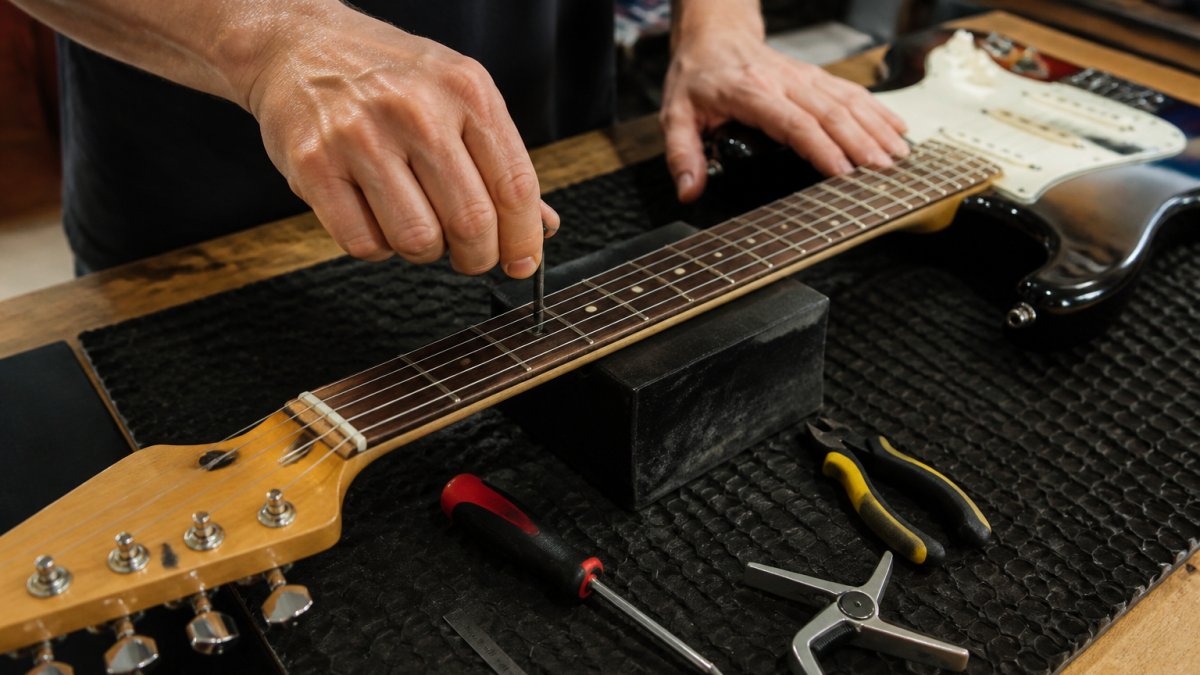
A guitar with high action is painful to play. Painful instruments discourage beginners faster than any other single cause, and it has nothing to do with the price on the tag.
What to Check Before You Buy: Action, Intonation and Fretwork
Run this checklist on any instrument before you pay:
- Press the low E at the 12th fret. Is the gap over the fret roughly 2-3 mm?
- Play the 12th fret harmonic, then the fretted note. Do they match?
- Run a finger along both edges of the neck. Any sharp fret ends?
Watch out: a guitar that fails the intonation or fretwork checks cannot be fixed by practice, only by a technician, so factor that into the decision before you commit.
New vs Used Guitar for Beginners: Which Is the Better First Buy?
For most beginners, a new budget guitar beats a used one, because you get a warranty and a return window instead of someone else's problem.
The new vs used guitar for beginners decision hinges on one question: can you spot a twisted neck or worn frets?
A used guitar can be excellent value, particularly from a seller who kept it humidified and set up.
Best Budget Guitars for Beginners Australia: What to Look For
The best budget guitars for beginners in Australia share three traits: comfortable action, stable tuning, and a body size you can actually hold for half an hour. Brand reputation matters less than the specific instrument in your hands.
Guitar.com's guide to affordable electric guitars names the Yamaha Pacifica 112J as a beginner pick and the Jackson Lee Malia LM-87 as a value option for downtuned metal, while Squier appears as an affordable choice for younger players.
Acoustic or Electric? Matching the Guitar to How You'll Learn
Choose acoustic if you want to practise without an amp and play songs around the house.
Electric guitars are generally easier on beginner hands. Acoustic guitars build strength faster but hurt more in week one.
One local factor matters more than most guides admit. Our guide to maintaining acoustic guitar humidity levels explains the routine.
For a shortlist built for first-time players, see our top beginner electric guitars for Australia.
The Total Cost of Ownership: Amp, Setup, Maintenance and Resale
The guitar is rarely the biggest line item in the first year. Total cost of ownership includes an amp, a professional setup, strings, a tuner, a case, and maintenance, and those add up quickly.
| Cost item | Typical AUD range (first year) | Notes |
|---|---|---|
| Guitar | $300-$700 | Mid-budget tier; entry tier is cheaper but needs more setup |
| Professional setup | $80-$150 | Highest-value spend on any budget instrument |
| Practice amp or headphone amp | $80-$250 | Essential for electric; acoustic needs none |
| Strings | $30-$60 | Two to three sets in the first year |
| Tuner, capo, picks, strap, cable, stand | $60-$120 | Bundled deals can reduce this |
| Case or gig bag | $40-$120 | A gig bag is adequate for home use |
| Maintenance (fretboard oil, humidity control for acoustics) | $20-$50 | Higher for solid-top acoustics in south-east Queensland |
A realistic first-year total for a mid-budget electric setup lands somewhere between $600 and $1,400, depending on how much you bundle and whether you pay for a setup.
Why the Setup Line Matters Most
A professional setup is the highest-value spend for any budget instrument. It addresses action, intonation, nut height and fret ends, which are exactly the areas where entry-tier instruments cut corners. Skipping the setup to save $100 often costs more in frustration, and it is the single most common reason a cheap guitar ends up unplayed.
Resale and Depreciation
Budget guitars depreciate steeply. A $500 instrument might fetch $250-$300 on the used market a year later, and entry-tier instruments often resell for less than half their new price. Expensive guitars hold value better in percentage terms, but they also cost more to lose. For a first instrument, treat resale as a rounding error, not a strategy.
Resale value is where expensive guitars earn back some of their cost. A premium model holds value better, but it also costs more to lose. For a first instrument, buy for playing, not investment.
Try Before You Buy at Our Gold Coast Shop
Playing the actual instrument is the only reliable test of whether a budget guitar is worth the money for you.
At Muzic Man, we keep many branded instruments in stock and ship Australia-wide, with a physical shop in Robina where you can sit down and play before deciding.
You can contact us to plan a visit or ask about stock before making the trip.
Frequently Asked Questions
Can a budget guitar sound as good as an expensive guitar?
In many cases, yes, once it is set up properly. The pickups, amp and playing technique shape tone more than the price tag alone. A well-adjusted budget electric through a decent amplifier can hold its own in a beginner or hobby context. Where expensive guitars pull ahead is consistency, hardware reliability and fretwork finish, which matter more as you play faster and perform live. Try several models side by side and judge with your ears, not the label.
Do cheap guitars need a professional setup?
Most do, and it is the single biggest factor in whether a budget guitar feels good to play. A setup covers action height, intonation, truss rod relief and sometimes fret levelling. Factory setups on lower-priced instruments are often rushed, so a fresh setup can transform playability and stop a new player quitting over sore fingers. Ask whether a setup is included or arranged before you buy, and budget for one as part of the purchase.
Is it better to buy a new budget guitar or a used guitar for beginners?
Both can work. A new budget guitar gives you warranty cover, return rights and no hidden wear. A used guitar can put a better-built instrument in your hands for the same money, but you need to inspect fretwear, neck straightness, electronics and cracks, or bring someone who can. For a first instrument where confidence matters, a new guitar from a retailer with clear returns is the lower-risk path. If you buy used, factor in a setup.
How long will a budget guitar last?
A budget guitar that is set up well and stored sensibly can last years of regular practice. Longevity depends more on care than price: keep it away from heat and humidity swings, change strings, and have the neck checked periodically. Cheaper hardware such as tuners and switches may wear sooner and can be upgraded later. The main risk to a beginner guitar is neglect or an unplayable setup, not the price point itself.
Does an expensive guitar make you a better player?
No. Practice, good technique and a guitar that is comfortable to play make you better. An expensive instrument can reward an advancing player with better tuning stability, smoother fretwork and nicer tone, but it will not teach you chords. A well-set-up budget guitar removes the physical barriers that discourage beginners, which is what actually keeps people playing. Spend the difference on lessons and a setup first.
The challenge is simple: most budget guitars fail beginners not because they are cheap, but because nobody checked them first. We stock a wide range of branded instruments, ship Australia-wide, and welcome you to play before you buy at our Gold Coast shop. Get started with Muzic Man and find a first guitar that actually plays.