




What to Check Before Buying Guitars: A Buyer's Guide
Posted by Editorial Team on 28th Oct 2026
Last Updated: October 27, 2026
Quick Summary
Before buying guitars, set a total budget that covers a case, tuner, spare strings and a setup, then match the body size to the player. In the shop, sight the neck for twist, check the action at the twelfth fret, run a finger along both fretboard edges for sharp fret ends, and play every string at every fret from the first to the twelfth.
- Acoustic guitars are self-contained, while electrics need an amplifier and are easier on the fingertips.
- A twisted neck generally cannot be fixed economically, so treat it as a walk-away.
- Check the first five frets first, because that is where fret wear shows earliest.
- Compare the open string and twelfth fret on a tuner to check intonation.
- Queensland humidity can crack a top or lift a bridge, so monitor it with a hygrometer.
Table of Contents
- Start With Your Musical Goals, Not the Guitar
- Acoustic vs Electric Guitar for Beginners: Which Suits You
- Your Guitar Buying Checklist: Budget, Size and Build Quality
- How to Check Guitar Action, Neck and Frets in the Shop
- How to Inspect a Second-Hand Guitar Before You Pay
- Local Climate, Storage and the True Cost of Owning a Guitar
- Book a Hands-On Trial at Muzic Man in Robina
- Frequently Asked Questions
Start With Your Musical Goals, Not the Guitar
Most people walk into a shop and fall for a finish. That is the wrong order of operations. Knowing what to check before buying guitars starts with a question that has nothing to do with wood grain: what do you actually want to play? A player who wants to strum campfire songs needs a very different instrument from someone chasing a warm jazz tone or a bright, driven rock sound.
Your musical goals decide three things: the guitar type, the body size, and how much of your budget should go to the instrument versus an amp and setup. Answer those first and the rest of this guide becomes a series of simple pass-or-fail checks.
Below are checks to consider when inspecting a guitar.
Acoustic vs Electric Guitar for Beginners: Which Suits You
Acoustic guitars are self-contained: no amp, no cables, no power. Electric guitars are easier on the fingertips because lighter strings and lower action reduce pressure, but they need an amplifier to be heard properly. For a beginner, the honest answer depends on what music made you want to play.
A common mistake is buying an electric guitar as a first instrument and then discovering the amp budget was never planned for. A practical approach is to decide your total spend first, then split it. If your heart is set on electric, our guide to the top 10 beginner electric guitar options in Australia is a sensible place to compare playability and value before you commit.
Neither type is "better". The wrong one is simply the one you will not pick up.
Your Guitar Buying Checklist: Budget, Size and Build Quality
Here is a checklist to consider:
- Set a total budget that includes a case or bag, a tuner, spare strings and a setup
- Match size to the player - full-size dreadnoughts suit adults; smaller bodies and short scale lengths suit children and smaller hands
- Check body condition - look for cracks, swelling, lifting bridges and moisture damage
- Inspect the hardware - rust on metal parts, loose tuning machines, stiff controls
- Test the electronics on electrics - every pickup position, every knob, no crackle
- Confirm build quality - clean joins, no sharp fret ends, straight neck
- Play it - comfort and tone matter more than the spec sheet
Size is where parents most often get it wrong. An instrument that is too big is uncomfortable, and an uncomfortable guitar gets abandoned. If you are buying for a child, our guide to the best beginner acoustic guitar for kids breaks down sizes and string types in more detail.
How to Check Guitar Action, Neck and Frets in the Shop
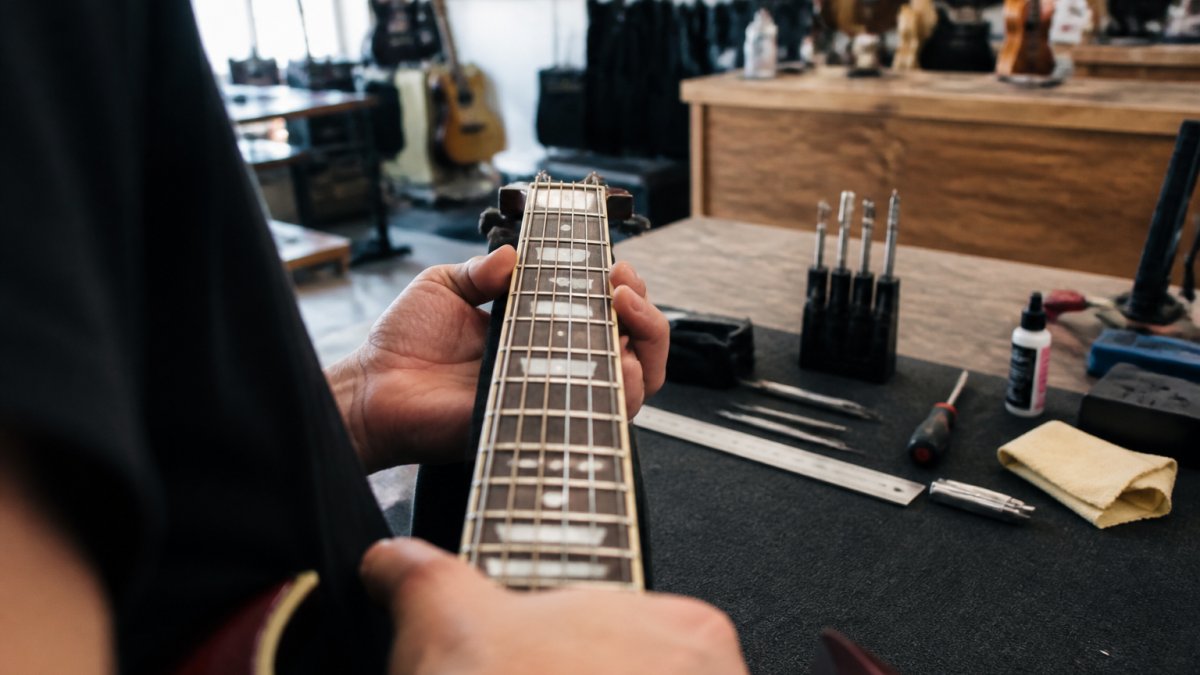
This is one part of the buying process to consider. Consider the checks below when inspecting a guitar.
1. Sight the neck for straightness and twist. Hold the guitar at eye level, body away from you, and look down the edge of the fretboard from the headstock toward the body.
2. Check the action at a known point. Action is the height of the strings above the fretboard, and it is the single biggest factor in whether a guitar feels easy or fights you.
3. Run a finger along both fretboard edges. Sharp fret ends mean poor finishing and will catch your hand as you play. Lightly run a fingertip up and down each side of the neck.
4. Look for fret wear. Check the first five frets first, because that is where wear shows earliest. Flat spots, dents and grooves mean the guitar has had heavy use. Light polishing marks are normal; deep divots are not.
5. Play every string at every fret from the first to the twelfth. Listen for buzz, dead notes and choking on bends.
6. Check intonation with a tuner. Tune the open string, then play the twelfth fret and compare on the tuner. If the twelfth-fret note is sharp or flat against the open string, the saddle position needs adjusting.
7. Test tuning stability. Tune the guitar, play for a few minutes, then re-check. A guitar that will not hold pitch may need new tuners, a nut repair or a string change. Ask how long it has been since the strings were replaced.
If you are shopping for a child, the same checks apply, but size comes first. Our guide to the best beginner acoustic guitar for kids breaks down body sizes and string types so you can narrow the field before you start inspecting.
Here are the in-shop checks to run through before you decide on a guitar.
| Check | What to do | Pass or fail |
|---|---|---|
| Neck straightness | Sight down the fretboard edge from headstock to body | Slight even relief passes; twist is a walk-away |
| Action | Measure at the twelfth fret or sight against fret tops | High action hurts; too low causes fret buzz |
| Fret ends | Run a fingertip along both fretboard edges | Smooth passes; snagging fails unless frets are dressed |
| Fret wear | Check the first five frets first | Light polishing marks normal; deep divots are not |
| Every fret | Play every string at every fret from first to twelfth | Listen for buzz, dead notes and choking on bends |
| Intonation | Tune open string, compare twelfth fret on a tuner | Sharp or flat means saddle position needs adjusting |
| Tuning stability | Tune, play a few minutes, then re-check pitch | A guitar that will not hold pitch may need repairs |
How to Inspect a Second-Hand Guitar Before You Pay
A second-hand guitar can be excellent value or a money pit. Here are checks to consider when inspecting one.
Before you travel:
- Ask for the serial number and photos of the headstock, soundhole label and any repairs.
- Ask why it is being sold, whether it has been dropped or repaired, and how long they have owned it.
- Confirm the price, payment method and whether they will hold it while you inspect.
- Ask for proof of ownership, such as the original receipt or a photo of the serial number matching the instrument.
At the inspection, in good light:
- Check for cracks around the soundhole, bridge and headstock, and for swelling or separation at the seams.
- Look for rust on hardware, loose tuning machines and stiff or scratchy controls.
- Sight the neck for straightness and twist, then check fret ends and fret wear as you would on a new guitar.
- Play every fret on every string, test every pickup position and knob on an electric, and tune it up to see whether it holds pitch.
- Check the truss rod moves freely if the seller will let you; a seized truss rod is a significant repair.
Payment and protection:
For private sales, pay in a way that leaves a record, meet in a public place, and get a written receipt with the serial number, date and price. If the seller will not provide proof of ownership or a receipt, treat that as a warning sign.
If you are buying online or from outside your region, ask for a video of the guitar being played through every pickup and a close-up of the serial number before you commit.
Local Climate, Storage and the True Cost of Owning a Guitar
Queensland humidity is the quiet killer of acoustic guitars. Solid timber swells in damp air and shrinks when it dries, and both movements can crack a top or lift a bridge. A hygrometer and a humidifier or dehumidifier, depending on the season, are not optional extras for a serious acoustic owner. Our guide on how to maintain acoustic guitar humidity levels covers the practical routine.
A hard case with a built-in hygrometer, like our dreadnought alligator case with hygrometer, solves storage and monitoring in one go.
Book a Hands-On Trial at Muzic Man in Robina
No article replaces holding the instrument. At our Gold Coast shop, you can browse our range of musical instruments and supplies. We offer a wide range of branded musical instruments and supplies, with Australia-wide shipping.
If you are ready to try a few guitars in person, get in touch with our team to arrange a visit.
Frequently Asked Questions
What should a beginner check before buying a guitar?
Run through a short checklist before you pay. Confirm the guitar type matches your goals, the body size fits your frame, and the neck feels comfortable in your fretting hand. Sight down the neck for twists, press each string at the first and last fret to check action, and play every fret for buzz. On electrics, test the pickups, controls and tuning stability. Ask whether a setup is included.
How do you check a guitar's neck and action?
Hold the guitar at eye level and sight down the edge of the fretboard from the headstock. The neck should have a slight forward bow, not a backbow or twist. To check action, press the low E string at the first fret and the fret where the neck meets the body, then look at the gap at the seventh or eighth fret. A business card's thickness is a rough guide for relief. If strings sit high or buzz when played, consider having the guitar assessed.
Is it better to buy a new or used guitar as a beginner?
Both work, but they suit different buyers. Second-hand guitars can offer better value on higher-spec models, but you need to inspect frets, electronics, cracks and the truss rod carefully. Try before you buy where possible.
How can you tell if a guitar is comfortable to play?
Comfort comes down to body size, weight and neck profile. Sit with the guitar as you would at home and check that your strumming arm rests naturally and your fretting hand can reach the lower frets without strain. Smaller bodies and short scale lengths suit younger players and smaller hands. Play for at least ten minutes to assess how the guitar feels over a longer session.
What accessories do you need when buying your first guitar?
Budget for a tuner, a spare set of strings, a gig bag or case, a strap and a few picks. If you buy an electric, add a cable and a small practice amp. Ask the retailer whether these are bundled.
Should a beginner buy an acoustic or electric guitar?
Choose acoustic if you want to strum songs without gear and your taste leans toward folk, country or singer-songwriter styles. Choose electric if you want to play rock, pop or metal, or if you find steel strings hard on your fingers, since lighter electric strings and lower action are easier on beginners. Electrics also need an amp and cable, which adds to the total outlay. Play both in store before deciding.
Buying a guitar is a decision your hands should make, not just your eyes. If you are weighing up options and want straight advice from people who play, Muzic Man can help you compare instruments, check setup and choose gear that suits your goals, with Australia-wide shipping and a Robina shop for hands-on trials. Get started with Muzic Man and find the guitar you will actually keep playing.