



Best Beginner Acoustic Guitar for Students in 2026?
Posted by Editorial Team on 27th Oct 2026
Last Updated: October 26, 2026
Quick Summary
The best beginner acoustic guitar for students is the Yamaha FG800, a dreadnought that balances brightness with warmth and is named a top pick across multiple beginner guides. Choose playability first, tone second and price last, and match body size to the student.
- The Yamaha FG800J is the budget-oriented sibling of the FG800, listed as a budget beginner pick.
- Guitar World names the Fender CD-60S its top beginner pick for its comfortable neck and easy action.
- MusicRadar's current top beginner choice is the Taylor Academy 10, praised for an ultra-playable neck.
- Dreadnought bodies feel large on smaller teenagers, so try a compact body if the student is under about 150cm.
- Ask the teacher before buying, since classical or formal programs usually specify nylon-string guitars.
Table of Contents
- Quick Comparison: Best Beginner Acoustic Guitars for Students
- Best Overall and Budget Picks for Students
- Beginner Guitar Size Guide: Matching the Guitar to the Student
- Steel-String vs Nylon-String Guitar for Beginners
- Acoustic Guitar Setup for Beginners: What to Check Before You Buy
- Acoustic Guitar Strings for Beginners: What to Fit and When to Change Them
- Student Budgets and the Real Total Cost of Starting Out
- Choosing Your First Beginner Acoustic Guitar at Muzic Man
- Frequently Asked Questions
Quick Comparison: Best Beginner Acoustic Guitars for Students
Choosing the best beginner acoustic guitar for students comes down to playability first, tone second, and price last. A guitar that fights your fingers will end up in a cupboard, no matter how good it sounds on the shop wall.
Here is the shortlist we would put in front of any Queensland student starting lessons in 2026.
| Model | Body Style | Best For | Why It Stands Out |
|---|---|---|---|
| Yamaha FG800 | Dreadnought | Most students | Balanced brightness and warmth, solid top |
| Yamaha FG800J | Dreadnought | Tight budgets | Budget-friendly sibling of the FG800 |
| Fender CD-60S | Dreadnought | Playability-first learners | Comfortable neck, easy action |
| Taylor Academy 10 | Grand Auditorium | Serious beginners | Bright, clean tone, ultra-playable neck |
| Taylor GS Mini | Compact | Smaller players and travel | Short scale, easy reach |
| Gretsch Jim Dandy | Parlour | Younger students | Small body, comfortable hold |
The picks above appear across multiple published beginner guides. Below, we break down exactly why each earns a place, and where it falls short.
Best Overall and Budget Picks for Students
Every model here has one job: get a student through their first year without creating bad habits. Some do it on tone, others on feel. None of them are perfect.
Yamaha FG800 and FG800J: The All-Round Student Workhorses
The Yamaha FG800 is a highly recommended first acoustic guitar. Multiple beginner guides name it as a top pick, and one source describes its tone as balancing brightness with warmth, which matters when a student is playing everything from chord drills to campfire songs.
The FG800J is the budget-oriented version, listed as a budget beginner pick by University of Rock. Same dreadnought shape, same learning curve, less strain on the wallet.
Watch out: Dreadnought bodies feel large on smaller teenagers. If the student is under about 150cm, try a compact body before committing.
Fender CD-60S: Playability First
Guitar World's beginner acoustic roundup names the Fender CD-60S as its top beginner pick, and playability is the reason. A comfortable neck and sensible factory action mean less finger fatigue in the first few weeks, which is when most students quit.
It is not the richest-sounding guitar here. It is one of the easiest to play, and for a beginner that trade is usually worth it.
Taylor Academy 10 and GS Mini: The Step-Up Options
The Taylor Academy 10 is MusicRadar's current top beginner choice, praised for an ultra-playable neck and a bright, clean tone.
The GS Mini is the compact alternative. It appears in several beginner lists and suits smaller players or anyone who needs to carry a guitar to school lessons.
Best for: students who have already shown six months of commitment. Skip if: the budget is tight and the student is still deciding whether guitar is for them.
Beginner Guitar Size Guide: Matching the Guitar to the Student
Guitar size is the single most overlooked factor in beginner purchases. A full-size dreadnought suits most adults, but a 12-year-old will struggle with the reach and give up.
- Full-size dreadnought: adults and taller teenagers, big sound, deeper body
- Concert or grand auditorium: smaller waists, comfortable for most teenagers
- Parlour and compact bodies: younger students, short arms, easier to hold
If you are buying for a child, our guide to the best beginner acoustic guitar for kids covers sizing, string types and models in more detail. Bring the student to the Robina shop if you can.
Steel-String vs Nylon-String Guitar for Beginners
This is the decision most beginner guides gloss over, and it is the one that most often sends a student back to the shop within a month. Steel-string and nylon-string acoustics are not interchangeable, they feel different, sound different, and suit different lesson contexts. Here is how to choose for a student specifically.
How they differ in practice
- String tension and fingertip comfort: nylon strings carry noticeably less tension, so the first few weeks hurt less. Steel strings build calluses faster but are harder on soft fingertips at the start.
- Neck width and profile: nylon-string classical guitars typically have wider, flatter necks. That helps some players and hinders small hands trying to wrap around for open chords.
- Tone and projection: steel-string acoustics are brighter and louder, which suits strumming, singer-songwriter work and school bands. Nylon-string guitars are warmer and softer, which suits classical technique and fingerstyle.
What the teacher will ask for
This is the deciding factor. Ask the teacher before buying:
- If the student is learning contemporary songs, chords and strumming, the typical path for most school-aged beginners, a steel-string acoustic is almost always the right call.
- If the student is enrolled in a classical or formal guitar program, the teacher will usually specify nylon-string. Buying steel in that case creates friction from lesson one.
- If the student is undecided, a steel-string with light-gauge strings is the more versatile default, because it covers more styles and most teachers build their beginner curriculum around it.
The finger-pain myth
A common mistake is buying nylon because it hurts less. It does hurt less, but the wider neck can be harder for small hands to fret cleanly, and the softer tone can make a student feel their playing sounds weak compared with friends on steel-string guitars. Finger pain on steel strings fades within a few weeks of regular practice; a neck that does not fit the hand is a daily problem.
A quick decision guide for students
| Student situation | Better choice | Why |
|---|---|---|
| School contemporary lessons, chords and songs | Steel-string, light gauge | Matches most curricula and style goals |
| Classical or formal guitar program | Nylon-string | Teacher requirement and technique |
| Small hands, younger student | Compact steel-string or short-scale | Easier reach than a full classical neck |
| Wants to play pop, rock or folk | Steel-string | Brighter tone and projection |
| Wants fingerstyle or classical repertoire | Nylon-string | Warmer tone and wider spacing |
If you are still unsure, bring the student to the Robina shop and try both side by side. Five minutes of holding each tells you more than any spec sheet, and it is the fastest way to avoid a term-one swap.
Acoustic Guitar Setup for Beginners: What to Check Before You Buy
Setup is what separates a guitar that plays well from one that fights the student. String action, or the height of the strings above the fretboard, should be low enough to fret cleanly without buzzing.
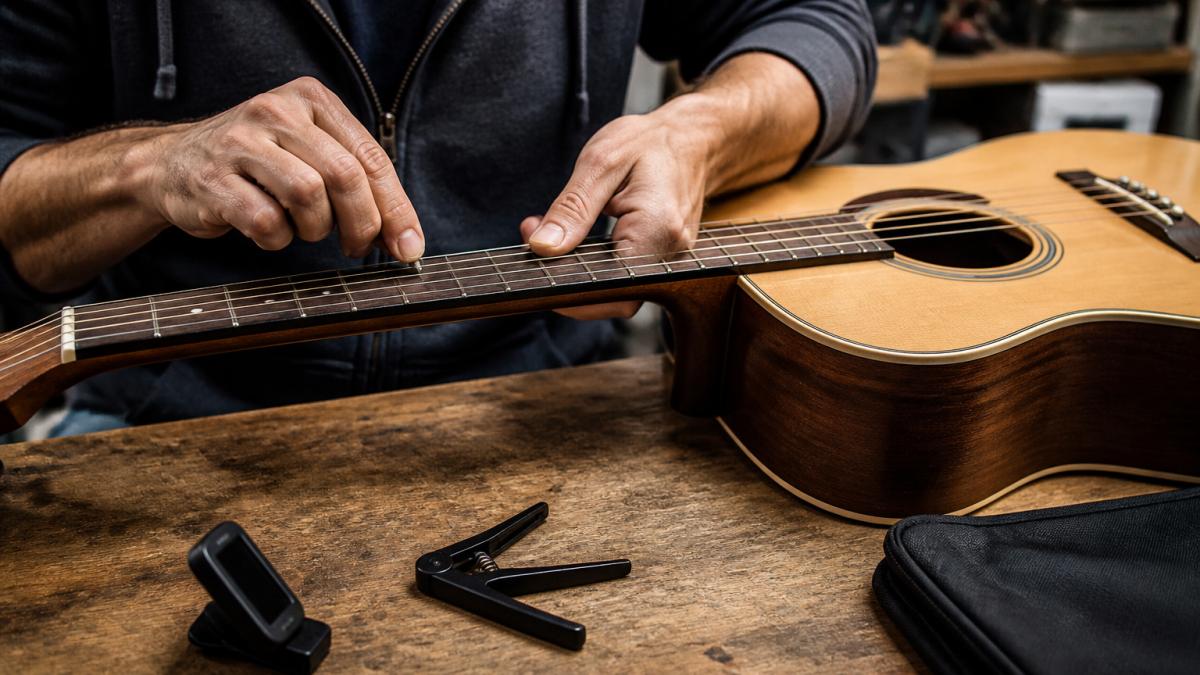
Before you buy, check these five things:
- String height at the 12th fret: should feel low, not stiff
- Fret ends: run a finger along the neck edge, no sharp burrs
- Tuning stability: play a chord, check tuning, repeat
- Intonation: open string and 12th fret should match on a tuner
- Neck relief: a slight forward bow is normal, a twist is not
Queensland humidity swings can shift a setup within weeks of purchase. Learn how to maintain acoustic guitar humidity levels so the action stays stable through summer.
Acoustic Guitar Strings for Beginners: What to Fit and When to Change Them
Most beginner acoustics ship with light-gauge strings, which is the right starting point. Light gauge means less tension, easier bends and less fingertip pain during the first month.
Change strings when they sound dull, feel rough, or stop holding tune. For a student practising daily, that is roughly every six to eight weeks.
- Light gauge (11-52): best for beginners, easier on fingers
- Custom light (11-52 hybrid): slightly fuller tone, still comfortable
- Coated strings: last longer, cost more, worth it for humid climates
Do not jump to medium gauge to chase volume. It will make chords harder and slow progress.
Student Budgets and the Real Total Cost of Starting Out
The guitar is only part of the spend, and the part most guides under-report. A student starting lessons in Robina needs a case or gig bag, a tuner, a strap, spare strings and a stand, and those extras add up quickly. Rather than quote a single figure that will be out of date by the time you read it, here is a realistic framework for what to budget.
The instrument itself
Beginner steel-string acoustics split into three broad price bands in Australia:
- Entry band: the Yamaha FG800J and Gretsch Jim Dandy sit here. Pricing for these models can be found on our website. These are genuine instruments, not toys, but they usually ship with a basic factory setup that may need a tweak.
- Mid band: the Yamaha FG800 and Fender CD-60S. A step up in consistency and resale value, and the band most students land in once they have tried a few in person.
- Step-up band: the Taylor Academy 10 and GS Mini. These cost meaningfully more and only make sense once a student has shown a term or two of commitment. If you are weighing whether to spend more on a first guitar, our guide on whether expensive instruments are worth it compares cost, quality and resale value.
Ask the shop whether a setup is included. A free or low-cost action adjustment on an entry-band guitar can matter more than the model name on the headstock.
The accessories you actually need
Budget for these alongside the guitar, they are not optional:
- Gig bag or hard case: essential for carrying to school or lessons. A padded gig bag is fine for local transport; a hard case is worth it if the guitar travels on buses or in a car boot regularly.
- Clip-on tuner: non-negotiable. A student who cannot tune quickly will not practise.
- Spare set of light-gauge strings: students break them, and a fresh set transforms a dull-sounding beginner guitar.
Lessons and the ongoing cost
Lessons are the biggest ongoing cost and the one most worth paying for. Weekly or fortnightly lessons through a local Robina teacher or a school music program will usually dwarf the guitar spend over a year. Factor that in before stretching the instrument budget, a mid-band guitar plus consistent lessons beats a step-up guitar and sporadic lessons every time.
A simple way to set the budget
- Decide the total you can spend on the instrument plus accessories in the first month.
- Reserve roughly a fifth of that total for accessories (case, tuner, strings, stand, humidity control).
- Spend the remainder on the guitar, favouring playability over cosmetics.
- Keep a small buffer for a setup or string change in the first three months.
Choosing Your First Beginner Acoustic Guitar at Muzic Man
The right beginner acoustic guitar for students is the one that gets played every day. Specs matter less than fit, and fit is something you feel in your hands.
We keep a range of student-friendly acoustics at our Gold Coast shop and ship Australia-wide.
Have a question about sizing, strings or which model suits your student? Get in touch with our team and we will point you in the right direction.
Frequently Asked Questions
Which acoustic guitar is best for a beginner student?
Most student players do well with a full-size steel-string model such as the Yamaha FG800 or Fender CD-60S, both named as beginner picks in 2026 guitar guides. The Yamaha FG800 is described as balancing brightness and warmth, while the Fender CD-60S is highlighted for playability. Younger or smaller students should look at a smaller body or scale length first. Try the guitar before buying where you can, and ask for a setup check so the action suits a beginner's hands.
What size acoustic guitar should a student beginner choose?
Use a beginner guitar size guide rather than guessing. A full-size dreadnought suits most teenagers and adults, but a smaller concert body or a short-scale model is easier for children and smaller players to hold and reach around. The Gretsch Jim Dandy, for example, is recommended by Guitar World as an option for younger players. Check that the student can wrap their fretting hand around the neck comfortably and reach the first fret without strain before committing.
Should a beginner student choose a steel-string or nylon-string acoustic guitar?
Steel-string guitars are the standard choice for pop, rock and most school lesson material, and they build calluses faster. Nylon-string classical guitars have softer tension and wider necks, which suits younger fingers and classical study. If the student is following a school program, ask the teacher which type the course expects. For general practice at home, a steel-string acoustic with a comfortable setup covers more ground and is the more common first purchase.
What should I check when buying a first acoustic guitar?
Check the setup before anything else: string action and string height at the 12th fret, fret comfort along the edges of the fretboard, and tuning stability after a few strums. Play every string up the neck to catch fret buzz. If you buy online, confirm the retailer will check the setup and that you can return the instrument if it does not feel right.
How often should a beginner change acoustic guitar strings?
Beginners practising daily usually need a new set every four to eight weeks, or sooner if the strings feel dull, look discoloured or struggle to hold tune. Sweaty hands and humid conditions shorten string life. Keep a spare set of acoustic guitar strings for beginners on hand and change them one at a time so the neck tension stays even. Fresh strings improve intonation and make practice sound better, which matters for keeping a new student motivated.
Buying a first guitar is a decision students and parents make once, and getting it wrong costs more than money. It costs momentum. We would rather you walk out with the right instrument than the most expensive one. Get started with Muzic Man and find a beginner acoustic guitar your student will still be playing in five years.