


Condenser vs Dynamic Microphone for Home Recording
25th Sep 2026
Table of Contents
- Condenser vs Dynamic Microphone: The Quick Comparison
- How Each Microphone Type Actually Works in a Home Room
- Do I Need an Audio Interface for Home Recording?
- Phantom Power Explained for Australian Musicians
- How to Treat a Home Studio Room for Recording
- Best Home Studio Microphone for Beginners in Australia
- Matching the Microphone to Your Recording Scenario
- Conclusion
- Frequently Asked Questions
Last Updated: September 24, 2026
Condenser vs Dynamic Microphone: The Quick Comparison
Choosing between a condenser microphone vs dynamic for home recording in Australia comes down to one question: how noisy is your room? This guide from Muzic Man covers both types, the gear they need, and which suits your space.
The short answer: condensers capture detail and suit treated rooms, while dynamics reject noise and forgive imperfect spaces.
| Factor | Condenser | Dynamic |
|---|---|---|
| Sensitivity | High, picks up room | Lower, rejects room |
| Detail | Fine and airy | Warm and focused |
| Power | Needs 48V phantom power | None required |
| Durability | Delicate capsule | Road-ready |
| Best for | Vocals, acoustic guitar | Drums, loud sources, untreated rooms |
That table is the whole argument in five rows. Everything below explains why.
How Each Microphone Type Actually Works in a Home Room
A condenser mic uses a thin, charged diaphragm that moves with the faintest sound wave. A dynamic mic uses a heavier diaphragm and coil, so it needs more volume to react at all.
That physical difference shapes everything else about how they behave in a spare bedroom.
Condenser Microphones: Sensitivity and Detail
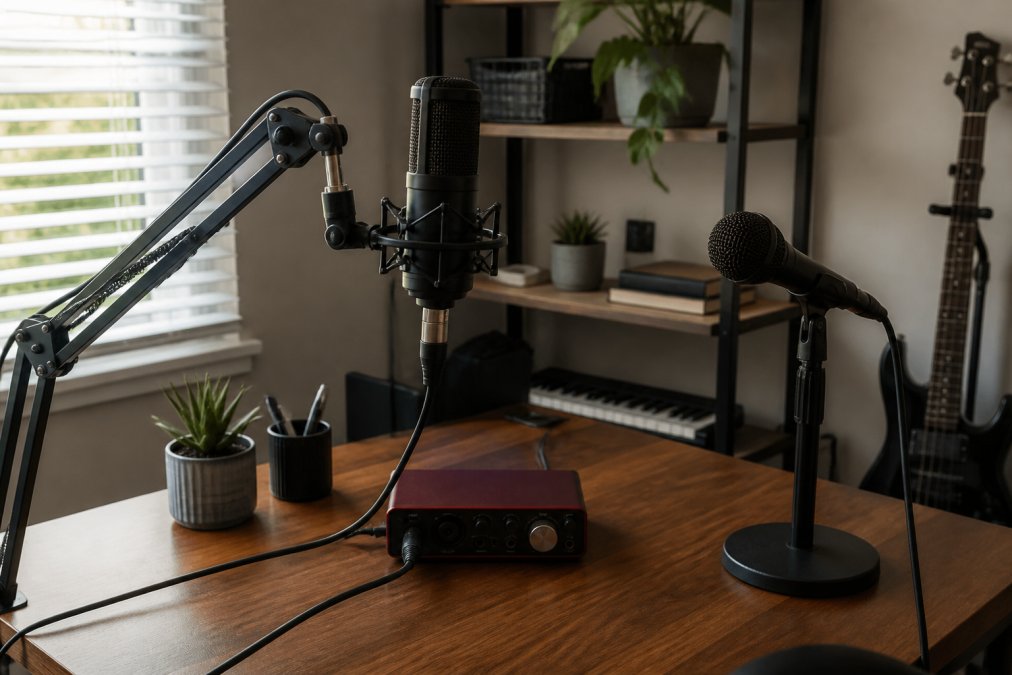
Condenser microphones are studio microphones that use a lightweight diaphragm and an electrical charge to capture fine detail across a wide frequency range.
That sensitivity is a gift in a treated room and a curse in a live one. A condenser will happily record your voice, your neighbour's lawnmower and the hum of your fridge.
The Rode NT1 5th Generation, designed in Australia, is a good example of a modern condenser with dual XLR and USB output and an ultra-low noise floor.
Dynamic Microphones: Durability and Noise Rejection
Dynamic microphones are moving-coil microphones that convert sound into signal through a magnet and coil, which makes them tough and far less sensitive to background noise.
If your recording space is a bedroom with hard floors and a window facing a main road, this is usually the practical choice.
The Shure SM7B is the benchmark here, with internal shock isolation and shielding against computer monitor hum.
Do I Need an Audio Interface for Home Recording?
Yes, in most cases. An audio interface converts your microphone's analogue signal into digital audio your computer can record.
Condensers almost always need one, because they require 48V phantom power that a laptop cannot supply. The Audio-Technica AT2020 is a classic example: a capable entry-level condenser that is useless without an interface.
Some modern condensers, like the Rode NT1 5th Generation, include USB output and a built-in preamp, so you can record straight into a computer. That flexibility matters if you are building your first setup.
Dynamic mics do not strictly need an interface, but a low-output dynamic like the SM7B benefits from a high-gain preamp to reach a healthy recording level.
Phantom Power Explained for Australian Musicians
Phantom power is the 48-volt current an interface or mixer sends down the microphone cable to power a condenser's internal circuitry.
It travels on the same XLR cable that carries the audio, so you never need a separate power lead. The catch is that only condenser microphones and active DI boxes use it; dynamic microphones ignore it entirely.
The practical rules are simple:
- Look for a "48V" button on your interface and switch it on for condensers
- Turn phantom power off before plugging or unplugging a dynamic mic
- Never worry about damaging a dynamic mic with phantom power; balanced dynamic mics are designed to ignore it
Australian buyers should confirm the interface ships with a power supply suited to 240V mains, since some imported units arrive with overseas plugs.
How to Treat a Home Studio Room for Recording
Treating a room is about controlling reflections, not soundproofing it. You cannot stop traffic noise with foam, but you can stop your own voice bouncing off bare walls.
Start with the cheapest, highest-impact fixes:
- Hang a heavy moving blanket or acoustic panel behind the microphone
- Add a rug over hard flooring to cut floor reflections
- Position your desk so you are not facing a bare wall
- Close curtains and windows before recording
- Record vocals in a wardrobe full of clothes if the room is hopeless
A condenser in an untreated room will pick up every reflection, which is why so many beginners blame the microphone when the room is the real problem. A dynamic mic in the same space will sound tighter with no treatment at all.
If you want to record detailed vocals at home, budget for treatment before you budget for a better microphone.
Best Home Studio Microphone for Beginners in Australia
The best home studio microphone for beginners in Australia is usually a dynamic model, because it works in untreated rooms without extra gear. The Sennheiser e835 is a strong first pick: a rugged dynamic cardioid that handles live gigs and home demos equally well.
For beginners with a treated space, the Audio-Technica AT2020 is the classic entry condenser, while the Rode NT1 5th Generation offers both XLR and USB in one unit.
Here is how they compare for a first setup:
| Microphone | Type | Power Needed | Best For |
|---|---|---|---|
| Sennheiser e835 | Dynamic | None | Untreated rooms, live use |
| Audio-Technica AT2020 | Condenser | 48V phantom | Treated rooms, vocals, guitar |
| Rode NT1 5th Generation | Condenser | 48V or USB | Flexible first studio |
| Shure SM7B | Dynamic | High-gain preamp | Podcasting, streaming |
Muzic Man offers a wide range of microphones, with Australia-wide shipping and a Gold Coast shop in Robina if you want to try before you buy.
Matching the Microphone to Your Recording Scenario
The right choice depends entirely on what you are recording and where. A microphone that suits a treated vocal booth can be the wrong pick for a live drum kit in a garage.
Vocals and Podcasting
For spoken word in a home room, a dynamic microphone wins almost every time. The Shure SM7B is the standard for podcasting because it ignores room reflections and monitor hum.
For sung vocals in a treated space, a condenser captures more nuance and air. The Rode NT1 5th Generation is a natural fit for Australian vocalists who want detail without a huge outlay.
Acoustic Guitar and Instruments
Acoustic guitar rewards a condenser's sensitivity. The AT2020 captures strumming detail and finger noise that a dynamic mic would smooth over.
If your room is noisy, use a dynamic and get closer to the instrument instead. Distance is your enemy with any microphone in an untreated space.
Drums and Loud Sources
Drums and loud amplifiers need dynamic microphones. Their higher sound pressure level handling means they will not distort when a snare cracks inches from the capsule.
Conclusion
The condenser vs dynamic decision is really a decision about your room and your workflow, not about which microphone is objectively better. Condensers reward good acoustics with detail; dynamics reward bad acoustics with usable recordings.
Frequently Asked Questions
Do I need a condenser or dynamic microphone for home vocals?
It depends on your room. A condenser microphone captures more detail and warmth, which suits vocals in a treated space. A dynamic microphone rejects more room noise, so it works better in an untreated bedroom or garage. If you record in a lively room, start with a dynamic mic like the Shure SM7B. If you can control reflections, a condenser such as the Rode NT1 5th Generation gives you more depth and clarity on vocals.
Are condenser microphones better for untreated rooms in Australia?
No. Condenser microphones are far more sensitive to room reflections and background noise, so an untreated room usually makes them sound worse, not better. Dynamic microphones handle poor acoustics more gracefully because they pick up less of the space around you. If you cannot add treatment, a dynamic mic or a hybrid option like the Rode NT1 5th Generation paired with some basic absorption will give you cleaner results.
Do dynamic microphones require phantom power?
No. Dynamic microphones do not need phantom power, so they work with almost any audio interface or mixer. Condenser microphones do require 48V phantom power, which is why you need an interface that supplies it. If you are choosing between a condenser and dynamic microphone for home recording, check your interface first. Most modern interfaces include phantom power, but budget or older models may not.
Which microphone is best for recording acoustic guitar at home?
A condenser microphone is usually the better choice for acoustic guitar because it captures the detail and warmth of the strings. The Audio-Technica AT2020 is a reliable, affordable option for beginners. If your room has hard floors and bare walls, a dynamic mic like the Sennheiser e835 will reject more of the room sound. Whichever you choose, position the mic 20 to 30 centimetres from the soundhole and angle it slightly toward the neck.
Is a dynamic microphone more durable for home studios?
Yes. Dynamic microphones are built with fewer fragile internal parts, so they handle knocks, drops and humidity better than condensers. The Sennheiser e835 and Shure SM7B are both rugged enough for regular gigging and home use. Condenser microphones are more delicate and should be stored in a case when not in use. If your setup doubles as a live rig, a dynamic mic will survive the road far better.