




How to Maintain Acoustic Guitar Humidity Levels
23rd Sep 2026
Table of Contents
- What You'll Need to Monitor Acoustic Guitar Humidity
- Best Guitar Humidifier for Australian Homes
- Hygrometer for Guitar Case: Choosing and Calibrating
- Step-by-Step: How to Maintain Acoustic Guitar Humidity Levels Daily
- Signs of Guitar Humidity Damage
- Managing Humidity in Subtropical and Coastal Climates
- Dehumidification Strategies for Wet Seasons
- Travel and Gigging with Your Acoustic Guitar
- Frequently Asked Questions
Last Updated: September 23, 2026
What You'll Need to Monitor Acoustic Guitar Humidity
Acoustic guitar humidity is the single most important number in your instrument's life. Get it wrong and you'll watch a solid top crack or a neck warp within a season. This guide from Muzic Man covers exactly how to maintain acoustic guitar humidity levels, from daily checks to wet-season dehumidifying.
Here's the good news: the tools are simple and cheap. You need a hygrometer, a humidifier, a dehumidifier or desiccant, and a hard-shell case.
- Digital hygrometer for inside the case
- Case humidifier for dry spells
- Dehumidifier or silica desiccant packs for wet spells
- Hard-shell case with a tight seal
- Soft cloth and distilled water for refills
Best Guitar Humidifier for Australian Homes
The best guitar humidifier for Australian homes is one you can refill, monitor, and switch off. Unlike the dry-winter advice on most overseas sites, Australian homes swing between two problems: dry air from winter heating and split-system air conditioning, and wet, sticky summer air that pushes indoor humidity past 70% in coastal Queensland.
That means the right setup is a system, not a single product. Here's how the main options compare for a typical Australian home.
| Type | How it works | Best for | Watch out for |
|---|---|---|---|
| Sponge-style case humidifier | Releases moisture slowly inside a sealed case | Single guitar, dry spells, winter | Needs refilling every few days in dry heat |
| Clay or gel case humidifier | Holds and releases moisture at a steadier rate | Players who forget to refill | Slower to react when humidity drops fast |
| Soundhole humidifier | Sits in the soundhole, targets the body interior | Guitars stored on a stand or in a gig bag | Less effective in a leaky case |
| Room humidifier | Adds moisture to the whole room | Multiple guitars, display rooms | Overkill for one instrument; needs a target setting |
Sizing matters. A single sponge humidifier is fine for one dreadnought in a hard-shell case. For two or more guitars, or a room with a heater running, you'll need either a larger case humidifier or a room unit. A humidifier that's too small just runs dry and does nothing.
The Australian seasonal split. In southern states, the dry risk peaks in winter when heaters run and indoor humidity can fall below 30%. In Queensland and northern NSW, the bigger risk is summer: high dew point days, coastal damp, and air conditioning that dries one room while the rest of the house stays muggy. A humidifier alone won't fix a wet room, you need dehumidification for that, which is covered further down.
Measure, don't guess. A humidifier without a hygrometer is guesswork.
Hygrometer for Guitar Case: Choosing and Calibrating
A hygrometer for a guitar case is a small meter that reads the relative humidity around your instrument. Digital models with a calibration function are worth the small extra cost, because cheap analogue units drift over time.
- Fill a bottle cap with table salt and add a few drops of water to make a paste.
- Place the cap and hygrometer in a sealed zip-lock bag.
- Leave it for 8 to 12 hours.
- The reading should settle near 75%. Note the difference.
- Adjust your readings by that offset from then on.
| Tool | What It Does | Best For |
|---|---|---|
| Digital hygrometer | Reads humidity in the case | Every player |
| Case humidifier | Adds moisture when air is dry | Dry spells, winter |
| Silica desiccant | Absorbs excess moisture | Wet season |
| Hard-shell case | Slows humidity swings | Storage and travel |
Step-by-Step: How to Maintain Acoustic Guitar Humidity Levels Daily
The daily routine for maintaining acoustic guitar humidity levels takes about two minutes. It's a check, an adjustment, and correct storage, in that order.
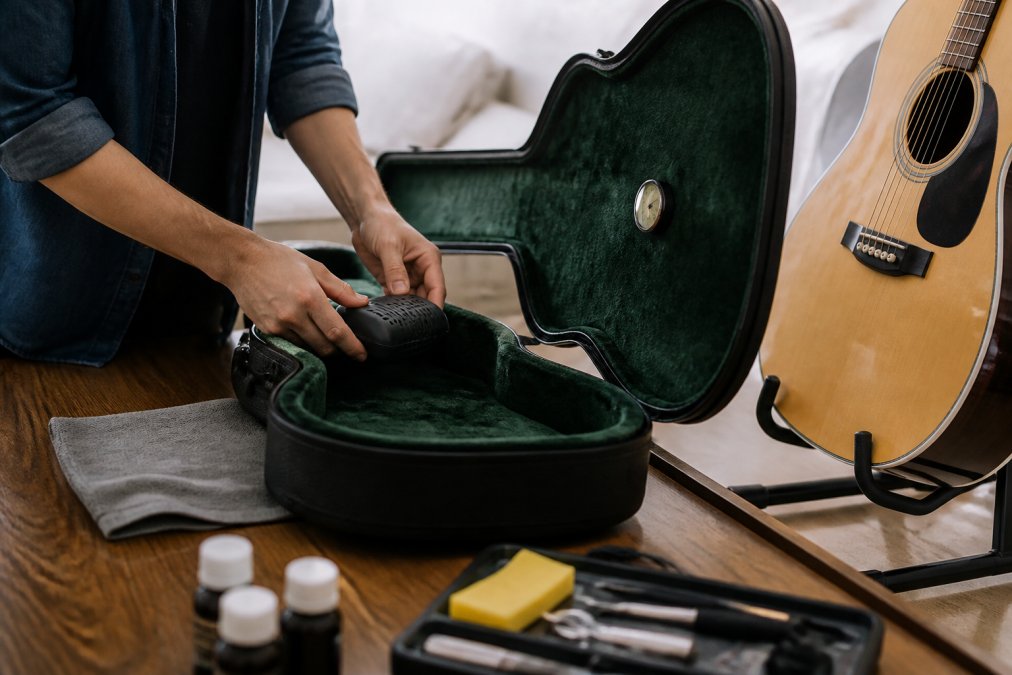
Step 1: Check Your Hygrometer Reading
Open the case and read the hygrometer before you play. You want a number between 45% and 55%. Write it down for a week if you're not sure how your home behaves.
Step 2: Adjust with Humidifier or Dehumidifier
Below 40%, add moisture with your case humidifier. Above 60%, dry the air with a dehumidifier or swap in fresh desiccant packs. Make small changes and recheck after a few hours.
Step 3: Store Correctly in a Hard-Shell Case
Return the guitar to its case when you're done. A hard-shell case slows humidity swings far better than a gig bag or a stand. Keep the case away from heaters, air conditioning vents, and direct sun.
Signs of Guitar Humidity Damage
Signs of guitar humidity damage show up before a crack does, if you know where to look. Catch them early and most issues are fixable.
Too dry (below 40%):
- Fret ends feel sharp along the neck edge, a problem players call fret sprout
- Action height drops and strings buzz
- The top sinks slightly around the bridge
- A cracked top or finish checking appears
Too wet (above 60%):
- The top swells and action height rises, making the guitar hard to play
- Bridge lift starts as a small gap under the bridge
- The tone goes dull and the guitar feels heavy
- Mould or a musty smell inside the case
Managing Humidity in Subtropical and Coastal Climates
Managing humidity in subtropical and coastal climates is the opposite problem to what most guides describe. In Robina and across Queensland, the risk is too much moisture, not too little. Our summers bring high dew point days and sticky air that pushes indoor humidity past 70%.
- Run the air conditioning, which dries the air as it cools
- Use a dehumidifier in the room where you store guitars
- Keep desiccant packs in every case and swap them monthly
- Avoid storing guitars in garages, sheds, or under the house
- Check the hygrometer more often during summer
Dehumidification Strategies for Wet Seasons
Air conditioning also helps, because cooling removes moisture from the air. Just don't point vents straight at your guitar. Rapid changes stress the wood more than steady, slightly-wet air does.
Travel and Gigging with Your Acoustic Guitar
Australian gigging scenarios to plan for:
- Summer coastal gigs (Gold Coast, Brisbane, northern NSW): outdoor or semi-outdoor venues can sit above 70% humidity. Pack silica desiccant in the case and keep the guitar cased between sets rather than on a stand.
- Air-conditioned venues: the room may be dry while the load-in area is humid. Keep the guitar cased until you're ready to play, and avoid parking it under a vent.
- Winter southern gigs (Melbourne, Adelaide, Hobart): heated venues can drop below 35% humidity. A case humidifier is the priority here, not desiccant.
- Long drives: a car boot in an Australian summer can exceed 60°C. Never leave a guitar in a parked car, even briefly. If you must transport it, keep it in the cabin with you.
Practical habits that travel well:
- Always use a hard-shell case, never a gig bag, for transport
- Keep a small hygrometer in the case so you know what the guitar experienced
- Pack desiccant for coastal or tropical gigs, and a humidifier for dry inland or heated venues
- Loosen strings slightly for long trips, but don't remove them
- Check the case seal before a big trip, a worn seal defeats every other measure
For players in Robina and around the Gold Coast, Muzic Man offers hands-on help choosing cases, humidifiers, and hygrometers, plus Australia-wide shipping if you're ordering from further afield. advice on instrument care from a national music body
Frequently Asked Questions
What is the ideal humidity range for an acoustic guitar?
The ideal relative humidity range for an acoustic guitar is 45% to 55%. Within this range, solid wood construction remains stable and the soundboard retains its intended moisture content. Below 40%, wood can shrink, causing cracked tops or fret sprout. Above 60%, the wood can swell, leading to bridge lift or a warped neck. A calibrated hygrometer for guitar case use helps you stay within this safe zone year-round.
How do I know if my guitar is too humid?
Signs of high humidity include a dull or muffled tone, action height that feels unusually high, and visible swelling around the bridge. In extreme cases, the bridge may lift from the soundboard. If your hygrometer reads above 60% for several days, use a dehumidifier or desiccant packs in your case. In subtropical climates, air conditioning and proper ventilation also help reduce ambient moisture.
Is 65% humidity bad for guitars?
Yes, 65% relative humidity is too high for acoustic guitars. Prolonged exposure at this level can cause the tonewood to absorb excess moisture, leading to swelling, bridge lift, and a warped neck. If your hygrometer consistently reads above 60%, act quickly: use a dehumidifier, add desiccant packs to your hard-shell case, and improve room ventilation. Bringing humidity back to 45-55% protects your instrument's structural integrity.
How does the Gold Coast climate affect acoustic guitar wood?
The Gold Coast's subtropical climate brings high humidity, especially during summer and the wet season. Average relative humidity often exceeds 70%, which is well above the safe range for acoustic guitars. This puts solid wood construction at risk of swelling, bridge lift, and warped necks. Musicians in the region need active dehumidification strategies, such as using desiccant packs, running air conditioning, and storing guitars in hard-shell cases with a calibrated hygrometer.
Wood moves, and no case fully stops it. The players who avoid cracks and warped necks are the ones who check a number, adjust, and store well, every week. Muzic Man can set you up with a digital hygrometer, a case humidifier, desiccant packs, and a hard-shell case that suits your guitar and your climate. Get started with Muzic Man and keep your acoustic sounding right through every season.