


Easiest Instrument for a Beginner to Learn: 2026 Guide
22nd Sep 2026
Table of Contents
- Comparison Table: Easiest Instruments for Beginners at a Glance
- How to Choose Your First Musical Instrument
- The Ukulele: The Easiest Instrument for Most Beginners
- Keyboards and Piano: Visual Learning That Suits Many Adults
- How Long to Learn Guitar for Beginners (and Why It's Not the Easiest Start)
- Best Beginner Instruments for Adults: Harmonica, Recorder and Percussion
- Essential Accessories for New Musicians
- Conclusion: Pick the Instrument You'll Actually Play
- Frequently Asked Questions
Last Updated: September 22, 2026
Comparison Table: Easiest Instruments for Beginners at a Glance
The ukulele is the easiest instrument for most beginners, thanks to its four nylon strings and simple chord shapes. At Muzic Man, we help new players find the right starting point, and the pattern is consistent: people who start on a forgiving instrument stick with it.
| Instrument | Difficulty | Why It's Beginner-Friendly | Best For |
|---|---|---|---|
| Ukulele | Easiest | Four nylon strings, soft on fingers | Most absolute beginners |
| Harmonica | Very easy | Breathe in and out, no fingering | Portability, self-teaching |
| Recorder | Easy | Simple fingering, clear tone | Kids, breath control |
| Keyboard | Moderate | Visual layout, no tuning | Theory and sight-reading |
| Guitar | Harder start | Steel strings, finger strength | Long-term versatility |
How to Choose Your First Musical Instrument
Match the instrument to your goal, not to what looks impressive. Consider your budget, practice space, and how much finger discomfort you can tolerate in month one. The learning curve matters more than the instrument's reputation.
What to Try Before You Buy
A common mistake is buying online without ever holding the instrument. Walk into a physical shop and check the ergonomics: does the neck feel comfortable, is it too heavy, can your hands reach the strings without strain? Our team lets beginners test instruments hands-on.
The Ukulele: The Easiest Instrument for Most Beginners
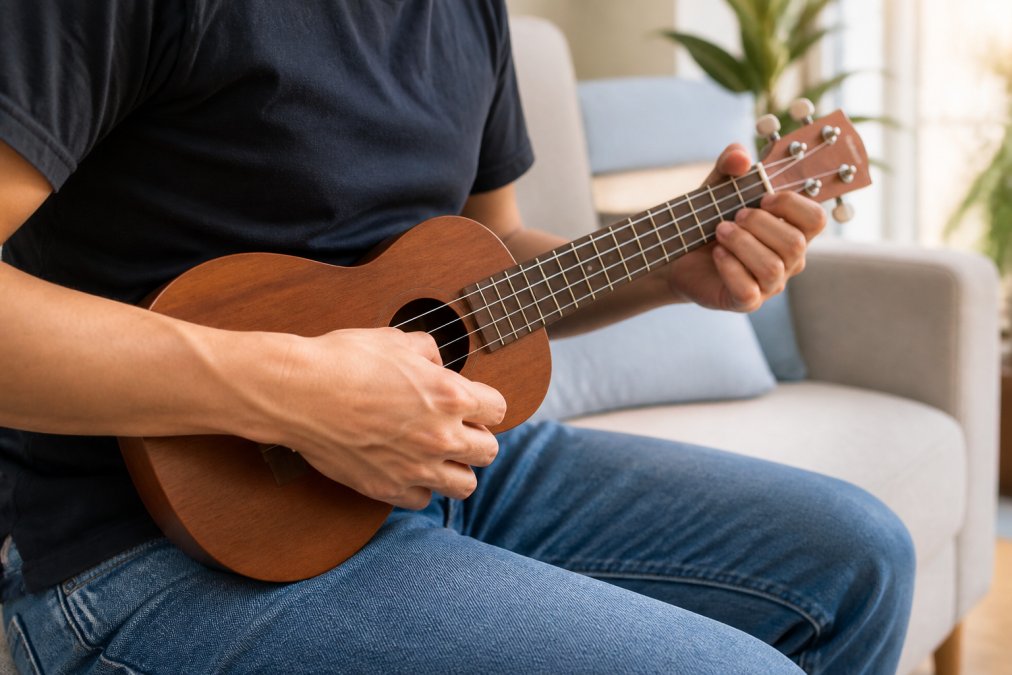
The ukulele is a four-string instrument tuned to G-C-E-A, and its nylon strings are gentle on untrained fingertips. Most people can play a basic chord progression within their first week, and it's small enough to carry anywhere.
Pros and Cons of Starting on Ukulele
Pros:
- Very affordable entry point
- Gentle on the fingers compared to steel-string guitars
- Compact and highly portable
- Simple chord structures build confidence fast
Cons:
- Limited range compared to larger instruments
- Some players outgrow a basic model within a year
The honest limitation is range: if you later want bass lines or complex fingerstyle pieces, you'll likely move on. But as a first instrument, that's a feature, not a flaw.
Keyboards and Piano: Visual Learning That Suits Many Adults
A digital keyboard is the best beginner instrument for adults who think visually. Every note sits in a clear left-to-right layout, making music theory and sight-reading far easier to grasp, with no tuning, calluses or finger pain. The Casio Casiotone line includes lesson functions and a headphone output for silent practice.
How Long to Learn Guitar for Beginners (and Why It's Not the Easiest Start)
Learning guitar takes most beginners three to six months to play basic songs comfortably, and the first few weeks are the hardest. Steel strings hurt until calluses form, and barre chords demand hand strength that takes time to build, which is why the guitar isn't the easiest instrument for a beginner.
Acoustic vs Electric: Which Is Easier for a Beginner?
Electric guitars are generally easier on the fingers than acoustics, thanks to string tension and gauge: electrics ship with lighter strings (commonly .009-.042) and lower action, so pressing a note takes noticeably less force. Acoustics carry heavier strings (.012-.053) at higher tension, which is what makes the first month sting.
| Factor | Acoustic | Electric |
|---|---|---|
| Finger pressure needed | Higher | Lower |
| Typical string gauge | .012-.053 | .009-.042 |
| Portability | High, no gear needed | Needs amp or headphone amp |
| Noise control | Loud, hard to mute | Quiet via headphones |
| Best for | Strumming, singer-songwriter | Rock, pop, lead lines, quiet practice |
Setup Matters More Than the Brand
A common pattern among beginners who quit in month one is a guitar with high string action, the strings sit too far above the fretboard, so every chord feels like a fight. This is a setup problem, not a talent problem: a technician can lower the action and adjust the truss rod so the instrument plays far more easily.
The Digital Learning Shortcut
How you learn now matters as much as what you learn on. Today, apps like Yousician and Fender Play, plus YouTube, give real-time feedback on chord accuracy and timing, shortening the painful early weeks considerably.
Music Australia, national music education and participation resources
Realistic Timeline for Guitar Beginners
- Weeks 1-2: Fingertips sore, basic open chords (E, A, D) feel clumsy. Expect 10-15 minutes of practice to be enough.
- Weeks 3-6: Calluses forming, chord changes getting smoother, first simple songs playable.
- Months 2-3: Barre chords start to work, strumming patterns become automatic, repertoire expands.
- Months 4-6: Most players can hold a song together in front of others.
If that timeline sounds slower than the ukulele's, that's because it is. Guitar rewards patience with range, but if your goal is playing something recognisable this week, the ukulele still wins.
Best Beginner Instruments for Adults: Harmonica, Recorder and Percussion
Adults often want a beginner instrument that fits around work, family and limited practice time. The three below are the most forgiving for self-teaching.
Harmonica: The Pocket-Sized Starter
The harmonica is the most portable beginner instrument you can buy. A standard 10-hole diatonic in C is tuned so blowing and drawing across the holes produces harmonious notes, even random breathing sounds musical, which is why it's so easy to self-teach.
Recorder: Underrated for Breath Control and Reading
The recorder is often dismissed as a children's instrument, but its standardised fingering and fipple (whistle) design make clean notes genuinely simple. It's excellent for breath control, melody reading and basic theory.
Percussion: For Players Who Feel Rhythm First
Percussion, cajóns, hand drums, bongos, djembe, suits players who feel rhythm naturally and don't want to wrestle with pitch. With no tuning or chord shapes to memorise, you focus entirely on timing, dynamics and feel.
How Adults Actually Learn These Instruments Now
Most beginner guides assume a weekly teacher. In practice, adult learners mix three paths:
- Apps and online courses, structured lessons with play-along tracks and progress tracking. Good for daily drills and accountability.
- YouTube, free, vast, but unstructured. Best used for specific techniques once you know what to search for.
- In-person teachers or community groups, essential for posture, technique correction and motivation. A monthly check-in can be enough if you're practising daily.
Local Resources in Robina and the Gold Coast
Essential Accessories for New Musicians
The right accessories make practice easier and protect your investment. For string instruments, a clip-on tuner and spare strings are non-negotiable; for keyboards, a sustain pedal and sturdy stand transform the experience; wind players need cleaning supplies.
Conclusion: Pick the Instrument You'll Actually Play
The best instrument is the one you'll pick up every day, and that's rarely the hardest one. Start with the ukulele for the fastest path to playing songs, a keyboard to understand music, or a harmonica for something you can carry in your pocket.
Frequently Asked Questions
Is it easier to learn guitar or piano for a beginner?
Most beginners find piano easier to start on. The keyboard lays every note out in a straight line, so you can see what you're playing, and there's no tuning or finger pain to work through. Guitar has a steeper learning curve because steel strings hurt until calluses form and chord shapes take time. That said, guitar is more portable, so if you want to play around a campfire, it may hold your attention longer.
What is the best instrument to learn at home in Australia?
A digital keyboard or ukulele suits home learning well. Keyboards let you practise silently through headphones, which matters in apartments and shared houses, and they never need tuning. Ukuleles are quiet enough to play at night and small enough to store anywhere. Both pair well with online lessons, and many Australian retailers ship them Australia-wide, so you can start without leaving home.
How long does it take to learn a musical instrument?
You can play a simple song on ukulele or harmonica within a week of consistent practice. Basic chord changes on guitar usually take a few weeks, and comfortable playing takes a few months. Reaching an intermediate level on any instrument generally takes a year or more. Practice consistency matters far more than total hours, so short daily sessions beat one long weekend session every time.
Are there instruments that are easier to learn for adults?
Yes. Adults often do well with keyboard, harmonica and ukulele because they combine simple fingering with quick auditory feedback. Adults tend to have stronger hand-eye coordination and more patience for music theory than children, which speeds up early progress. The main hurdle is time, not ability, so choose an instrument that fits your schedule and is easy to pick up for ten minutes at a time.
Do I need a music teacher to start learning an instrument?
Not necessarily. Apps, YouTube tutorials and method books can carry you through the first few months on ukulele, harmonica or keyboard. A teacher helps most once you hit a plateau, want to fix technique early, or aim for classical training. Many beginners take a few lessons after self-teaching for a while, which keeps costs down and makes the lessons more focused.