




How Long Do Drumsticks Last for Beginners?
26th Sep 2026
Table of Contents
- How Long Do Drumsticks Last for Beginners? The Honest Answer
- What Decides How Long Drumsticks Last: Wood, Weight and Wear
- Signs of Worn Out Drumsticks Every Beginner Should Check
- How to Prevent Drumstick Splintering and Make Sticks Last Longer
- The Best Drumstick Size for Beginners: Weight, Tip and Taper
- Beginner Technique Mistakes That Wear Sticks Out Early
- Frequently Asked Questions
Last Updated: September 25, 2026
How Long Do Drumsticks Last for Beginners? The Honest Answer
Most beginners get three to six months out of a pair of drumsticks. The truth is that no single number fits everyone. The truth is that no single number fits everyone. How long drumsticks last depends on the wood, your grip, and how hard you hit.
Here's the part most guides miss: your first pair usually dies faster than your second. New drummers grip too tight, hit too hard, and aim badly. Fix those habits and the same sticks last far longer.
Below, we break down what wears sticks out, how to spot the warning signs, and how to make each pair go the distance.
What Decides How Long Drumsticks Last: Wood, Weight and Wear
Four things control stick life: the material, the stick's weight, your playing style, and where you hit. Change any one of them and your replacement schedule shifts.
Drumstick lifespan is the amount of playing time a stick survives before it splits, warps, or loses its tip. A light player on maple sticks might get a year. A heavy hitter on oak might get weeks.
The biggest factor is technique. Beginners who choke the stick and strike with the arm rather than the wrist burn through sticks fast. But there's a second factor most guides ignore entirely: where you live in Australia and how that climate treats timber.
How Australian Climate Affects Wooden Drumsticks
Wood is hygroscopic, it absorbs and releases moisture from the air. That means the same pair of hickory 5As can behave completely differently in Cairns than in Alice Springs.
In humid regions like coastal Queensland and northern New South Wales, sticks take on moisture. The grain swells slightly, the stick feels heavier, and rebound dulls. Worse, repeated swelling and drying as you move between air-conditioned rooms and humid garages can warp a shaft out of true. A warped stick rolls unevenly on a practice pad and throws off your grip.
In dry regions, inland Victoria, South Australia, and the Northern Territory, the opposite happens. Timber dries out, becomes brittle, and splinters along the grain far sooner than the same stick would on the coast. Winter heaters make this worse indoors.
A common pattern reported by drummers in south-east Queensland is that sticks bought in summer last noticeably longer than sticks bought in a dry winter, even with identical playing hours. The wood itself is the variable.
Practical steps for Australian players:
- Store sticks in a sealed bag or case with a silica gel packet if you live in a humid zone
- Keep sticks away from air-conditioning vents and heaters in dry zones
- Let new sticks acclimatise indoors for a day before heavy use
- Rotate pairs so each stick has time to equalise with room humidity
Hickory, Maple, Oak and Synthetic Options Compared
Hickory is the default for most drummers. It bends before it breaks, which suits hard hitting and rimshots.
| Material | Durability | Feel | Best For |
|---|---|---|---|
| Hickory | High | Balanced | All-round playing |
| Maple | Medium | Light, warm | Quiet gigs, jazz |
| Oak | Very high | Heavy, stiff | Loud rock, marching |
| Carbon fibre | Very high | Consistent | Touring, heavy use |
| Laminate | Medium-high | Dense | Budget-friendly backup |
Maple feels lighter in the hand but dents faster. Oak lasts longest of the woods but tires your wrists. Carbon fibre and laminate sticks resist warping and splintering, though they cost more upfront, and they're the sensible choice if you play in a climate that swings between humid and dry.
Signs of Worn Out Drumsticks Every Beginner Should Check
Check your sticks before every session. The warning signs are easy to spot once you know them, and catching them early stops a stick snapping mid-song.
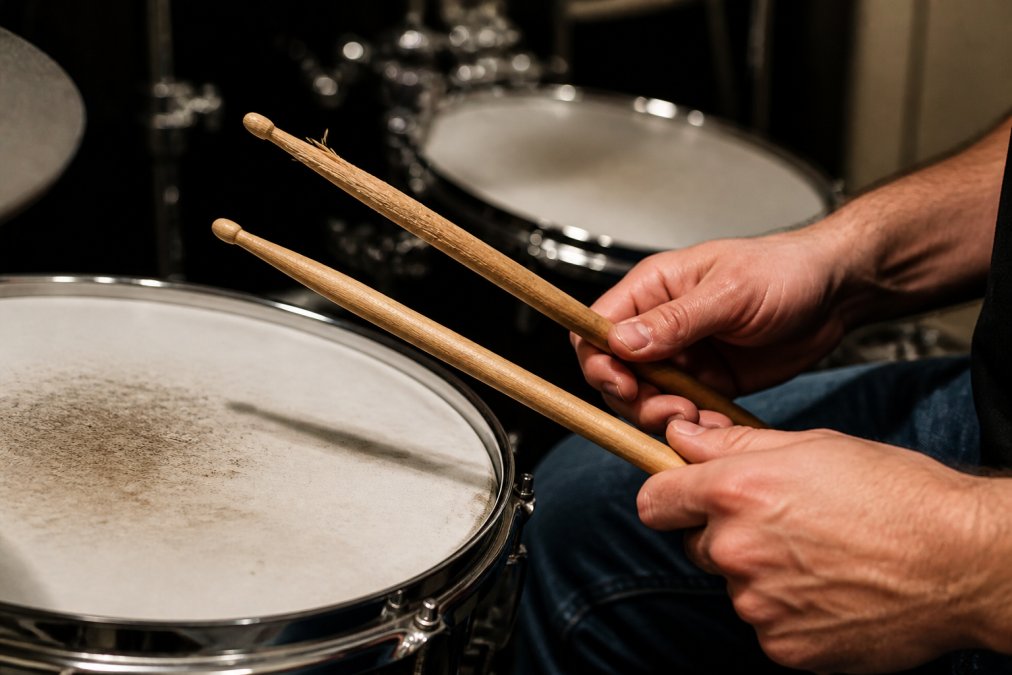
Look for these signs of worn out drumsticks:
- Splintering along the shaft, especially near the rim contact point
- A chipped or flattened tip that changes your cymbal sound
- Warping, where the stick no longer rolls straight on a flat surface
- Deep dents under the rimshot zone
- A loose or cracked nylon tip on synthetic-tipped sticks
How to Prevent Drumstick Splintering and Make Sticks Last Longer
You cannot stop wear completely, but you can slow it down. Preventing drumstick splintering comes down to grip, angle, and a little care between gigs.
A few habits that stretch stick life:
- Warm up on a practice pad before hitting a kit
- Aim for the centre of the head, away from the rim
- Trim long fingernails that chew the wood
- Store sticks flat, out of direct sun and heaters
- Rotate two or three pairs instead of one
The Best Drumstick Size for Beginners: Weight, Tip and Taper
The best drumstick size for beginners is usually a 5A or 7A in hickory. Both are light enough to control and tough enough to survive daily practice.
Beginner Technique Mistakes That Wear Sticks Out Early
Most early stick death traces back to technique, not bad wood. Fix these mistakes and your sticks last months longer. But to fix them, you need to understand why each one chews through timber, because the mechanism tells you what to change.
Mistake 1: Gripping Too Hard
A tense hand kills rebound. When you clamp the stick, the wood can't flex on impact, so the shock travels straight through the grain instead of dissipating. Over hundreds of strikes, that stress shows up as hairline cracks near the fulcrum, the point where your thumb and index finger meet the stick.
Mistake 2: Striking With the Arm Instead of the Wrist
Beginners often swing from the elbow or shoulder because it feels powerful. It isn't. Arm strokes are slower to recover and land with inconsistent force. When the stick hits at an angle rather than flat, the tip digs into the head and the grain takes a shear load instead of a compression load. Wood handles compression well. It handles shear badly.
Mistake 3: Accidentally Clipping the Rim
Rimshots are part of drumming, but beginners clip the edge by accident far more often than they intend to. Every stray rim strike removes a small chip of wood at the contact point. Those chips become stress concentrators, the point where a crack will eventually start.
Mistake 4: Sawing Across Cymbal Edges
Cymbal strikes wear sticks differently to drum hits. A glancing blow across a cymbal edge acts like a saw, slicing wood fibres along the shaft. The damage is invisible until the stick snaps.
Mistake 5: Practising on Worn or Sharp Drumheads
A pitted or dented drumhead has a rough surface that abrades the tip. Sharp edges on old heads do the same. If your tips are flattening faster than your shafts are splintering, check your heads before you blame the sticks.
The Cost-Per-Hour Reality for Beginners
When it's time to restock, Muzic Man stocks hickory, maple, and oak sticks in every common size, with Australia-wide shipping and a Gold Coast shop in Robina for hands-on testing.
Frequently Asked Questions
How long should a pair of drumsticks last?
It depends on how often you play and how hard you hit. A beginner practising a few times a week may get several months from a pair, while daily players who hit rimshots can wear through sticks in a few weeks. Check the tip, shoulder and taper for splintering or flattening before each session, and replace sticks once they show deep cracks rather than waiting for a break mid-practice.
What size drumsticks are best for beginners?
Most beginners start with a 5A or 7A stick. The 7A is lighter and thinner, which suits younger players or those building stamina, while the 5A offers a middle ground for general drum kit work. Heavier 2B sticks can help with practice pad workouts but tire new players quickly. Try a few pairs and notice which weight gives you clean rebound without gripping too tightly.
Do drumsticks go bad if they are not used?
Wood sticks can dry out and become brittle over time, especially in hot, dry conditions, which makes them more likely to crack on the first hard hit. Storing sticks away from direct sun, heaters and damp garages helps them hold their moisture balance. If an old pair feels unusually light or shows fine surface cracks, treat them as practice-only sticks rather than relying on them for a gig.
Does playing on a practice pad make drumsticks last longer?
Yes. Practice pads are far kinder to sticks than cymbals and metal rims, so working on rudiments and stick control on a pad reduces the wear that comes from rimshots and cymbal strikes. Many teachers recommend splitting practice time between pad and kit. Keep an eye on the tip even on a pad, since repeated impact still flattens nylon and wood tips over time.
Sticks wear out, and no pair lasts forever. The fix is simple: buy quality sticks, learn to hold them right, and replace them before they break. Muzic Man carries a wide range of branded drumsticks and percussion gear, backed by reliable Australia-wide delivery and a Robina store where you can try before you buy. Get started with Muzic Man and keep your kit sounding its best.