


How to Choose Your First Keyboard in Australia
Posted by Editorial Team on 13th Nov 2026
Last Updated: November 11, 2026
Quick Summary
Start by deciding who will play and what they want to play, since that matters more than the brand. Learning how to choose your first keyboard in Australia means matching key count, key action and budget to the player's goals. Test the instrument in person where you can before buying.
- Decide who the player is and what they want to play before shopping.
- An 88-key instrument suits piano method books and classical repertoire.
- Weighted or semi-weighted keys are worth it for a player who wants to progress.
- Budget for the stand, sustain pedal, headphones and delivery, not just the instrument.
- Play the full range, soft and hard, and test the sustain pedal before buying.
Table of Contents
- Digital Piano vs Keyboard for Beginners
- Choosing Between a 61-Key and 88-Key Keyboard
- Setting a Realistic Budget in AUD
- How to Test a Keyboard Before Buying
- Keyboard Accessories for Beginners
- Booking Your Test Session at the Robina Store
- Frequently Asked Questions
Choosing your first keyboard in Australia starts with one question: who will play it, and what do they want to do with it? Learning how to choose your first keyboard in Australia begins with that same question. A common mistake is picking the cheapest instrument on the shelf, then giving up after a few weeks because it does not suit how the player wants to play. The right first keyboard depends on the player, not on the brand name on the box.
Think about the goal first. A child learning songs for fun needs something different from an adult who wants to play classical pieces at home. A gigging musician needs sounds, controls and connections that a bedroom learner will never use.
Ask yourself a few simple questions:
- Who is the player? A young child, a teenager, or an adult beginner.
- What do they want to play? Simple songs, classical pieces, pop, or backing tracks.
- How often will they practise? Daily practice calls for a sturdier instrument than occasional play.
- Where will it live? A bedroom, a family room, or a space they can carry to lessons.
Write the answers down. They will guide every decision that follows.
Digital Piano vs Keyboard for Beginners
A digital piano and a keyboard can look similar, but they are built for different players. A digital piano usually has weighted keys that feel closer to an acoustic piano, a solid stand, and a sustain pedal. For a child-focused comparison of digital and acoustic options, see child-focused buying guide. A keyboard is often lighter, cheaper and easier to move, but its keys may feel thin under the fingers.
If the player is serious about classical piano or wants to build good technique, a digital piano is usually the better pick. For a child who is just trying the instrument out, a light keyboard can be a sensible start.
Our pick for most families is a digital piano if there is room for it. If space or budget is tight, a good keyboard with touch-sensitive keys still gives a beginner a solid start.
Choosing Between a 61-Key and 88-Key Keyboard
When learning how to choose your first keyboard in Australia, key count matters more than many buyers expect. A standard piano has 88 keys, and a 61-key keyboard covers fewer notes. That makes a 61-key model smaller, lighter and often cheaper.
An 88-key instrument suits a player who plans to follow piano method books or classical repertoire. A 61-key model can work well for a young child, a player with limited space, or someone who mainly wants chords and simple melodies.
Think about the future too. Buying a 61-key board and outgrowing it within a year means paying twice. If there is any chance of serious study, start with 88 keys.
Weighted, semi-weighted and unweighted keys
Key action changes how the instrument feels to play:
- Weighted keys feel heavier and closest to an acoustic piano. They suit classical and serious learners.
- Semi-weighted keys sit between the two. They are a practical middle ground for many beginners.
- Unweighted keys are light and springy. They are fine for synth sounds and casual play, but they build the wrong feel for piano technique.
For a player who wants to progress, weighted or semi-weighted keys are worth the extra money.
The table below sums up how key count and key action affect what a first keyboard will suit.
| Option | Best for | Key difference |
|---|---|---|
| 61-key keyboard | Young children, limited space, chords and simple melodies | Smaller, lighter and often cheaper |
| 88-key keyboard | Piano method books and classical repertoire | Matches a standard piano's full range |
| Weighted keys | Classical and serious learners | Feels closest to an acoustic piano |
| Semi-weighted keys | Many beginners | Practical middle ground |
| Unweighted keys | Synth sounds and casual play | Light and springy, poor for piano technique |
Setting a Realistic Budget in AUD
Budget is where many first-time buyers go wrong, and the mistake is usually the same: they price the instrument and forget everything that has to sit around it. A first keyboard is a system, not a single box, so build the budget in layers before you shop.
Start with the instrument itself. Pricing depends on the model, features, stock and delivery, so confirm current prices on Muzic Man's website or ask our team for a quote before you commit.
Then add the ownership layer. A realistic Australian first-setup budget usually has five lines:
- The instrument. The largest single cost, and the one most worth stretching slightly if the player is likely to continue.
- A stand or bench. A proper stand or bench is a safety and posture item, not a luxury; a wobbly setup makes practice frustrating and can damage the instrument.
- A sustain pedal. Many keyboards ship without one, and piano repertoire needs it, so check the box contents before you assume it is included.
- Headphones. Essential for apartment and evening practice, and often the cheapest item that protects household peace.
- Delivery and setup. Bulky digital pianos and cabinets may carry delivery charges, and stairs or remote regional addresses can add to that; ask before ordering rather than after.
Lessons are a separate ongoing cost and should be budgeted alongside the instrument, not after it. A common pattern is that buyers who plan lesson costs from the start practise more consistently, because the instrument and the learning path are funded together.
Watch out: a cheap instrument the player abandons is the most expensive outcome of all, so balance the sticker price against how long the player is likely to keep going rather than optimising for the lowest number on the shelf.
If the budget is tight, buying second-hand is a legitimate route, but inspect before you pay. Check that every key responds and returns cleanly, that the speakers and headphone output both work, that the power supply is the correct Australian model and is included, that pedal and USB/MIDI ports function, and that the stand, pedal and music rest come with it. A missing power supply or pedal can quietly erase the saving.
Finally, ask about warranty terms and whether servicing is handled locally. Knowing who you would contact if a key fails is part of the real cost of ownership.
How to Test a Keyboard Before Buying
Online research narrows the field, but nothing replaces playing the instrument. Key feel and key size are personal, and what suits one player can frustrate another, so build a shortlist online and then test it in person.
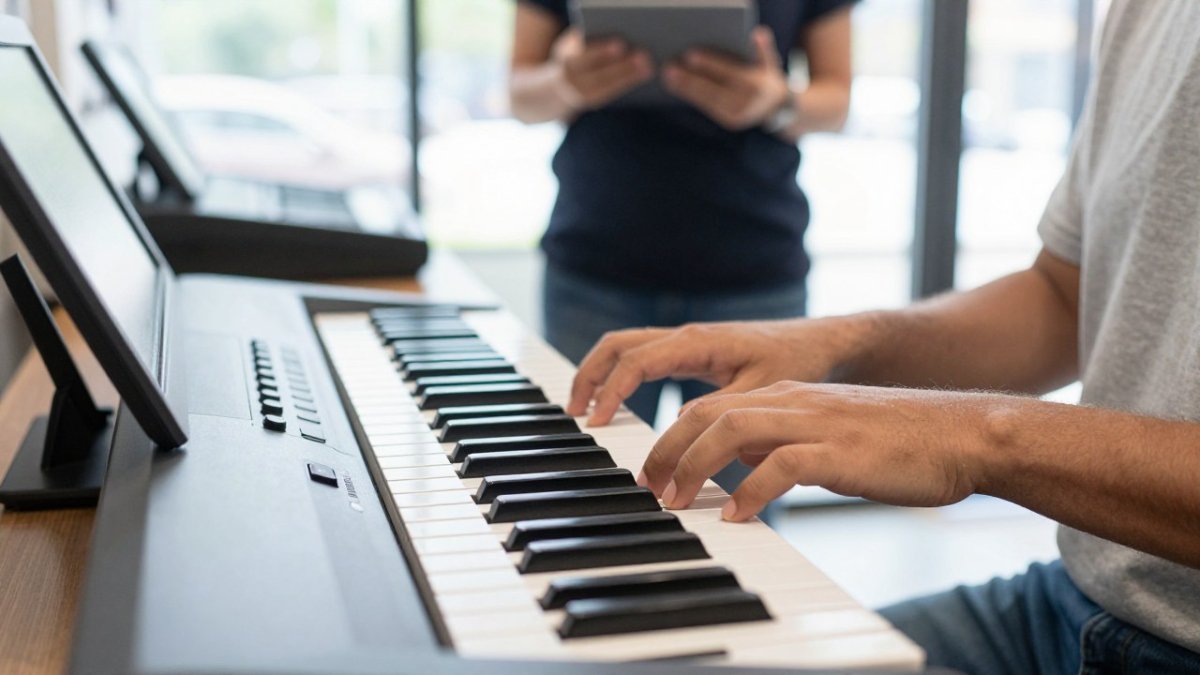
Before you travel, decide what kind of learner you are, because the test changes with the answer:
- A young child trying the instrument out. Prioritise key size and reach, a sturdy stand at the right height, and whether the child can comfortably press the keys. A lighter, compact keyboard is often the better fit.
- An adult casual learner. Prioritise touch-sensitive keys, headphone output and a sound you enjoy, because enjoyment drives practice more than specs do.
- A committed piano student. Prioritise weighted or semi-weighted action, 88 keys and a sustain pedal, because technique built on light keys does not transfer cleanly to an acoustic piano.
When you test, work through these checks:
- Play the full range. Run the lowest and highest notes and listen for dead, sticky or unevenly voiced keys.
- Try soft and hard playing. Good touch sensitivity means soft and loud notes sound clearly different, not just quieter and louder.
- Check the feel over time. Play for several minutes, not several seconds; an action that tires the fingers in the showroom will tire them at home.
- Test the sustain pedal. Make sure it responds and holds notes properly, and that it does not squeak or slip.
- Listen through headphones. Many instruments sound different at home volume than in a large showroom, so check the headphone output specifically.
- Check the connections you will actually use. Confirm headphone, pedal and USB/MIDI ports are present and working if you plan to use apps or recording software.
Bring the player with you whenever you can. A child's reaction to the instrument matters more than any spec sheet, and an adult's reaction to the action matters more than the brand name.
If you live in Robina or nearby on the Gold Coast, you can visit our store to try instruments, ask questions and compare models side by side. Bring the player, the budget you have set and the shortlist from this guide. If you cannot visit, browse our range online and contact us for advice before you order.
Keyboard Accessories for Beginners
A few accessories make the first months of learning easier and keep the instrument safe:
- A sturdy stand or bench. A wobbly stand makes practice frustrating and can damage the instrument. Our guide to essential keyboard stands, bags and extras covers what to buy and where to find it.
- Headphones. They let the player practise at any hour without disturbing the household.
- A sustain pedal. It is needed for many piano pieces, so check whether one is included.
- A dust cover. It keeps the keys clean when the instrument is not in use.
- A music stand. It keeps sheet music at eye level and reduces neck strain.
Booking Your Test Session at the Robina Store
Reading about keyboards is useful, but playing them in person is better. If you live in Robina or nearby on the Gold Coast, you can visit our store to try instruments, ask questions and compare models side by side.
Bring the player, the budget you have set and any questions from this guide. If you cannot visit, you can still browse our range online and contact us for advice before you order.
Ready to find the right first keyboard? Visit the Muzic Man store in Robina, or contact our team to talk through your options.
Frequently Asked Questions
What should a beginner look for when buying a keyboard?
Start with a full-size keyboard that has weighted or semi-weighted keys, a key count that matches your practice goals, and a sound you enjoy playing. Check the touch response in person if you can. Set a budget before you shop, and remember that pricing depends on the model, stock and delivery. Muzic Man can advise on current prices and options, so contact the team or visit the website for an up-to-date quote.
How many keys should a beginner keyboard have?
Many beginners start with 61 keys, which is enough for learning scales, chords and simple melodies and takes up less space. An 88-key instrument matches a full acoustic piano and suits learners who plan to play classical or more advanced repertoire. If you are unsure, consider where you expect to be in one or two years and choose the layout that fits that path.
Is a digital piano or a keyboard better for beginners?
A digital piano usually has weighted keys, a more realistic piano action and a stronger built-in sound, which suits adult beginners aiming for a piano feel. A portable keyboard is lighter, often cheaper and useful if space or budget is tight, but its keys may feel lighter. Both can work well, so the right choice depends on your practice goals, your space and how the instrument feels under your hands.
What accessories do I need for my first keyboard?
Most beginners need a sturdy stand or bench, a sustain pedal if the model supports one, and headphones so you can practise without disturbing others. A music stand and a dust cover are useful extras. Check whether the keyboard includes a power adapter and whether the stand is compatible with its weight and size before you buy.