


What Music Equipment Do Beginners Need in Australia?
Posted by Editorial Team on 11th Nov 2026
Last Updated: November 9, 2026
Quick Summary
Beginners need an instrument that suits their music style, a clip-on tuner, spare strings or keys with a case or gig bag, a stand, headphones and a metronome or timing app. Buy the instrument first and add the rest in that order, since what music equipment do beginners need in Australia depends on the instrument you pick.
- Buy the instrument first, since it is the only purchase that matters on day one.
- A clip-on tuner stops chords sounding wrong and is inexpensive.
- A stand keeps the instrument out and ready, which encourages more frequent practice.
- Closed-back headphones let you practise quietly at home without disturbing others.
- Delay buying a second instrument, large pedalboard, studio monitors or premium microphone.
Table of Contents
- Start With Your Instrument: Choosing Your First Instrument
- Beginner Music Equipment Checklist: The Essentials
- Amplification and Cables: Do Beginners Need an Amp?
- Setting Up a Beginner Home Recording Kit
- Guitar Pedals for Beginner Sound Exploration
- Buying Smart: New, Second-Hand and Where to Shop in Australia
- Your Next Step: Build Your Starter Kit with Muzic Man
- Frequently Asked Questions
Start With Your Instrument: Choosing Your First Instrument
Most beginners who quit within the first few months did not lack talent. They bought the wrong gear for the way they wanted to play, or they bought too much at once. Knowing what music equipment do beginners need in Australia makes the first purchase far easier.
The core answer is short. You need an instrument, something to tune it with, a way to hear yourself, and a few accessories to keep it playable. Everything else can wait until you know what you enjoy.
Acoustic or electric guitar: how to decide
Choose an acoustic guitar if you want to play on your own, around a campfire, or without any extra gear. For sizes and string types, see the best beginner acoustic guitars for kids.
Choose an electric guitar if you want to play rock, blues or metal, or if you plan to play through headphones at home. Compare beginner electric guitar options for Australia on playability, tone and value before you buy.
Watch out: a cheap guitar with high string height is harder to play than a slightly better one. Ask a shop to set up the action before you accept a guitar that feels sore on your fingers.
Keyboards and digital pianos
A keyboard is a good first choice for children and anyone who wants to learn chords and melody quickly. A 61-note model covers most beginner music. Look for touch-sensitive keys if you want the keys to respond to how hard you play.
A digital piano suits learners who want a piano feel and plan to keep practising for years. It costs more than a basic keyboard, but the weighted keys build better finger strength.
Beginner Music Equipment Checklist: The Essentials
Here is what most beginners need, in the order you should buy it, since knowing what music equipment do beginners need in Australia starts with sequence. For a complete beginner gear guide covering the essentials in one place, see the best music gear for beginners.
- An instrument that suits your music style. This is the only purchase that matters on day one. Everything else is support.
- A clip-on tuner. Accurate, battery-powered and cheap. Beginners who skip this often wonder why their chords sound wrong.
- Spare strings or a spare set of keys, plus a case or gig bag. Strings break at the worst time. A gig bag protects the instrument on the trip home from the shop and keeps dust off it in a bedroom.
- A stand. An instrument left in its case is an instrument that does not get played. A stand keeps it out and ready, which matters more for practice frequency than most beginners realise.
- Headphones for practising quietly at home. Closed-back headphones let you play at night in a share house or apartment without disturbing anyone. Look for a detachable cable so a broken lead does not retire the whole pair.
- A metronome or a free timing app. Timing is the skill beginners most often neglect. A phone app is fine to start; a dedicated metronome is easier to leave on the music stand.
Start with these six items. Add anything else only when you have a clear reason. If you are still unsure which instrument to start on, compare the easiest instruments for a beginner with their costs, pros and cons. Pricing depends on the model, the brand and the stock on hand, so check current prices on the Muzic Man website or ask our team for a quote.
Watch out: buying a full "starter pack" can hide poor-quality extras. Check each item separately before you commit, and ask whether the tuner is chromatic (works for any instrument) or guitar-only.
What you can safely delay
A few items look essential but are not, and buying them early is how beginners overspend:
- A second instrument. Learn one properly before adding another.
- A large pedalboard. One or two pedals cover most beginner needs.
- Studio monitors. Headphones are enough until you are mixing regularly.
- A premium microphone. The room matters more than the mic at this stage.
A note on regional and remote buyers
If you are outside a capital city, the checklist changes slightly.
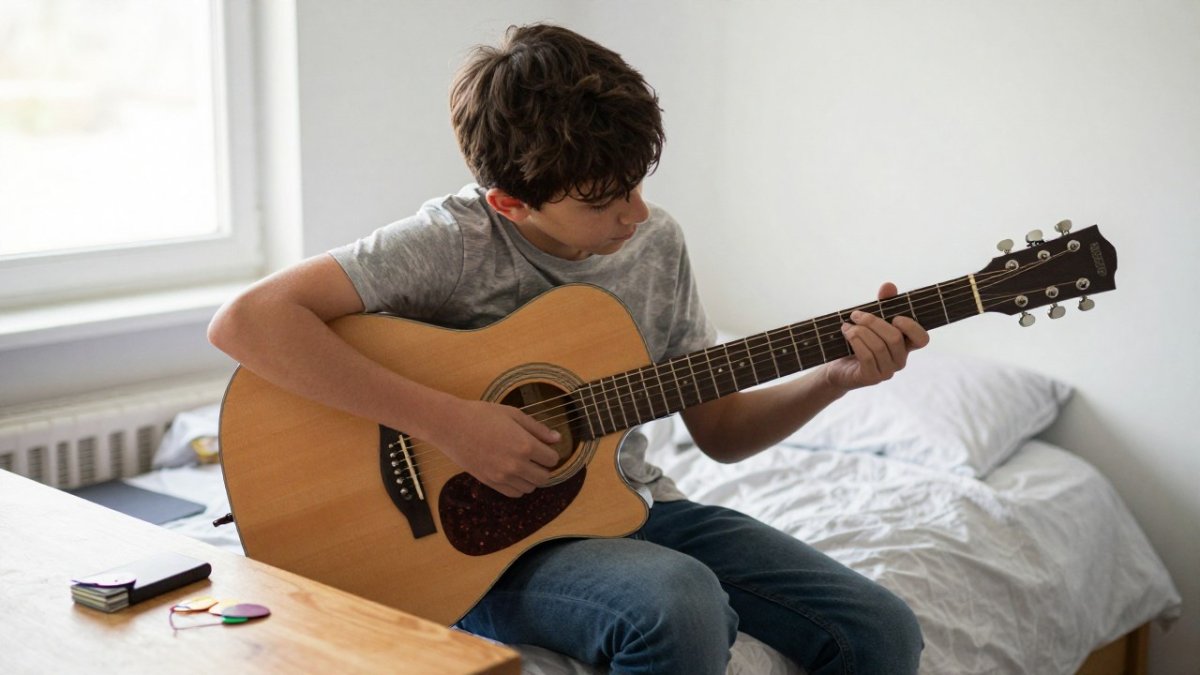
!A young beginner sitting in a bright home bedroom with an acoustic guitar resting on the knee, a tuner clipped to the headstock and spare picks and strings on a wooden desk
The six essentials, in the order to buy them, with what each one does for a beginner.
| Item | Why it matters | Buying note |
|---|---|---|
| Instrument | The only day-one purchase that matters | Match it to your music style |
| Clip-on tuner | Stops chords sounding wrong | Check if it is chromatic or guitar-only |
| Spare strings or keys, case or gig bag | Strings break; bag protects the instrument | Protects it on the trip home and from dust |
| Stand | Keeps the instrument out and ready | Helps practice frequency |
| Headphones | Practise quietly at home | Closed-back; detachable cable helps |
| Metronome or timing app | Timing is the skill beginners neglect | A phone app is fine to start |
Amplification and Cables: Do Beginners Need an Amp?
Yes, if you play electric guitar. An electric guitar makes almost no sound without an amplifier. A small practice amp is enough for home use, and it keeps noise low for housemates and neighbours.
Acoustic players do not need an amp unless they play live or in a band.
For cables, one good instrument cable is enough to start. Choose one that is long enough to reach your amp without stretching.
Setting Up a Beginner Home Recording Kit
Many beginners want to record their own songs or practice takes. A simple home kit is enough to start:
- An audio interface that connects your instrument or microphone to a computer
- A USB microphone or a dynamic microphone with an XLR cable
- Studio headphones for accurate monitoring
- Free or low-cost recording software (a digital audio workstation, or DAW)
A common mistake is buying a condenser microphone before the room is treated. A bedroom with curtains, a rug and soft furniture often sounds better than a bare room, and this costs very little. Think about acoustic treatment before you spend on extra gear.
Mobile devices can also work for quick ideas. Many apps record clean audio straight from a phone or tablet, which lets you capture a melody without setting up a full studio.
Guitar Pedals for Beginner Sound Exploration
Pedals change how your guitar sounds. They are fun to explore, but most beginners do not need many. One overdrive or distortion pedal and one reverb or delay pedal cover many styles.
Start with the pedals that match the music you play. If you play clean chords, a reverb pedal adds space without much cost.
Watch out: a chain of many pedals can make tone muddy and hide mistakes. Learn your guitar's natural sound first.
Buying Smart: New, Second-Hand and Where to Shop in Australia
Buying new gear can give beginners more certainty about what they are purchasing. Keep your receipt, because a warranty claim is much easier with proof of purchase (Consumer rights and guarantees).
Second-hand gear can save money, especially on amps and acoustic guitars, but the savings only hold if you inspect properly. A structured check takes ten minutes and catches most problems:
- Neck and action (guitars). Sight down the neck from the headstock. The fretboard should be close to straight, with no visible twist or hump around the body joint. High action is fixable; a warped neck usually is not worth the repair.
- Cracks and seams. Look along the sides and around the neck joint for hairline cracks, and check that the bridge is not lifting from the top.
- Electronics. Plug into an amp and turn every knob and switch through its full range. Scratchy pots are common and cheap to fix; dead pickups or a silent output jack are not.
- Amps. Let the amp warm up for a few minutes and listen for hum, crackle or a scratchy volume knob. Ask whether the valves (if it is a valve amp) have been replaced and when.
- Keys and digital pianos. Test every key and every pedal input, and confirm the power supply is included. Replacement power supplies are often model-specific and hard to source.
- Serial numbers. Ask for the serial number and check it against the manufacturer's records where possible. This is the simplest defence against stolen gear.
Watch out: common second-hand scams include listings with stock photos, sellers who refuse an in-person inspection, and requests for payment by bank transfer before you have seen the item. Meet in a public place, pay after inspecting, and be wary of any price that is far below the market for that model.
Buying online and shipping within Australia
When you buy online, check stock levels, shipping times and return conditions before paying. Muzic Man ships Australia-wide. If you are buying a gift with a deadline, confirm the delivery timeframe with our team before you order.
Regional and remote buyers should check return conditions and shipping times before ordering, as these can differ from capital city addresses.
Local support and repairs
A beginner's gear will eventually need a setup, a string change or a repair, and having someone local who can do that work is worth more than a small discount online. Before you buy, ask whether there is a music shop, luthier or repairer within reasonable distance of your town. In parts of regional Queensland, the nearest repairer may be a few hours away, which changes how you should buy: a pre-set-up instrument from a retailer who ships carefully is often the better choice than a cheap second-hand find that needs work.
For hands-on advice, visit our Gold Coast shop.
Your Next Step: Build Your Starter Kit with Muzic Man
Choosing your first gear does not need to be complicated. Pick an instrument that matches your music, add a tuner and a few accessories, and expand only when you know what you need. Our team can help you think through a starter kit that fits your style. Browse our range online or call in to our Gold Coast shop to get started.
Frequently Asked Questions
What music equipment does a beginner need to get started?
Most beginners need an instrument, a tuner, a capo for guitarists, spare strings or picks, and a stand or case to keep the instrument protected. Electric guitarists also need a cable and a small practice amplifier. Pricing varies with the instrument, brand and accessories chosen, so check Muzic Man's website for current prices or ask the team for a quote before budgeting. Starting with the instrument and a few essential accessories is usually enough; upgrades can come once you know what you enjoy playing.
Do beginners need an amplifier or can they practise without one?
Acoustic guitarists and most pianists can practise without an amplifier, using headphones on a digital instrument if neighbours or housemates are a concern. Electric guitarists and bassists need an amplifier to hear their instrument at normal volume, and a small practice amp is usually sufficient at the start. Check the amp's wattage and speaker size against where you will practise, and check the amp's specifications before buying.
Should beginners buy new or second-hand musical instruments?
Both can work well. Second-hand instruments can offer good value, but check the neck, frets, electronics and any cracks before buying, and ask whether the seller can demonstrate it working. If you are unsure what to look for, a new entry-level instrument from a recognised brand is the lower-risk choice.
What equipment do I need to record music at home?
A basic home recording setup usually includes a computer with recording software (a digital audio workstation), an audio interface to connect microphones and instruments, a microphone suited to your source, headphones for monitoring, and good quality cables. Studio monitors are optional at first. Treating the room with soft furnishings or acoustic panels can improve the sound more than an expensive microphone. Prices depend on the gear you choose, so check Muzic Man's website for current options.