




How to Track Musical Instrument Delivery: 2026 Guide
10th Sep 2026
Table of Contents
- How to Track Musical Instrument Delivery: Step-by-Step
- Reliable Music Gear Shipping Australia Wide: What to Expect
- Courier Delivery Times for Musical Equipment
- What to Do If a Musical Instrument Arrives Damaged
- Insurance for Shipping Musical Instruments
- Why Tracking Matters for Instrument Delivery in Robina and the Gold Coast
- Conclusion
- Frequently Asked Questions
Last Updated: September 10, 2026
How to Track Musical Instrument Delivery: Step-by-Step
Knowing how to track musical instrument delivery turns an anxious wait into a predictable countdown. At Muzic Man, we ship guitars, digital pianos and accessories across Australia, and tracking helps close the gap of uncertainty during transit.
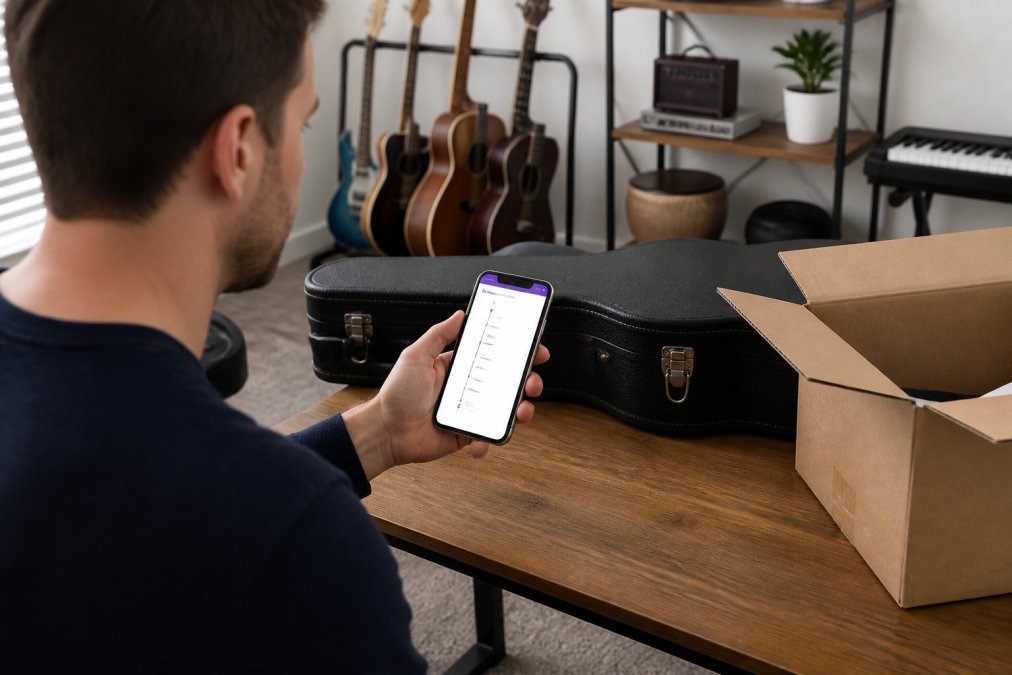
Here is the full process, in order.
Step 1: Find Your Tracking Number and Consignment Note
Your tracking number is the alphanumeric code your parcel carrier assigns to your consignment, and it is the key to every tracking tool that follows. You will find it in two places: the shipment notification email sent at dispatch, and the consignment note attached to the carton itself.
Check your spam folder if the email has not arrived within a day of your order fulfilment confirmation. Write the number down somewhere other than your inbox. If you are collecting from a depot, bring photo ID and the consignment note reference.
Step 2: Use the Courier Website or Online Portal
Every major parcel carrier runs a tracking page where you enter the number and see the current delivery status. The courier website is usually faster than a phone queue, and it updates more often.
Paste the number exactly, with no spaces. If the portal returns no result, wait a few hours: labels are often generated before the parcel is physically scanned into the network. A "label created" status simply means the freight has been registered, not that it has moved yet.
Step 3: Set Up ETA Updates and Shipment Notifications
Most logistics providers let you opt into SMS or email alerts tied to your tracking number. Turn these on immediately after dispatch. ETA updates remove the need to refresh the tracking tool manually, and they flag a delivery window before the driver arrives.
For high-value instruments, add the driver's "authority to leave" instruction only if someone will be home. A signature on delivery is worth the minor inconvenience when a hard case is on the truck.
Reliable Music Gear Shipping Australia Wide: What to Expect
Reliable music gear shipping Australia wide depends on three things: the packaging, the carrier, and the paperwork. Get all three right and most instruments arrive without incident.
Fragile handling is not a label you can rely on alone. Carriers sort thousands of parcels a day, and a sticker does not slow a conveyor belt. What protects your instrument is the packaging underneath it:
| Stage | What to Do | Why It Matters |
|---|---|---|
| Packaging materials | Double-box with bubble wrap and padding | Absorbs impact during sorting |
| Hard case | Ship inside a hard case where possible | Rigid shell resists crushing |
| Shake test | Shake the sealed box; no movement means packed correctly | Reveals loose items before dispatch |
| Labelling | Attach the shipping label flat and clear of seams | Prevents scan failures |
A shake test takes ten seconds and catches the most common packing error: an instrument that shifts inside its box. If you can hear it move, the carrier can hear it break.
Courier Delivery Times for Musical Equipment
Courier delivery times for musical equipment vary by route, carrier and service level, but the variation is predictable once you understand how the Australian parcel networks actually route a guitar case or a digital piano. Most top-ranking guides stop at "it depends", here is what it actually depends on.
The three service tiers that matter
Australian carriers broadly split musical instrument freight into three tiers:
| Tier | Typical use | Transit pattern |
|---|---|---|
| Standard parcel | Pedals, cables, small accessories, gig bags | Road linehaul between metro depots; 2-5 business days east coast |
| Express parcel | Guitars in hard cases, amps under ~20 kg | Air or priority road; 1-3 business days to metro |
| Freight / oversize | Digital pianos, full-size hard cases, drum kits | Dedicated freight network; 3-8 business days, more handling points |
The tier is usually set by cubic weight, not just dead weight. A guitar in a hard case can be light on the scale but bulky enough to be reclassified as oversize freight, which adds a day or two because it moves on a different truck and through a different depot.
Network cut-off times
Every carrier has a daily cut-off, the time a parcel must be scanned into the depot to travel that night. Lodging at a retail counter at 4:55 pm on a Friday when the cut-off is 4:00 pm means your instrument sits until Monday. A common pattern on the east coast is a mid-afternoon cut-off for express and a late-afternoon cut-off for standard road, but this shifts by depot and by season.
If you are ordering from a Gold Coast retailer, ask when the daily pickup runs. A Robina or Burleigh Heads pickup that misses the linehaul to Sydney or Melbourne can add a full day before the parcel even leaves Queensland.
Route-specific realities for the Gold Coast
From Robina, the typical east coast routes look like this:
- Brisbane metro: often next business day on express, 1-2 days standard
- Sydney / Melbourne: 2-4 business days express, 3-6 standard
- Adelaide / Perth: add 2-4 days; Perth freight frequently routes via Melbourne or Adelaide
- Regional and remote (NT, far north QLD, WA outback): add 3-7 days and expect fewer scans, not slower trucks
Two factors matter more than raw distance. First, oversized items such as digital pianos and full-size hard cases travel on freight services rather than the standard parcel network, which adds handling steps. Second, dispatch timing: a parcel lodged late on a Friday may not enter the network until Monday.
When you order from Muzic Man, we send a shipment notification with your tracking number as soon as your order is dispatched. That notification is your starting point for any ETA estimate.
What to Do If a Musical Instrument Arrives Damaged
If a musical instrument arrives damaged, do not unpack it fully or discard any packaging. Photograph the carton before opening, then photograph the instrument and all packing materials as you remove them.
Then follow this sequence:
- Note the damage on the delivery confirmation or driver's device if the parcel is still in front of you
- Contact the retailer within 24 hours with your order number and photos
- Keep the original box, inserts and bubble wrap until the claim is resolved
- Do not attempt repairs before the carrier or insurer has assessed the claim
- Request a written outcome, not a verbal one
The packaging evidence is what decides most claims. A carrier will ask whether the item was packed to withstand normal transit, and photos taken before you unwrap everything are the clearest answer you can give.
Insurance for Shipping Musical Instruments
Insurance for shipping musical instruments is the difference between a frustrating week and a financial loss, and in Australia the rules that decide who pays are more specific than most guides admit. Standard carrier liability is limited and calculated by weight or a default cap, which rarely reflects what a professional-grade instrument is actually worth (accc.gov.au).
Who is actually liable
Three layers of protection can apply to a damaged instrument in transit, and they do not stack the way buyers assume:
- Carrier liability, the default cover included in the freight charge. It is capped, usually by weight or a per-item ceiling, and is often far below the replacement cost of a vintage or professional instrument.
- Transit insurance, a separate policy, either taken out by the sender or the receiver, that covers the declared value above the carrier's cap.
- Australian Consumer Law guarantees, if you bought from an Australian retailer, the ACL gives you rights against the retailer for goods damaged before they reach you in acceptable condition. These rights sit alongside, not instead of, any insurance claim.
For a consumer purchase, the ACL route is often the fastest. For a private sale or a shipment you arranged yourself, transit insurance is the only realistic protection.
What to check before your gear leaves the store
- Declared value. Make sure the cover reflects the replacement cost of the instrument, not the sale price alone. Under-insuring a vintage guitar to save on premium is the most common mistake.
- Exclusions. Read what is not covered. Pre-existing damage, inadequate packaging and unattended deliveries are common exclusions, and "inadequate packaging" is the exclusion carriers reach for first.
- Claim window. Note the deadline for lodging a claim, because it is often shorter than buyers expect, commonly measured in days from delivery, not weeks.
- Who lodges the claim. On most Australian freight, the sender lodges the claim, not the receiver. If you bought from a retailer, that is usually good news: they handle the paperwork.
If a claim is disputed
If a carrier or insurer rejects a legitimate claim, Australian consumers and small businesses can escalate to the Australian Financial Complaints Authority (AFCA) for insurance disputes, and to the relevant state consumer affairs body for retail disputes (afca.org.au). AFCA is free to consumers and covers most general insurers. Keep every photo, tracking screenshot and email, the paper trail is what decides the outcome.
For valuable instruments, transit insurance is not optional. Ask about cover before dispatch rather than after a problem appears, because most policies cannot be backdated.
Why Tracking Matters for Instrument Delivery in Robina and the Gold Coast
Instrument delivery in Robina and across the Gold Coast carries a few local quirks worth knowing. The region's humidity swings between seasons, and a guitar that sits in a hot delivery van or on a doorstep through a summer afternoon can shift in ways a cooler climate would not cause (peer-reviewed research).
Tracking helps here in a practical way: it tells you when to be home. If you know the delivery window, you can bring the parcel inside promptly rather than leaving a timber instrument in direct sun. For anyone searching for a music shop near me that ships locally, a Robina-based retailer also means shorter transit routes and fewer handling points between dispatch and your door.
Muzic Man operates a physical shop in Robina alongside our online store, so Gold Coast customers can arrange hands-on selection or local pickup and skip the courier leg entirely.
Conclusion
Waiting on an instrument you are excited to play is the hard part, and uncertainty makes it worse. Muzic Man provides every order with a tracking number and a shipment notification, backed by reliable Australia-wide delivery and a real shop in Robina where you can see the gear in person first. Browse the online store or visit us on the Gold Coast, and let us get your next instrument to your door with a tracking link you can actually follow.
Frequently Asked Questions
How long does it typically take to ship musical instruments within Australia?
Courier delivery times for musical equipment usually range from 2 to 7 business days depending on your location and the courier service chosen. Metro areas like Brisbane and the Gold Coast often see faster transit, while regional and remote destinations take longer. Bulky items such as drum kits or amplifiers may need freight services with slightly extended windows. Always check the estimated delivery window on your tracking page, and allow extra time during peak periods or public holidays.
What should I do if my musical instrument tracking hasn't updated?
If your parcel tracking shows no movement for more than 48 hours, first check the courier website directly in case the retailer's portal is lagging. Look for a 'delayed' or 'in transit' status on the consignment note. If there is still no scan, contact the courier with your tracking number, then follow up with the retailer. Keep screenshots of the delivery status and any communication. Most delays resolve within a few days, but persistent silence may mean the parcel needs a formal trace.
Do I need to be home to sign for a musical instrument delivery?
Many couriers require a signature for high-value items like guitars, keyboards, and amplifiers. If you are not home, the driver may leave a card and redirect the parcel to a nearby depot or collection point. You can often authorise an 'authority to leave' through the courier's online portal, but this removes your ability to claim damage that occurred after drop-off. For expensive gear, it is safer to arrange delivery for a day you will be home or use a secure parcel locker.
How does Muzic Man handle insurance for shipping musical instruments?
Transit insurance covers your instrument against loss or damage while it is with the courier. For information on cover included with Muzic Man shipments, please refer to our website or contact customer service. For high-value or vintage instruments, additional insurance may be worth arranging. If damage occurs, photograph the packaging and the instrument before opening it fully, keep all tracking records, and lodge a claim promptly. Muzic Man's customer service can guide you through the process.