


Best Musical Instruments for School Kids: 2026 Guide
20th Aug 2026
Table of Contents
- Why Musical Instruments for School Kids Matter More Than You Think
- How to Choose the Right Instrument for Your Child
- The 8 Best Musical Instruments for School Kids
- 1. Keyboard and Piano: The All-Round Starter
- 2. Ukulele: Small, Affordable, and Genuinely Fun
- 3. Acoustic Guitar (3/4 Size): For Kids Ready to Commit
- 4. Violin: Challenging but Rewarding
- 5. Recorder: The Ideal First Woodwind
- 6. Clarinet: The Step-Up Woodwind for Older Students
- 7. Trumpet: Entry Point into Brass
- 8. Drums and Percussion: For Kids Who Can't Sit Still
- Renting vs Buying Musical Instruments in Australia
- How Long Do Drumsticks Last for Beginners?
- Musical Instrument Maintenance Tips for Beginners
- Conclusion
Last Updated: August 20, 2026
Why Musical Instruments for School Kids Matter More Than You Think
Research from Australian Music Association's music education resources links music education to stronger cognitive development, improved auditory processing, and better hand-eye coordination in primary-aged children. Children who begin learning an instrument before age ten develop stronger musical literacy, sharper focus, and greater capacity for self-expression that carries through secondary school and beyond.
At Muzic Man, we work with parents navigating this decision for the first time. The core argument is this: the right first instrument is not necessarily the most impressive one. It is the one your child can physically manage, stay engaged with, and access through their school's ensemble or band program.
This guide covers the eight best musical instruments for school kids, explains how to match an instrument to your child's physical requirements and school program, and gives you a practical breakdown of renting versus buying. We also address Queensland climate considerations that most guides ignore entirely.
How to Choose the Right Instrument for Your Child
Choosing the right instrument comes down to three practical filters: age and physical readiness, personal engagement, and school program alignment.
Age, Size, and Physical Requirements
Instrument ergonomics matter enormously for young players. A full-size guitar on a seven-year-old teaches bad technique that takes years to unlearn. Most instruments come in child-sized variants, and matching size to age is non-negotiable.
| Age Range | Recommended Starting Instruments | Key Physical Consideration |
|---|---|---|
| 4-6 years | Keyboard, percussion, ukulele | Short attention span; needs immediate reward |
| 6-9 years | Recorder, ukulele, 3/4 guitar, keyboard | Fine motor skills developing; smaller hands |
| 9-12 years | Violin (1/2 or 3/4), clarinet, trumpet | Stronger fingers; can manage breath control |
| 12+ years | Full-size guitar, full brass, full strings | Adult-sized hands; sustained practice possible |
Children under 125 cm tall generally struggle with a full 3/4 acoustic guitar. Violins come in sizes from 1/16 through full size, and proper fitting prevents injury and accelerates progress. For woodwind and brass, breath control is the limiting factor: most teachers recommend waiting until at least age nine before starting clarinet or trumpet.
School Band Programs and Local Requirements
Many Queensland state and independent schools run formal band programs from Year 4 or Year 5 onward. These programs specify which instruments are accepted into the ensemble, and buying outside those approved options means your child cannot participate. Check directly with your child's school music coordinator before purchasing anything.
Common school band instruments in Queensland programs include clarinet, trumpet, flute, trombone, and percussion. Schools in the Robina area that run Gold Coast Schools Music Festival programs often have specific brand and size requirements for ensemble participation.
The 8 Best Musical Instruments for School Kids
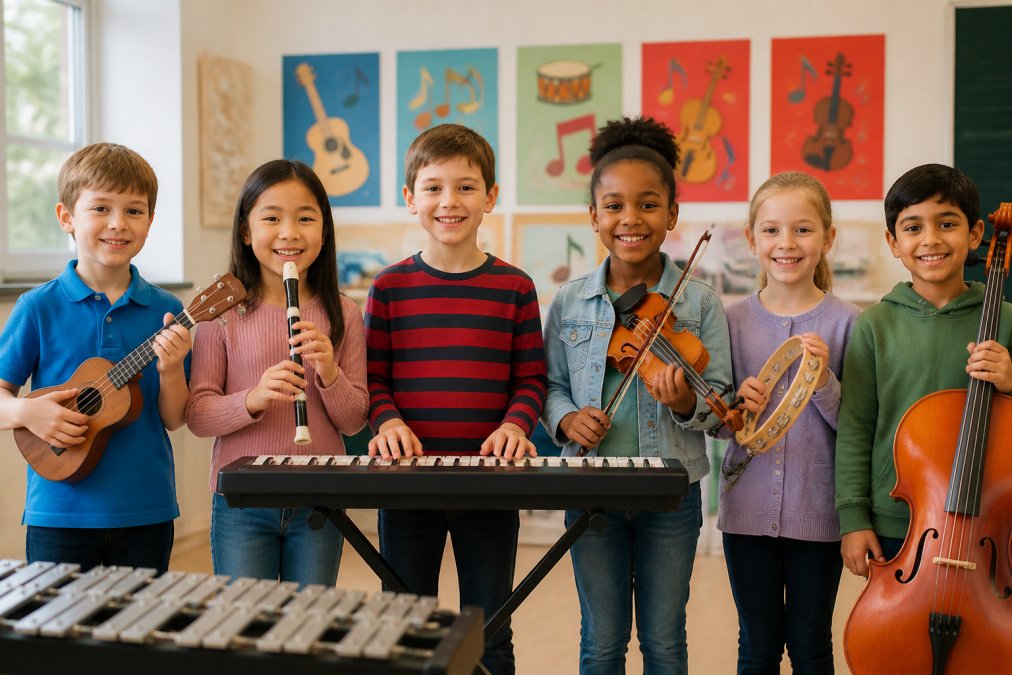
The instruments below are ordered by accessibility, starting with the easiest entry points and progressing toward instruments that demand more physical development and financial commitment.
Quick Picks:
- Best Overall Starter: Keyboard/piano, teaches music theory fundamentals that transfer to every other instrument
- Most Accessible: Recorder, standard in Queensland primary curricula, extremely affordable
- Best String Starter: Ukulele, compact, gentle on fingers, immediately rewarding
- Best for School Bands: Clarinet or trumpet, directly aligned with ensemble programs
1. Keyboard and Piano: The All-Round Starter
The keyboard is the single best first instrument for musical aptitude development. The visual layout of the keys makes music theory immediately tangible: pitch recognition, harmony, and rhythm become concrete concepts. Children who learn keyboard first tend to pick up secondary instruments faster.
For early primary, a lighting keyboard like the Maestro MK-L200 provides visual guidance. For children aged seven and up, the Casio CT-X700 61-key portable keyboard offers 600 tones, 195 rhythms, touch-sensitive full-size keys, and USB connectivity. It runs on batteries, which matters for families who want portability.
What works: The range of sounds keeps practice sessions interesting, and the keyboard never needs tuning.
What to watch: Non-weighted keys on entry-level models mean transition to an acoustic piano later requires adjustment.
Best for: Ages 4 and up. No physical prerequisites.
2. Ukulele: Small, Affordable, and Genuinely Fun
The ukulele is the most forgiving string instrument for beginners. Nylon strings are soft on fingers, the soprano body fits comfortably on small frames, and basic chord shapes are achievable within weeks. Children can play recognisable songs almost immediately.
The Kala KA-15S Satin Mahogany Soprano Ukulele, priced between A$129 and A$169, offers a warmer tone with Aquila Super Nylgut strings and geared tuners that hold pitch reliably.
What works: Compact size suits ages six and up. The mahogany body produces a tone suitable for school performances.
What to watch: Soprano size can feel cramped for children with larger hands by age eleven or twelve.
Best for: Ages 6-11. Children who want a string instrument without the steep learning curve of guitar or violin.
3. Acoustic Guitar (3/4 Size): For Kids Ready to Commit
The 3/4 size acoustic guitar is the right choice for children who are serious about learning. Steel strings require more finger strength than nylon, and chord transitions demand consistent practice.
The Artist LSP34 3/4 Size Beginner Acoustic Guitar Ultimate Pack at A$239 includes a built-in chromatic tuner, gig bag, strap, spare strings, and picks. Low string action reduces the finger pressure needed for clean notes, which is the main frustration point for beginners.
What works: The complete pack removes guesswork. Low action genuinely helps with early chord formation.
What to watch: Steel strings will cause finger soreness in the first few weeks. This is normal and passes.
Best for: Ages 8+ and children over approximately 125 cm tall. Best suited to children who have expressed sustained interest.
4. Violin: Challenging but Rewarding
The violin is the most technically demanding instrument on this list for a beginner. Producing a clean tone requires correct bow hold, proper posture, and consistent practice. Violin works best when paired with formal lessons from the start.
The Stentor Student I Violin Outfit, priced between A$269 and A$329, is widely recommended by Australian music teachers. The solid carved spruce top and maple back produce a genuine tone. It comes in sizes from 1/16 through full, which means it scales with your child as they grow.
What works: Available in the right size for almost any age. The complete outfit includes a wood bow and moulded case. Teacher-approved across Queensland schools.
What to watch: Requires regular tuning and rosin application. Progress in the first three months can sound discouraging.
Best for: Ages 5 and up, with appropriate sizing. Children with patience and access to regular lessons.
5. Recorder: The Ideal First Woodwind
The recorder is the most logical first woodwind instrument for primary school children. Queensland school curricula treat it as the standard introduction, with almost every primary music program introducing the recorder in Year 2 or Year 3.
The Yamaha YRS-24B Soprano Recorder, priced between A$11.49 and A$17.99, is the standard school choice. ABS resin construction handles school environments. Baroque fingering aligns with how most school programs teach.
What works: Extremely affordable. Produces accurate intonation that helps children develop pitch recognition.
What to watch: The tonal range is limited. Most children who progress musically will move to a more complex woodwind within two to three years.
Best for: Ages 6-10. Any child enrolled in a Queensland primary school music program.
6. Clarinet: The Step-Up Woodwind for Older Students
The clarinet is where many Queensland school band programs begin for woodwind players in upper primary. It produces a rich, clear tone and sits comfortably in ensemble settings.
The Yamaha YCL-255 Student Clarinet, priced between A$850 and A$1,100, is the teacher-recommended standard. The ABS resin body handles Queensland humidity better than wooden instruments, which can crack in fluctuating conditions. The adjustable thumb rest and 65mm barrel make it manageable for smaller hands.
What works: Widely approved by Queensland school music programs. Produces good in-tune sound that aids the learning process.
What to watch: The initial investment is significant. Reeds require regular replacement and represent an ongoing cost.
Best for: Ages 9-12. Children already enrolled in or planning to join a school band program.
7. Trumpet: Entry Point into Brass
Brass instruments develop breath control, discipline, and focus in ways that string and woodwind instruments do not. The trumpet is the most accessible brass entry point and features in virtually every Queensland school ensemble.
The Yamaha YTR-2330 Student Bb Trumpet, priced between A$919 and A$1,099, is the benchmark student brass instrument in Australia. Monel alloy pistons provide smooth valve action that does not stick. The lightweight design reduces fatigue during practice sessions.
What works: Excellent intonation for a student model. Recognised and recommended by brass teachers across Queensland.
What to watch: Developing embouchure takes months of consistent practice. The first few weeks produce limited musical sound.
Best for: Ages 9 and up. Children with strong interest in ensemble participation and access to regular lessons.
8. Drums and Percussion: For Kids Who Can't Sit Still
Rhythm and percussion instruments are the natural starting point for children who respond physically to music. Drumming builds fine motor skills, coordination, and an innate sense of musical timing. According to Music Australia's research on music education outcomes, percussion-based music education has documented links to improved motor coordination in primary school children.
What works: Immediately engaging for high-energy children. Percussion skills transfer directly to school band programs.
What to watch: A full drum kit requires significant space and generates considerable noise. Electronic drum kits solve the noise problem but add cost.
Best for: Any age. Children who respond to rhythm before melody, and families with appropriate space.
Renting vs Buying Musical Instruments in Australia
Renting makes sense for the first six to twelve months. Many children try an instrument and move on, and a rented instrument returned after one term costs far less than a purchased one sitting unused.
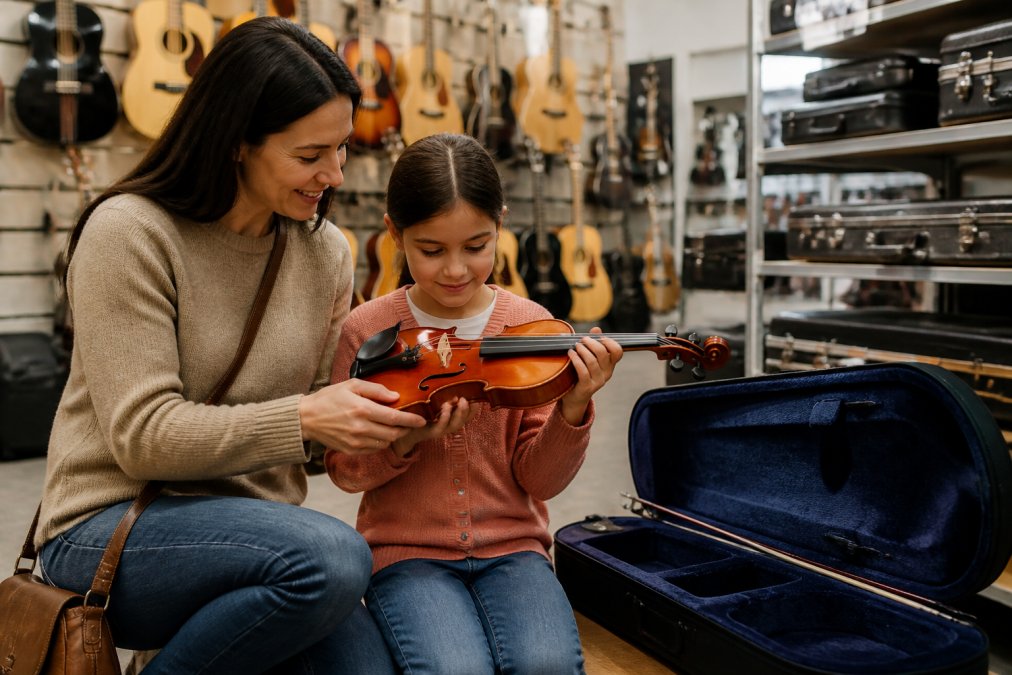
Most instrument rental schemes in Australia operate on a monthly fee that includes basic maintenance, and some allow rental payments to count toward a purchase price if the child commits.
Buying outright makes sense when:
- Your child has completed at least one full school year on the instrument
- The school band program requires ownership rather than rental
- You are purchasing an entry-level instrument like a recorder or ukulele, where the purchase price is comparable to a few months of rental fees
The second-hand market for student instruments in Queensland is active, particularly for violins, clarinets, and trumpets. However, buying without a teacher's assessment carries risk: instruments that appear functional may have structural issues that make them difficult to play in tune. For instruments above A$200, a brief assessment by a music teacher before purchase is worthwhile.
| Scenario | Recommended Approach |
|---|---|
| Child is trying their first instrument | Rent for 6-12 months |
| Child has completed one year of lessons | Buy outright or rent-to-own |
| Instrument costs under A$150 (recorder, ukulele) | Buy outright |
| Buying second-hand | Get teacher assessment first |
| School band program requires ownership | Buy a teacher-approved model |
How Long Do Drumsticks Last for Beginners?
Drumstick lifespan for beginners depends primarily on practice frequency and striking technique. A beginner practising three to four times per week with reasonable technique can expect a pair of standard drumsticks to last four to twelve weeks. Poor technique dramatically accelerates wear and causes tip breakage.
Signs a stick needs replacing:
- Visible cracking along the shaft
- Tip chips or breaks off entirely
- Noticeable warping that affects balance
- Surface splintering that creates grip problems
Buying sticks in multi-pair packs reduces per-stick cost and ensures a replacement is always available. For a beginner drummer in a school program, budgeting for a new pair every six to eight weeks is reasonable in the first year.
Musical Instrument Maintenance Tips for Beginners
Instrument maintenance is where many parents underestimate the ongoing commitment. The instrument that gets maintained plays better, stays in tune longer, and lasts for years rather than months. According to ABRSM's guidance on instrument care for students, consistent basic maintenance is one of the strongest predictors of instrument longevity in student use.
Universal maintenance habits:
- Wipe down strings and body after every session (guitars, ukuleles, violins)
- Swab the bore after playing (clarinet, recorder, trumpet)
- Store in the case when not in use
- Keep away from direct sunlight and heat sources
Humidity and Storage in Queensland's Climate
Queensland's climate creates specific challenges that mainland guides ignore. High humidity, particularly in summer, accelerates corrosion on metal instruments and can cause wooden instruments to swell, warp, or crack if not stored correctly. The Gold Coast and surrounding areas like Robina experience humidity levels well above the ideal storage range for most instruments for much of the year.
Practical steps for Queensland conditions:
- Wooden instruments (violin, acoustic guitar): Store in a hard case with a humidity control pack. Avoid leaving instruments in cars, which reach extreme temperatures and humidity levels quickly.
- Brass instruments (trumpet): Valve oil prevents corrosion and keeps pistons moving smoothly. Apply after every session.
- Clarinet: The ABS resin body of student models like the Yamaha YCL-255 handles humidity better than wooden clarinets, which is one reason it is the preferred school instrument in Queensland.
- Keyboards: Keep away from air conditioning vents, which cause rapid humidity fluctuation that damages internal components.
A simple silica gel pack in a hard case costs very little and extends instrument life significantly in Queensland conditions. For families in Robina and the broader Gold Coast region, this is not optional advice: it is the difference between an instrument that lasts three years and one that lasts ten.
Choosing the right first instrument is one of the most consequential decisions in a child's musical education. Muzic Man stocks a curated range of teacher-approved, child-sized instruments from brands including Yamaha, Kala, Stentor, and Casio, with Australia-wide shipping and a physical store on the Gold Coast for families who want to see and hear an instrument before committing. Browse the full range at muzicman.com.au or visit the Robina-area store for hands-on guidance from staff who understand what Queensland school programs actually require.
Frequently Asked Questions
What is the best musical instrument for kids to learn first?
Keyboard and ukulele are two of the most beginner-friendly starting points for school kids. Keyboards build music theory foundations and work for all ages, while the ukulele's compact size and nylon strings make it easy on small hands and fingers. The recorder is also a strong first choice, particularly for children aged 5 to 8, as it is affordable, durable, and widely used in Australian primary school music programs.
Should I rent or buy a musical instrument for my child?
Renting suits the early months when you are unsure whether your child will stick with an instrument. It keeps upfront costs low and lets you upgrade sizes as your child grows, especially relevant for violin and cello, which come in multiple sizes. Buying outright makes more sense once your child has committed to lessons for at least a term. Many Australian music retailers and schools offer rental schemes; check what your child's school band program recommends before deciding.
What instrument is best for a child with ADHD?
Percussion instruments, including drum kits and hand percussion, are often recommended for children with ADHD because they channel physical energy into rhythm and focus. The immediate tactile and auditory feedback keeps engagement high. Keyboards can also work well because visual key layouts make musical literacy more concrete. Short, structured practice routines of 10 to 15 minutes tend to produce better results than longer, open-ended sessions for children who find sustained attention challenging.
What instrument should a 10-year-old play?
At 10, most children have the hand size and fine motor skills for guitar, violin, clarinet, or trumpet. A 3/4 size acoustic guitar suits kids who are musically curious and enjoy popular music. Clarinet and trumpet are excellent if your child's school has a band program, as ensemble participation builds discipline and musical literacy quickly. If your child already has some keyboard experience, this is also a good age to progress to a more expressive instrument.
How do I know if my child is ready to start music lessons?
Most children show readiness between ages 5 and 7, though this varies by instrument. Signs include showing genuine interest in music, the ability to follow simple instructions, and basic hand-eye coordination. Piano and ukulele suit younger starters from around age 5. Woodwind and brass instruments generally work better from age 8 or 9, when lung capacity and embouchure control are more developed. A short trial lesson is the most reliable way to gauge readiness before committing to instrument purchase.
This article was written using GrandRanker