


Music Store Return Policy for Beginners: Your 2026 Guide
5th Sep 2026
Table of Contents
- Why Music Store Return Policies Confuse Beginners
- Music Store Return Policy Basics: What to Check Before You Buy
- Australian Consumer Law Refunds: Your Statutory Rights Explained
- Online vs In-Store Return Rights Australia: What Changes?
- How to Inspect a New Instrument for Defects on Delivery
- The Return Process: A Step-by-Step Guide for Beginners
- Common Mistakes to Avoid When Returning Gear
- Conclusion: Shop with Confidence
- Frequently Asked Questions
Last Updated: September 5, 2026
Why Music Store Return Policies Confuse Beginners
Most beginners assume every store handles returns the same way, leading to frustration, unexpected fees, and gear that stays in its box. Return policies vary wildly between retailers, and the fine print often hides the details that matter most.
A music store return policy is the set of rules a retailer applies when you want to send back or exchange an item you've purchased. This guide from Muzic Man breaks down what those rules mean, what protections you have under Australian Consumer Law, and how to handle returns without the headache.
Music Store Return Policy Basics: What to Check Before You Buy
A store's return policy is a voluntary commitment that can range from generous to extremely restrictive. Read it before you buy, not after you're staring at a box you want to send back.
The Pre-Purchase Checklist for First-Time Buyers
Before you commit to any purchase, ask these five questions. The answers will save you from the most common return headaches.
-
What is the exact return window? Is it 7 days, 14 days, or 30 days? For online orders, the clock usually starts when the parcel arrives at your door, not when you hit 'buy'. Write the final date on the box itself with a marker.
-
What condition does the item need to be in? Most stores require the item to be in 'as new' condition. For instruments, this often includes keeping the plastic film on pickguards and not removing any tags.
-
Do I need the original packaging? This is the most common trap. Many retailers, especially for guitars and keyboards, will refuse a change of mind return if you don't have the original box and all the internal packing materials. Keep it all for at least the length of the return window.
-
Is there a restocking fee? Some stores charge a fee (often 10-15% of the purchase price) to process a change of mind return. This fee is legal for change of mind, but it should be disclosed at the time of purchase (accc.gov.au). A store cannot charge a restocking fee for a faulty product.
-
What is the proof of purchase requirement? Do you need the original receipt, or will a bank statement or loyalty account history work? Many local shops in areas like Robina can look up your purchase if you paid by card, but smaller stores might rely solely on the physical receipt. Take a photo of the receipt and email it to yourself as a backup.
The 'Ask the Staff' Test
A good music store will happily answer these questions. If the staff are vague, dismissive, or tell you 'it'll be fine,' treat that as a red flag. Ask them to point to the specific clause covering change of mind returns; if they can't find it, the policy may be more restrictive than they're letting on.
Australian Consumer Law Refunds: Your Statutory Rights Explained
Australian Consumer Law is the foundation of every purchase you make, and it overrides any store policy. These consumer guarantees apply automatically to all goods sold in Australia, regardless of what a retailer's terms say. The Australian Competition and Consumer Commission's guide to consumer guarantees explains that your statutory rights cannot be excluded, restricted, or modified by any store.
Your rights under Australian Consumer Law refunds are straightforward: goods must be of acceptable quality, match their description, and do what they're supposed to do. When a product fails these guarantees, the retailer must provide a repair, replacement, or refund, depending on the severity of the problem.
Faulty Goods vs Change of Mind: A Critical Difference
A faulty product and a change of mind are two completely different situations with different rules. For faulty goods, you have strong protections and the remedy is on the retailer. For change of mind, you're relying entirely on the store's goodwill.
Faulty goods means the product has a defect, doesn't work as intended, or fails to meet consumer guarantees. You're entitled to a repair, replacement, or refund, and the retailer typically covers shipping costs for the return.
Change of mind means the product works fine, but you've decided you don't want it. You have no automatic right to a refund, and the store can refuse, offer store credit, or charge a restocking fee. Your only recourse is the retailer's voluntary policy.
Online vs In-Store Return Rights Australia: What Changes?
Online purchases come with extra protections under the Australian Consumer Law distance selling rules, which recognise that you can't inspect a product before buying. These rules give you additional cooling-off periods and require clear disclosure of return terms before checkout.
When you buy in person, you've had the chance to examine the item, so change of mind returns are entirely at the store's discretion. Faulty goods protections still apply, but the return process typically requires you to bring the item back to the physical location.
For faulty goods, buying from a store in Robina or ordering online from the same retailer yields identical remedies. For change of mind, the online purchase usually gives you more flexibility, which matters when you're buying an instrument you haven't been able to test in person.
How to Inspect a New Instrument for Defects on Delivery
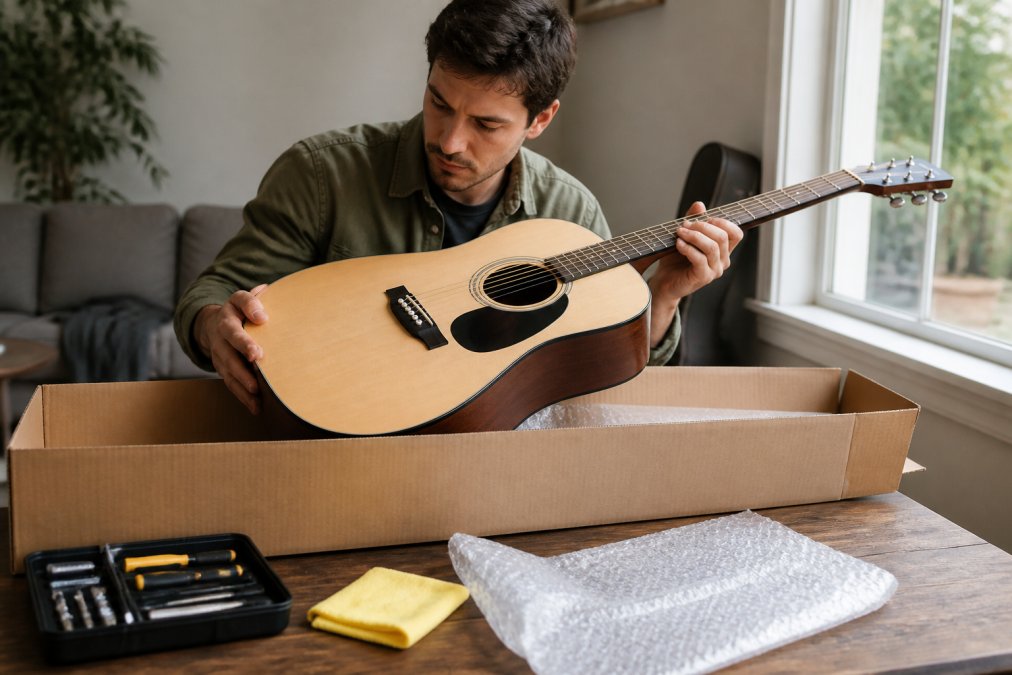
Your inspection routine begins the moment the delivery arrives. Don't sign for a package until you've checked the box for obvious damage. If the packaging looks crushed or punctured, note it on the delivery receipt and photograph the damage before you open anything.
Work through this checklist systematically:
- Check the body and finish for cracks, dents, or scratches. Run your fingers along the edges where damage is easiest to hide.
- Examine the neck for warping or twists. Sight down the neck from the body to the headstock to check alignment.
- Test all moving parts. For guitars, that means tuning pegs and the bridge. For keyboards, test every key and pedal.
- Plug in and play if the instrument is electric. Listen for buzzing, crackling, or dead output.
- Inspect the case or bag for damage that could indicate rough handling during transit.
If you find a defect, stop and document it. Take clear photos, note the delivery date, and contact the retailer immediately. Under Australian Consumer Law, you're entitled to a remedy for defective products, and a fast report makes the process smoother.
The Return Process: A Step-by-Step Guide for Beginners
Once you've decided an item needs to go back, the process is straightforward if you follow the right order. The biggest mistake is rushing to ship the item back without understanding the store's specific workflow.
Step 1: Classify Your Return (Fault vs. Change of Mind)
Your entire process, and the store's obligations, change based on this classification.
- Faulty Goods: If the item is broken, defective, or doesn't do what it's supposed to do, you are making a claim under the Australian Consumer Law (ACL). You are entitled to a repair, replacement, or refund. The store cannot charge you a restocking fee or make you pay for return shipping.
- Change of Mind: If the item works perfectly but you simply don't want it, you are relying on the store's voluntary policy. The store can refuse the return, offer store credit, or charge a restocking fee. You are responsible for return shipping costs.
Step 2: Initiate Contact Within the Window
Contact the retailer immediately. For faulty goods, you have up to the 'reasonable time' period under the ACL, which can be months or even years for a high-value instrument (accc.gov.au). For change of mind, you are bound by the store's specific window (often 7-30 days).
- For online purchases: Look for a 'Returns' or 'Contact Us' portal in your order history. Use this instead of a general email address, as it creates a formal record linked to your order.
- For in-store purchases: Call the store directly and ask to speak to the manager or the department head. Explain the situation clearly and ask for their preferred process.
Step 3: Obtain Formal Return Authorisation (RA)
Never ship an item back without a Return Authorisation (RA) number.
- What it is: A unique reference number that links your return to your original order in the retailer's system.
- How to get it: The store will issue it after you've explained the issue. For faulty goods, they may ask for photos or a video to diagnose the problem first. This is standard practice for items like amplifiers or electronic keyboards.
- What to do if they refuse: If the store refuses to issue an RA for a faulty item, do not argue on the phone. Calmly state that you will be lodging a formal complaint with your state's consumer affairs body (e.g., Office of Fair Trading in Queensland or NSW Fair Trading) and mention that you will be relying on your rights under the ACL. This often prompts a change in attitude.
Step 4: Pack the Item Securely
The item must arrive in the same condition it left your house.
- Use the original packaging. This is the safest option. If you've lost it, you must find a box that provides equivalent protection. For a guitar, this means a hard case or a sturdy box with at least 5cm of foam or bubble wrap on all sides.
- Include everything. All manuals, cables, straps, picks, and accessories must be in the box. Missing a single cable can result in a partial refund or a rejected return.
- Photograph the packed item. Take a photo of the item inside the box, just before you seal it. This is your evidence that it was packed correctly and undamaged.
Step 5: Choose the Right Shipping Method
For faulty goods, the retailer should provide a prepaid shipping label. Under the ACL, the retailer bears the cost of returning a faulty item.
For change of mind returns, you are responsible for shipping. Do not use the cheapest option. Use a tracked service like Australia Post's Parcel Post with tracking or a courier service.
Step 6: Track and Follow Up
Keep your tracking number safe. Once the tracking shows 'Delivered', note the date. If you haven't heard from the retailer within 5 business days of delivery, contact them with a follow-up email referencing your RA number and the tracking confirmation.
Common Mistakes to Avoid When Returning Gear
Beginners make predictable errors when navigating returns, and most are avoidable with a little preparation. The most expensive mistake is waiting too long; once return windows close, your change of mind options disappear entirely.
Another frequent error is failing to distinguish between a fault and change of mind when contacting the retailer. If your instrument arrived with a genuine defect, say so clearly; apologising for returning a faulty item can lead to restocking fees being applied.
A third mistake involves discarding the original packaging before you're certain the item is a keeper. Many retailers require original packaging for returns, so hold onto everything until you're confident about your purchase.
Finally, don't ignore cosmetic damage out of embarrassment. If a product arrives with visible scratches or dents, that's a faulty goods claim, not a change of mind. You're entitled to a remedy and shouldn't accept damaged gear simply because you feel awkward complaining.
| Mistake | Consequence | How to Avoid It |
|---|---|---|
| Waiting past the return window | No refund or exchange available | Mark the deadline immediately on delivery |
| Misreporting a fault as change of mind | Restocking fees or store credit instead of refund | Clearly state the defect and your statutory rights |
| Discarding original packaging | Return refused or reduced refund | Keep all packaging until you're certain |
| Shipping without return authorization | Package rejected, no refund | Always obtain a reference number first |
Conclusion: Shop with Confidence
Returns don't have to be stressful. Understanding your rights under Australian Consumer Law, knowing the difference between faulty goods and change of mind, and following a simple inspection routine puts you in control of every purchase.
When you shop with Muzic Man, you're dealing with a team that understands these rules inside out. Our Robina store and online shop across Australia offer a wide range of branded instruments, and we're happy to walk you through the return process before you buy. Get started with Muzic Man and make your next gear purchase with total confidence.
Frequently Asked Questions
Can I return a musical instrument if I simply change my mind?
Yes, but only if the store's specific policy allows it. A change of mind return is not covered by Australian Consumer Law. Most music stores offer a return window for items in their original packaging and unused condition. You may receive a store credit or exchange rather than a full refund, and restocking fees can apply. Always confirm the change of mind policy before purchasing.
What are my rights under Australian Consumer Law if an instrument is faulty?
If your new instrument has a major fault, such as a cracked neck or electronic failure, you are entitled to a repair, replacement, or full refund under the consumer guarantees. This right applies regardless of the store's return window. The store cannot refuse your claim if the faulty goods fail to meet consumer guarantees. Keep your receipt or proof of purchase, as you will need it to make a claim.
Can I return online if bought in store?
It depends on the store's policy. Many retailers allow returns at their physical location even for online purchases. However, returning an in-store purchase online usually isn't possible. The best approach is to contact customer support to start the return process. They will advise whether to ship the item back or bring it to the store, and provide a return authorization if needed.
Can I return an item after opening it?
For faulty goods, yes. If the item is defective, your consumer rights apply even after opening. For a change of mind, it depends on the item and the store policy. Items like headphones may not be returnable once opened for hygiene reasons. Other items can be returned if they are in unused condition with original packaging. Check the store's policy on opened items before you buy, especially for software or accessories.
This article was written using GrandRanker