


Portable Keyboard Stands for Gigging Musicians Australia
27th Sep 2026
Table of Contents
- Quick Comparison: Portable Keyboard Stands for Gigging Musicians
- How to Choose a Portable Keyboard Stand for Gigging
- Keyboard Stand Weight Capacity Guide
- Heavy Duty Keyboard Stand Options in Australia
- Keyboard Stand Setup Tips for Live Gigs
- Where to Buy Portable Keyboard Stands in Australia
- Conclusion
- Frequently Asked Questions
Last Updated: September 26, 2026
Quick Comparison: Portable Keyboard Stands for Gigging Musicians
Portable keyboard stands for gigging musicians Australia-wide come down to a simple trade-off: weight versus stability. A stand that folds flat into a hatchback in seconds is rarely the same stand that holds a weighted 88-key stage piano steady through a four-hour set. This guide from Muzic Man breaks down the real options, from budget X-frames to heavy-duty column stands, so you can pick the right one the first time.
Here's the short version. Match the stand to your heaviest keyboard, not your lightest.
| Stand Type | Weight Capacity | Folded Size | Setup Time | Best For |
|---|---|---|---|---|
| X-style | Light to medium | Very compact | Under 1 minute | Light synths, quick gigs |
| Z-frame | Medium to heavy | Compact | 1-2 minutes | Two-tier rigs, stage pianos |
| Column | Heavy | Moderate | 2-4 minutes | Professional touring setups |
| Table-style | Heavy | Bulky | 2-3 minutes | Studio-to-stage players |
The 61 and 76-note keyboards most gigging players carry sit comfortably on any of these. The trouble starts when you add a second tier, a mixer, or a weighted 88-key board.
How to Choose a Portable Keyboard Stand for Gigging
Choosing a portable keyboard stand starts with three questions: how heavy is your keyboard, how often do you move it, and how much space does your vehicle give you. Answer those honestly and the shortlist writes itself.
Most players overbuy on weight capacity and underbuy on portability, or the reverse. Neither mistake is fatal, but both cost you money or your back.
Types of Keyboard Stands: X-Style, Z-Style, and Table-Style
X-style stands use two crossing legs that scissor open. They're the cheapest and lightest option, and they fold down to almost nothing.
Z-frame stands have a zigzag leg profile with a wider base. They handle heavier keyboards and often support a second tier for a two-keyboard rig.
Table-style stands spread weight across four legs and a wide top. They give you far more legroom, which matters if you play seated or use a sustain pedal heavily.
Column stands, a fourth category worth knowing, use a single vertical post with arms.
Portability and Folding Mechanisms
Folding design is where cheap stands and good stands separate. Look for a quick-release mechanism or locking pins rather than friction clamps that loosen over time.
Keyboard Stand Weight Capacity Guide
Weight capacity is the number that decides whether your stand survives a gigging year or fails in month three. Manufacturers publish a load capacity, but that figure assumes even weight distribution on a level surface.
A few practical rules:
- Add 20 to 30 per cent to your keyboard's weight as a safety margin
- Weigh your keyboard with its power supply and any attached gear
- For a two-tier setup, check the capacity of the upper tier separately
- Never exceed the stated load capacity, even briefly during setup
Heavy Duty Keyboard Stand Options in Australia
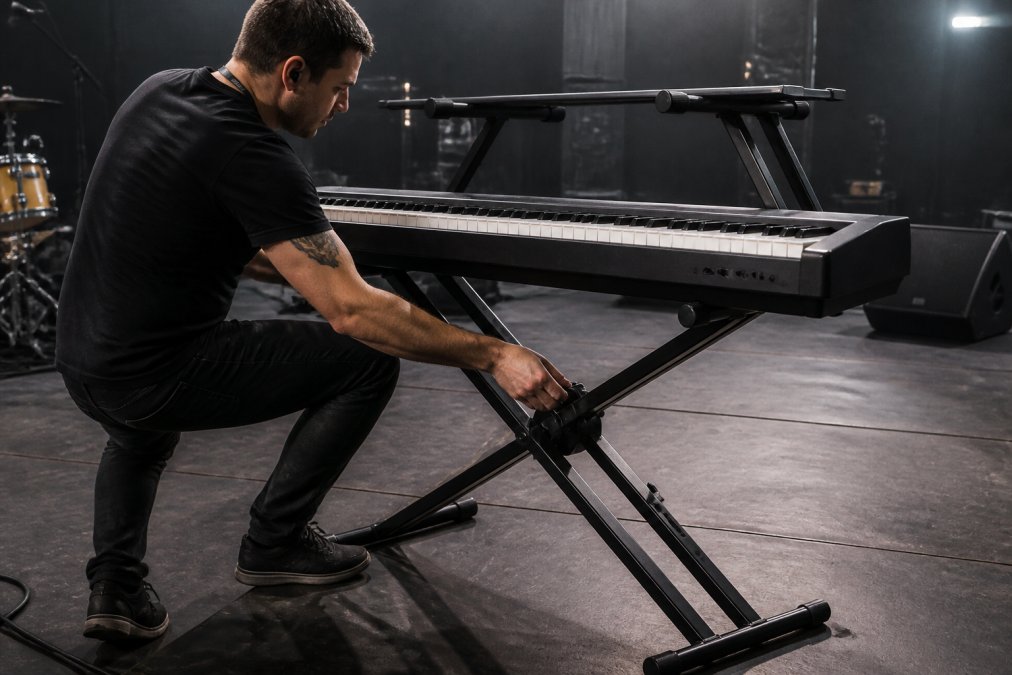
Heavy-duty stands earn their keep when your rig includes a weighted electric piano, a synthesiser in a flight case, or a second tier for a mixer. The trade-off is always weight and folded size, and the useful way to judge a stand is the weight-to-stability ratio: how much the stand itself weighs against how much gear it can safely hold.
Durability in humid Australian climates
Material choice matters more in coastal Queensland than in drier inland regions. Humid, salt-laden air accelerates corrosion on cheap chrome and zinc-plated fittings, and it is the small hardware, locking pins, clamp screws, height collars, that fails first, not the main frame.
A few practical patterns:
- Powder-coated steel frames resist surface rust better than bare or thinly plated finishes.
- Aluminium components do not rust, but they can corrode where they meet steel fittings, so keep those junctions dry.
- Stainless or well-plated locking pins last noticeably longer in coastal conditions than budget chrome.
- Wipe-down after load-out removes the film of moisture and salt that starts the corrosion cycle.
Keyboard Stand Setup Tips for Live Gigs
Setup efficiency separates a calm soundcheck from a rushed one. The gap most guides leave is that they never put a number on it. In practice, the stand type you choose sets a floor on your setup time, and that floor matters more than any individual habit.
| Stand Type | Typical Setup Time | Breakdown Time | Main Time Cost |
|---|---|---|---|
| X-style | Under 1 minute | Under 1 minute | Friction clamp height adjustment |
| Z-frame | 1-2 minutes | 1-2 minutes | Seating locking pins, attaching second tier |
| Table-style | 2-3 minutes | 2-3 minutes | Folding out four legs, levelling |
| Column | 2-4 minutes | 2-4 minutes | Extending and locking the column, mounting arms |
Habits that cut time regardless of stand type:
- Set the stand height before you mount the keyboard, not after
- Seat every locking pin by feel, then confirm with a gentle push
- Position non-slip feet on the stage before adding weight
- Run cables through integrated clips or along the frame, not across the floor
- Mark your preferred height with tape so repeat setups take seconds
- Keep the carry bag open and flat beside you so pack-down is one motion
Transport logistics: fitting a stand into an Australian car
This is the part most guides skip entirely, and it is where gigging musicians actually lose time. A stand that folds small but folds awkwardly can still cost you a second trip to the car.
- Sedans and hatchbacks: a Z-frame or X-style stand that folds to a slim, long profile usually slides behind the front seats or across the boot floor. Table-style stands with a wide folded footprint are the awkward ones here.
- SUVs and wagons: almost any folding stand fits, so portability weight becomes the deciding factor rather than folded size.
- Public transport and rideshare: if you gig around Brisbane, the Gold Coast or inner Melbourne and do not drive, a stand with a shoulder carry bag and a sub-10kg frame is the only realistic option. Column stands are the hardest to manage on a train or tram.
Where to Buy Portable Keyboard Stands in Australia
Buying a keyboard stand online works well if you know your keyboard's weight and your folded-size limit. Buying in person lets you test the height adjustment and feel the frame rigidity before you commit.
Conclusion
Getting the stand right the first time saves you a mid-gig wobble and a replacement purchase six months in. Muzic Man carries branded keyboard stands and accessories with Australia-wide shipping and a Robina shop where you can test the folding mechanisms hands-on. Browse the range online or visit the Gold Coast store to match a stand to your rig.
Frequently Asked Questions
What is the most stable keyboard stand for live performances?
Column-style stands like the K&M 18860 Spider Pro and table-style stands such as the K&M Omega 18810 offer the best stability for live performances. They have a lower centre of gravity and wider base than X-style stands, which reduces wobble during energetic playing. Look for stands with locking pins, non-slip feet, and a weight capacity at least 1.5 times your keyboard's weight. For heavy 88-key weighted pianos, a heavy-duty Z-frame or column stand is a safer choice than a basic X-stand.
How do I choose a portable keyboard stand for gigging?
Start by weighing your keyboard and checking the stand's load capacity. If you gig weekly, prioritise quick-release mechanisms and a folding design that fits in your vehicle. Consider the number of tiers you need, whether you play standing or seated, and how much assembly time you can tolerate. A portable keyboard stand for gigging should balance weight, stability, and setup speed. Try before you buy if possible, or read detailed specs online.
Are X-stand or Z-stand keyboard stands better for heavy keyboards?
Z-stands are generally better for heavy keyboards because their lower profile and wider base provide more stability than X-stands. X-stands are lighter and cheaper but can wobble under a heavy 88-key piano, especially at higher height settings. For a heavy-duty keyboard stand in Australia, look for a Z-frame or column design with a load capacity of at least 50 kg. If you must use an X-stand, choose a double-braced model and keep it at a lower height.
How do I transport a keyboard stand safely between venues in Australia?
Fold the stand completely and secure any loose parts with cable ties or a strap. Use a padded carry bag if available, or wrap the stand in a blanket to prevent scratches. Place it in the boot or back seat so it cannot slide around. In Queensland's heat, avoid leaving the stand in a hot car for long periods, as extreme temperatures can affect rubber feet and plastic components. A lightweight aluminium stand like the Stay Slim Model is easier to handle on your own.
Are there lightweight keyboard stands suitable for touring musicians?
Yes, aluminium column stands such as the Stay Slim Model are designed for touring musicians who need to minimise weight. They typically weigh under 5 kg and fold into a compact carry bag. However, lightweight stands may sacrifice some stability compared to steel models, so they suit lighter keyboards or solo gigs. If you tour frequently and play a heavy keyboard, consider a heavier stand with a quick-release mechanism to balance portability and stability.