


7 Beginner Drum Kits Worth Buying in Australia
Posted by Editorial Team on 31st Oct 2026
Last Updated: October 30, 2026
Quick Summary
The strongest beginner drum kit recommendations in Australia include the Alesis Nitro Max for quiet home practice, the Roland TD-07KV and Pearl eRoadshow as electronic options to compare, and the Pearl Roadshow for an acoustic feel. Choose electronic if you live in a shared home or apartment, and acoustic if you have room and can tolerate full volume.
- Electronic kits suit apartments and shared homes because they offer headphone output and adjustable volume.
- Check whether the kit includes stands, pedals, a throne and cymbals, or whether these cost extra.
- Mesh heads generally feel closer to an acoustic kit than rubber pads.
- Budget for headphones, a throne, spare sticks and a rug or vibration mat before buying.
- Measure your practice room and confirm noise limits before choosing acoustic or electronic.
Table of Contents
- Why Buying Your First Beginner Drum Kit Is a Decision Worth Getting Right
- What to Look for in a Beginner Drum Kit
- Best Beginner Electronic Drum Kits in Australia
- Beginner Acoustic Drum Kit Options for Australian Players
- Acoustic or Electronic: Which Suits Your Practice Space and Budget
- Drum Kit Accessories Beginners Should Budget For
- Booking a Hands-On Look at Your First Kit at Muzic Man Robina
- Frequently Asked Questions
Choosing your first drum kit is a bigger decision than it looks. Get it right and you'll practise often, enjoy the process and keep the kit for years. Get it wrong and the kit sits in the corner, too loud for the household or too basic to hold your interest. This guide walks through what matters most when comparing beginner drum kit recommendations in Australia for your first purchase.
Quick Picks:
- Best Electronic Starter for Home Practice: Alesis Nitro Max, a widely recommended entry-level electronic kit
- Best Electronic Options to Compare: Roland TD-07KV and Pearl eRoadshow
- Best Acoustic Starter: Pearl Roadshow
Why Buying Your First Beginner Drum Kit Is a Decision Worth Getting Right
A first kit shapes how much you practise. A kit that is comfortable to play, fits your space and sounds decent encourages you to sit down most days. A kit that frustrates you tends to get ignored, even if it was expensive.
Most beginners underestimate two things: noise and space. A full acoustic kit is loud, and a drum kit in a shared home or apartment can quickly become a source of friction. Electronic kits solve much of this with headphone output and adjustable volume, but they bring their own considerations around module features and pad feel.
What to Look for in a Beginner Drum Kit
Before comparing models, decide on a few basics:
- Format: Acoustic kits offer a natural sound and feel. Electronic kits offer quiet practice, built-in sounds and often headphone use.
- Practice space: Measure the room. Leave enough space for the kit plus a seat and room to move.
- Noise tolerance: Check how loud your home can realistically be, and whether neighbours or family members will be affected.
Watch out: buying the cheapest kit with no headphone output in a shared home often leads to the kit being used far less than expected.
Best Beginner Electronic Drum Kits in Australia
Electronic kits are the most common starting point for Australian beginners because they let you practise at low volume, switch sounds, and play through headphones in a shared home. The trade-off is that pad feel and module features vary enormously between models, so the right pick depends on how serious you are and how quiet you need to be. This section looks at the strongest beginner drum kit recommendations in Australia in the electronic category.
What separates a good beginner electronic kit from a frustrating one
Before comparing models, understand the four things that actually determine whether an electronic kit will serve you well:
- Pad type. Mesh heads feel closer to an acoustic drum and respond to dynamics; rubber pads are more durable and cheaper but feel firmer and less expressive. Most beginners who stick with it prefer mesh, at least on the snare.
- Kick pad and pedal. A kit with a proper kick tower and a real pedal feels far more natural than a simple pedal switch. Check whether a bass drum pedal is included or sold separately.
- Module features. Look for at least 10-15 preset kits, a built-in metronome, a headphone output, USB or MIDI out for recording, and the ability to add a second crash or a hi-hat upgrade later.
Alesis Nitro Max: strong starter pick for home practice
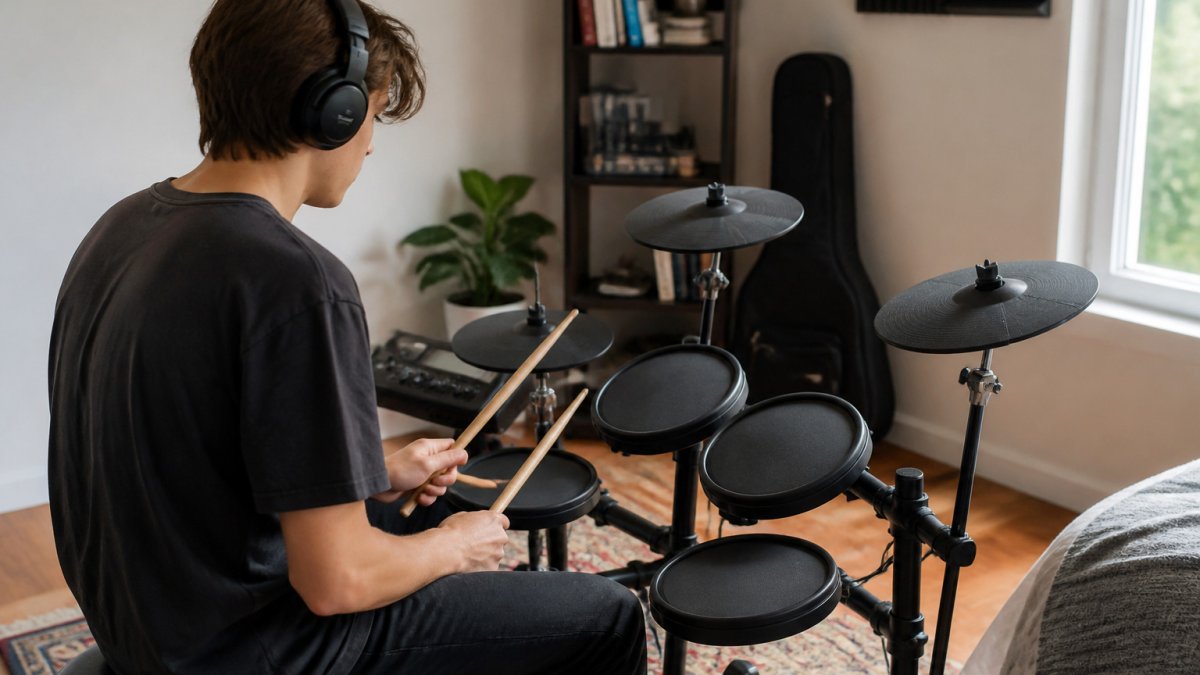
The Alesis Nitro Max is a practical choice for home practice where acoustic volume is a concern.
Best for: beginners who want an electronic kit for quiet home practice. Skip if: you want a real acoustic feel and sound from the outset.
Roland TD-07KV and Pearl eRoadshow: options to compare
The Roland TD-07KV and the Pearl eRoadshow are both worth comparing for beginner electronic practice. Check current pricing and included components directly with the retailer before deciding.
Best for (TD-07KV): beginners who expect to progress past the first year. Best for (eRoadshow): beginners comparing electronic kits from established drum brands. If you are weighing mesh-head electronic options, you can also look at the Kahzan Electronic Mesh Head Bluetooth Pro Drumkit as an alternative.
How to compare electronic kits side by side
When you are looking at two or three kits in a store or online, run through the same checklist for each:
- Pad material and size, mesh versus rubber, and whether the snare is a realistic size or larger.
- Kick setup, is there a proper kick tower, and is a pedal included?
- Hi-hat realism, simple switch pedal or a more expressive hi-hat controller?
- Module outputs, headphone out, USB/MIDI, aux in for playing along to music.
- Expandability, can you add a crash, a second tom or a better hi-hat later?
- Included extras, throne, sticks, headphones, drum key, cables.
- Warranty and after-sales support in Australia, who services it, and how long is the warranty?
Budgeting for the rest of the electronic setup
An electronic kit is rarely the only cost. Plan for a set of closed-back headphones (essential for quiet practice), a drum throne, a spare pair of sticks, and, if you want to play with others or hear yourself properly without headphones, a small powered monitor or amp. A rug and a vibration-isolating mat are cheap additions that protect your floor and your relationship with neighbours.
Beginner Acoustic Drum Kit Options for Australian Players
An acoustic kit gives the most natural feel and sound, and it is the usual choice for players who want to develop touch and dynamics on real drums.
The Pearl Roadshow is a sensible option for a player who has a suitable practice space and accepts the noise an acoustic kit makes.
Best for: beginners who want an acoustic feel and have room to practise. Skip if: you share walls or need to play late at night.
Acoustic or Electronic: Which Suits Your Practice Space and Budget
Most beginner guides frame this as a simple sound-versus-noise choice. In practice, the decision comes down to three things: how much noise your household and neighbours will tolerate, how much space you have, and what the total cost of ownership looks like over the first year or two. Work through those honestly and the right format usually becomes obvious.
Noise and household suitability
An acoustic kit is genuinely loud; a full kit played with normal force can be heard through walls and floors, and a kick drum transmits low-frequency vibration that travels further than you expect. If you live in an apartment, a townhouse or a shared house, an acoustic kit will usually create friction unless you can practise at limited hours and have some separation from neighbours.
Electronic kits are quieter but not silent. The sticks hitting rubber or mesh pads produce a tapping sound that carries through thin walls, and the kick pedal still thumps through the floor. Practical mitigations for either format:
- Put the kit on a thick rug over a hard floor to reduce vibration transfer.
- Use a vibration-isolating mat or platform under an electronic kit, especially in upstairs rooms or apartments.
- Face the kit away from shared walls and keep it out of corners where sound builds up.
Space and setup
Measure the room before you commit. A full acoustic kit with a throne needs enough floor space to play comfortably, plus room to move around it. Electronic kits are usually more compact but still need space for the rack, pads and throne, and you need clearance for the kick pedal and sticks. Leave space for a music stand or a tablet if you plan to follow lessons online.
Total cost of ownership in AUD
The kit price is only the start. Think about what each format costs to own over the first year or two:
- Acoustic kits may need new heads, tuning, cymbals and hardware over time, and a full set of decent cymbals can cost as much as the kit itself. Add sticks, a throne, a practice pad and possibly ear protection for loud playing.
- Electronic kits need headphones, a throne, sticks, and often a monitor or amp if you want to play without headphones. Mesh heads and pads can wear over years of heavy use, and module repairs or replacements are a real cost if something fails.
- Both formats benefit from a practice pad, a metronome (often built into electronic modules) and a comfortable throne.
Budget for the essentials you will actually need in the first few months, such as headphones, a throne, sticks, a rug or mat, and a practice pad, so the kit does not sit unused because you did not factor in the extras.
A simple decision framework
- Choose electronic if: you live in an apartment or shared home, practise in the evening, want to play along to music through headphones, or need to record via USB.
- Choose acoustic if: you have a detached or well-separated space, want the most authentic feel and dynamics from day one, and can practise at reasonable hours.
- Consider a hybrid approach if: you want acoustic feel but need quiet practice; some beginners start on an electronic kit and add an acoustic kit later once space and circumstances allow.
Buyer's guide comparing acoustic and electronic drum kits for beginners
The right format depends on your noise limits, space and total running costs, as this comparison shows.
| Factor | Electronic kit | Acoustic kit |
|---|---|---|
| Noise | Quieter, but sticks and kick still carry | Genuinely loud, carries through walls and floors |
| Best for | Apartments and shared homes | Detached homes or well-separated spaces |
| Feel | Mesh or rubber pads | Natural drum feel and dynamics |
| Ongoing costs | Headphones, monitor or amp, possible module repairs | Heads, tuning, cymbals and hardware over time |
| Playing along | Headphones and USB recording | Requires a room that tolerates full volume |
Drum Kit Accessories Beginners Should Budget For
Plan for a few extras alongside the kit:
- Practice pad: A quiet practice pad helps you work on technique between sessions. Compare mesh, rubber and gel practice pads for quiet practice before you buy.
- Acoustic foam: Foam wedges can help reduce room reflections in a practice space (The ultimate beginner's guide to room acoustics).
- Drum mic shield: If you play acoustic kits near others, a drum mic shield can help control bleed and noise. The CrashGuard drum mic acoustic shield is one option for this.
Booking a Hands-On Look at Your First Kit at Muzic Man Robina
Reading specifications only goes so far. Playing a kit tells you far more about pad feel, stability and comfort. Muzic Man is a leading online music equipment retailer in Australia, with a physical shop on the Gold Coast where you can get a hands-on look at kits and ask questions before you buy. Pricing depends on the model, stock and any current offers, so check our website or contact the store for a current quote.
Frequently Asked Questions
What is the best drum kit for a beginner in Australia?
There is no single best kit for everyone, but the Alesis Nitro Max is repeatedly recommended in 2026 beginner round-ups as a strong entry point, with a reported price of approximately AUD $750. Choose based on where you will play, how much noise you can make at home, and whether you prefer the feel of acoustic shells or the quiet practicality of electronic pads. Pricing varies with stock and bundles, so check Muzic Man's website or request a quote for current figures.
Should a beginner buy an acoustic or electronic drum kit?
Electronic kits suit players practising in apartments or shared homes because they can be played at low volume with headphones. Acoustic kits offer a natural feel and sound but need a space where volume is acceptable and more setup time. Think about your practice space, your neighbours and how much tuning you are willing to do before deciding.
Are electronic drum kits suitable for beginners?
Yes. Electronic kits are widely recommended for beginners because they include built-in sounds, play-along tracks and headphone output. Their rubber or mesh pads are quieter than acoustic drums, which helps at home. The trade-off is that the feel of the pads can differ from a real drum, so try to play one before committing if you can.
Can you learn drums on an electronic kit?
Yes. Electronic kits teach the core skills of timing, limb independence and rudiments, which transfer directly to acoustic drums. Many beginners start on electronic kits and later move to acoustic kits. Look for a kit with a responsive hi-hat and pads of reasonable size so you can develop accurate technique.
What should I look for when buying my first drum kit?
Focus on playability, footprint, the number of pads and cymbals, included hardware such as a throne and pedal, and warranty terms. Check whether the kit needs assembly or tuning and whether the included accessories cover your needs. Ask about after-sales support before buying, especially if you are ordering online and cannot try the kit in person.
Choosing a first kit comes down to your space, your noise limits and how you plan to practise. Start with those three things, then compare the shortlisted models. Visit Muzic Man in Robina to play the kits in person and find one that suits your practice routine.