


How to Buy Entry-Level Instruments Online Safely
Posted by Editorial Team on 29th Oct 2026
Last Updated: October 27, 2026
Quick Summary
Buying instruments online is safer when you set a budget, check the seller's business details, pay by a method with buyer protection, and read the returns and delivery terms before ordering. Each step takes minutes and guards against the most common regrets.
- Set a firm maximum price that includes delivery and accessories.
- Confirm the store shows a business name, physical address, phone number and email.
- Pay by credit card or PayPal, which offer the strongest buyer protection.
- Never pay by direct bank transfer, cryptocurrency, gift cards or to a personal account.
- Inspect the box on arrival, photograph it, and report any problems in writing immediately.
Table of Contents
- Why Buying Entry-Level Instruments Online Needs a Plan
- Building a Beginner Instrument Buying Checklist
- How to Check an Online Music Store Is Legitimate
- Choosing a Safe Payment Method
- Understanding the Musical Instrument Return Policy in Australia
- Planning Instrument Shipping and Delivery
- Your Next Step: Buying Your First Instrument with Muzic Man
- Frequently Asked Questions
Buying an entry-level instrument online can save money and widen your choice, but it also carries real risks. Muzic Man is an online music equipment retailer based on the Gold Coast. This guide walks through what to check before you pay, from confirming a store is legitimate to understanding returns and delivery.
Why Buying Entry-Level Instruments Online Needs a Plan
Buying an instrument online is different from walking into a shop. You cannot pick it up, play it, or hear how it sounds before the box arrives. That gap is where most regret comes from.
A beginner's guide to used instruments makes the same point. It notes that online buyers may be unable to test an instrument first, and it advises gathering more information before you buy. That advice applies to new instruments too.
A simple plan helps. Decide your budget, choose the instrument type, check the seller, pick a safe payment method, and confirm the return and delivery terms. Each step takes a few minutes and protects you from costly mistakes.
Building a Beginner Instrument Buying Checklist
Start with the basics. You can also see which instruments suit each age, skill level, and budget on our best musical instruments for school kids guide. Before you search, write down what the player needs. A young beginner may need a smaller acoustic guitar with lighter strings, while an adult may want a full-size model with a solid playing action.
Use this checklist to narrow your options:
- Budget: Set a firm maximum price, including delivery and any accessories.
- Size: Check the instrument's dimensions, especially for children.
- Playability: Look for a comfortable neck width and low string action.
- Build quality: Read the product description for the materials used.
- Accessories: Confirm whether a case, tuner, or strap is included.
- Warranty: Find out how long the manufacturer covers defects.
If you are buying for a child, our guide to the best beginner acoustic guitar for kids compares sizes, string types, and top models. For a wider view of beginner gear, see our best music gear for beginners guide. You can also compare entry-level electric options in our top 10 beginner electric guitar picks. Check the current price on our website before you decide.
How to Check an Online Music Store Is Legitimate
Start by looking at the store itself. A legitimate retailer shows a clear business name, a physical address, a phone number, and an email contact. Be cautious if these details are missing or hard to find.
Next, check the website's terms. Look for a returns policy, a shipping policy, and a privacy policy. A store that hides these pages is a warning sign.
Finally, look at how the store handles questions. Send a short message asking about stock or delivery. A real store replies with specific answers, not vague promises.
Spotting Counterfeit and Misdescribed Instruments
Some listings describe an instrument in ways that do not match what arrives. Watch for these signs:
- Brand names that are misspelled or missing
- Photos that look like stock images with no model details
- Prices far below what other sellers charge for the same model
- Descriptions that skip the model number or specifications
Compare the listing's model number with the manufacturer's official listing. If the details do not match, do not buy.
Choosing a Safe Payment Method
The method you choose can affect whether you have a route to recover your money if the instrument never arrives, arrives damaged, or is not what was described.
Payment methods ranked by buyer protection
- Credit card (including via PayPal): Strongest protection. Card schemes allow you to raise a chargeback with your issuing bank if goods are not delivered or are significantly not as described. PayPal adds a separate dispute process on top. Keep the transaction inside the platform, never agree to "friends and family" transfers, which remove buyer protection.
- Debit card: Weaker than credit. Some issuers offer chargeback, but the funds leave your account immediately and recovery is slower.
- Buy-now-pay-later services: Protection varies by provider. Check the provider's dispute policy before relying on it for a high-value instrument.
- Direct bank transfer: Almost no recovery route once funds clear. Treat this as cash-in-an-envelope.
- Cryptocurrency, gift cards, or payment to a personal account: Never appropriate for a retail purchase. These are the standard tools of marketplace scams.
Red flags at checkout
- The seller asks you to move the conversation off the platform (to SMS, WhatsApp, or a personal email) and then requests payment directly.
- The price is well below market and the seller pressures you to pay quickly "before someone else does".
- The checkout page is not secure, the address should begin with
httpsand show a padlock, with no browser warnings. - The seller asks for payment to a name that does not match the business name on the website.
- You are asked to pay a deposit by transfer to "hold" an item before any invoice or terms are provided.
Before you pay
Confirm in writing: the total price including delivery, the model number, the condition (new or used), the estimated dispatch date, and the returns window. A short email trail is your evidence if a dispute arises later. Screenshot the listing and the checkout confirmation, listings can be edited or removed after purchase.
For used instruments bought through marketplaces, check the platform's payment and delivery terms before paying.
The payment method you choose determines how much protection you have if something goes wrong.
| Payment method | Buyer protection | Note |
|---|---|---|
| Credit card (including via PayPal) | Strongest | Chargeback and PayPal dispute available |
| Debit card | Weaker | Some issuers offer chargeback; slower recovery |
| Buy-now-pay-later | Varies | Check the provider's dispute policy |
| Direct bank transfer | Almost none | Hard to recover once funds clear |
| Cryptocurrency, gift cards, personal account | Never appropriate | Standard tools of marketplace scams |
Understanding the Musical Instrument Return Policy in Australia
Return policies vary between retailers, so read them before you pay. Look for three details: how many days you have to return an item, who pays the return postage, and whether the instrument must be in its original condition.
Check the official Australian Competition and Consumer Commission guidance for the current rules. Where you are unsure, ask the seller in writing before you buy.
Keep your packaging and receipt. If you need to return an instrument, the original box and paperwork make the process much easier.
Planning Instrument Shipping and Delivery
Delivery is part of an online instrument purchase that you cannot inspect until it arrives. You can find realistic transit estimates for shipping instruments across Australia in our shipping times for musical instruments guide.
Delivery to the Gold Coast and Queensland
- Courier coverage: Confirm which delivery service applies before ordering.
- Weather and transit: Queensland's humidity and summer storms are hard on timber instruments. A guitar or violin that sits in a hot delivery van or on a damp loading dock can arrive with a shifted neck or swollen joints. Where possible, avoid ordering timber instruments during heatwaves or storm events, and bring the box inside to acclimatise for 24 hours before opening.
- Collection option: If the retailer has a physical shop, ask whether you can collect in person.
- Local inspection: For used instruments, ask whether you can view and play the instrument before paying.
Questions to ask before you order
- Is the item in stock, or will it be sourced after I order?
- What is the estimated delivery time to my postcode?
- Does the shipment include tracking?
- How is the instrument packed?
- What should I do if the item arrives damaged?
What to do when the box arrives
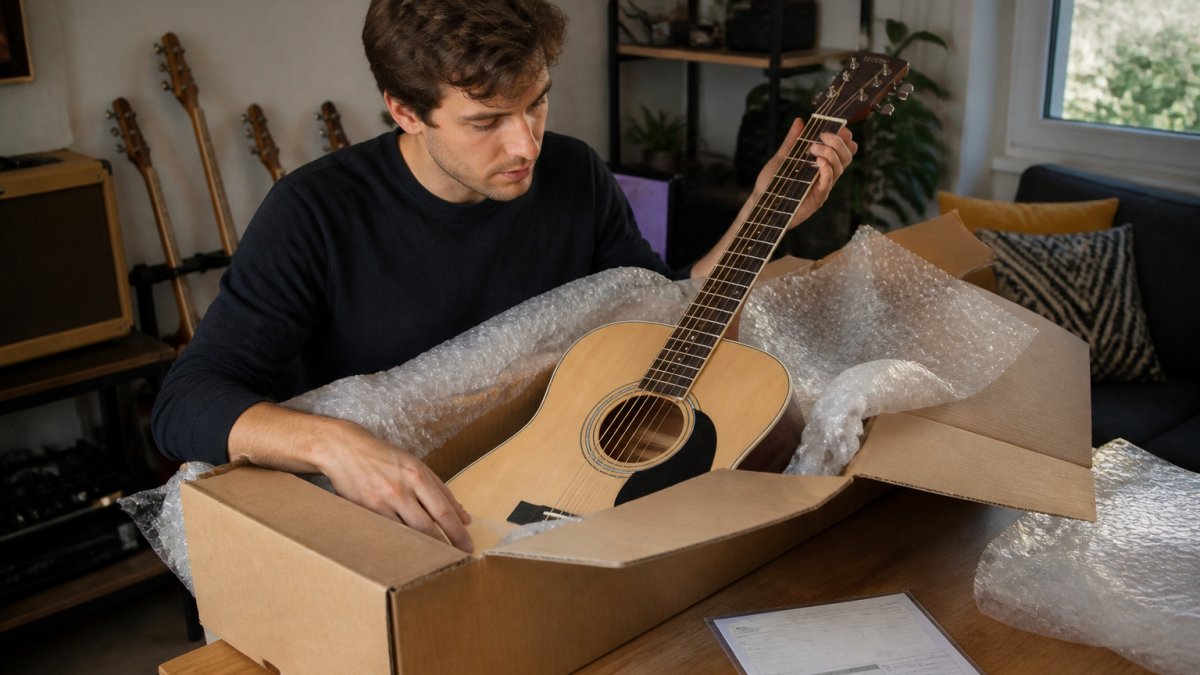
- Inspect before signing where the courier allows it. Note any visible box damage on the delivery docket.
- Photograph the packaging before opening, then photograph the instrument from multiple angles as you unpack.
- Check the instrument against the listing, model number, finish, accessories, and condition.
- Test functionality the same day: tune and play a guitar, check every key on a keyboard, test pickups and wiring on an electric instrument.
- Report problems in writing immediately. Report problems in writing immediately.
Your Next Step: Buying Your First Instrument with Muzic Man
You now have a clear plan for buying an entry-level instrument online. Work through the checklist, confirm the store's details, pick a safe payment method, and read the returns and delivery terms before you order.
Muzic Man stocks branded musical instruments and supplies, ships Australia-wide, and runs a physical shop on the Gold Coast for hands-on selection. Visit our website to browse the range and ask about current pricing, stock, and delivery times.
Frequently Asked Questions
How can beginners safely buy a musical instrument online?
Start by confirming the seller's business details, reading recent customer reviews, and checking that the listing states the exact model, condition and what is included. Compare the description with the product photos and look for a clear returns policy before you pay. Keep all order emails and receipts so you have a record if anything goes wrong. Check the retailer's business details and customer service contact before buying, especially for a first instrument where you cannot test it in person.
Can I return an instrument bought online in Australia?
Returns depend on the seller's policy. Check the official Australian Competition and Consumer Commission guidance for current information. Read the seller's policy before ordering, including who pays return shipping, how long you have to notify the seller, and whether the instrument must be returned in its original packaging.
What payment method is safest for buying musical instruments online?
Check the payment provider's terms before paying, including any dispute process. Be cautious of any seller who asks for payment through unusual channels. Make sure the checkout page address begins with https and that the seller's site is the one you intended to use.
How can I avoid counterfeit musical instruments online?
Compare the model details with the manufacturer's product information, and check the headstock, logo, finish and hardware against official product photos. Ask the seller questions if you need more information.