


7 Benefits of Music Education for Children in Australia
Posted by Editorial Team on 30th Oct 2026
Last Updated: October 29, 2026
Quick Summary
The benefits of music education for children in Australia include stronger emotional intelligence, academic performance and prosocial skills, according to a 2021 systematic review, alongside growth in listening, persistence and confidence. Research links music learning to emotional, physical, social and cognitive development, though effect sizes are modest and depend on consistent practice and teacher quality.
- Children with arts education were 56% more likely to attend live music events as adults than those without (36%).
- Signs a child is ready for formal lessons include following two-step instructions and sitting through a short activity.
- Ten focused minutes of practice daily beats a forced forty-minute session once a week.
- Ask three providers for a term-by-term breakdown and compare total first-year costs, not headline lesson prices.
- Treat claims that lessons raise IQ by a set number of points with scepticism.
Table of Contents
- Why Music Education Matters for Australian Children
- How Music and Child Development Go Hand in Hand
- Music Education and Wellbeing: Confidence, Social Skills and Self-Expression
- Choosing an Instrument for a Child: A Practical Guide
- How to Encourage Children to Practise Music Without the Battles
- Costs, Access and Support for Music Learning in Australia
- What to Ignore: Realistic Expectations About Music Education
- Finding the Right Instrument at Muzic Man in Robina
- Frequently Asked Questions
Why Music Education Matters for Australian Children
Children who received arts education were reported to be 56% more likely to attend live music events as adults than those who did not (36%), according to Music Australia's More Than Notes on a Page report.
The short answer: music education is structured learning in an instrument or voice, usually through weekly lessons and home practice, that develops musical skill alongside broader developmental outcomes. The evidence is encouraging but not magical.
How Music and Child Development Go Hand in Hand
Music and child development connect through several pathways at once: listening, moving, remembering and cooperating. The University of Melbourne's Music, Education and Technology Lab summarises national and international research indicating music education contributes to students' emotional, physical, social and cognitive growth.
What most list-style articles skip is how those benefits actually show up at different ages, and how strong the evidence really is.
Brain Development and Cognitive Skills
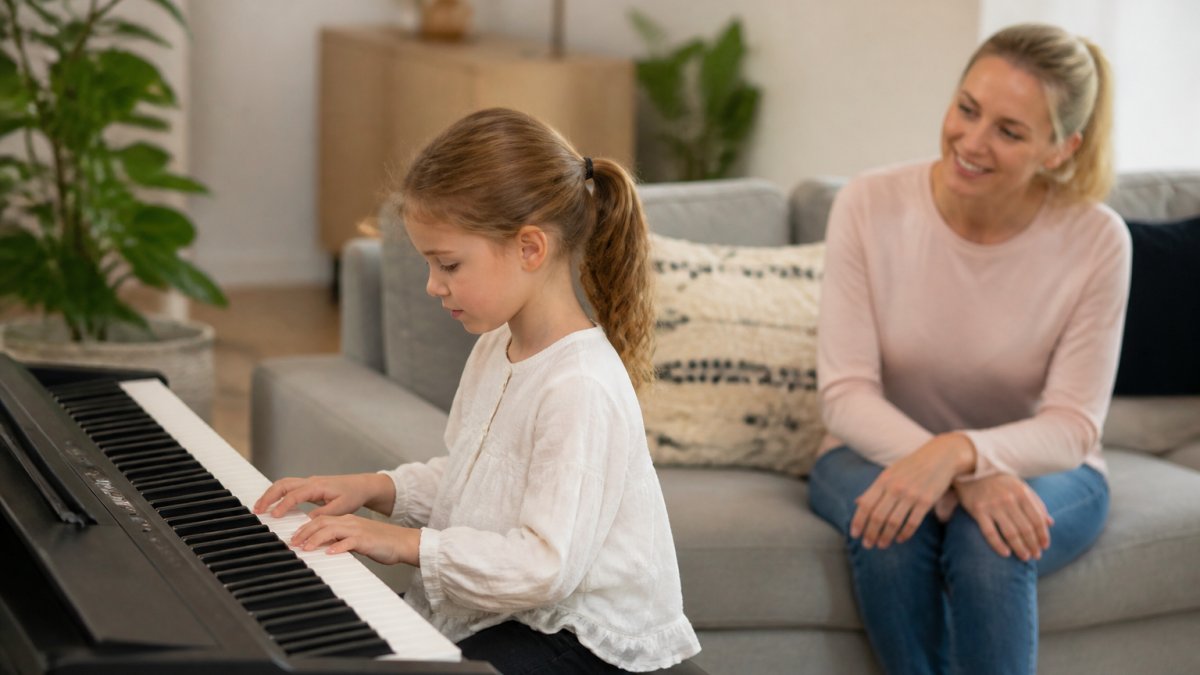
Learning an instrument asks a child to coordinate hands, eyes, ears and memory simultaneously. That demand is thought to support cognitive abilities such as attention span, concentration, memory and problem-solving. The evidence here should be read carefully: much of it shows association rather than proof that music alone causes gains.
What we can say confidently is that regular music-making builds disciplined, repeated practice habits, and those habits carry into other learning.
Language, Literacy and Numeracy
Songs teach rhythm, rhyme and repetition, which support language development and listening skills in early childhood. Counting beats and subdividing notes introduces patterns that mirror early numeracy concepts.
The mechanism is worth spelling out. When a child claps a steady beat while singing, they are holding two streams of information at once, the same divided-attention skill later used for decoding words while remembering their meaning.
Age-by-Age: What the Benefits Look Like in Practice
The benefits are not identical at every age. A rough guide, based on common patterns in early-childhood and instrumental teaching:
| Age band | What music mainly supports | Typical format |
|---|---|---|
| 0-2 years | Listening, bonding, response to rhythm and voice | Parent-and-baby singing, music playgroups |
| 3-4 years | Beat, pitch matching, turn-taking, language through song | Group rhythm and singing classes |
| 5-6 years | Following instructions, early notation, fine motor control | Small-group keyboard, ukulele, violin |
| 7-9 years | Reading notation, sustained practice, ensemble listening | Weekly lessons plus school band or choir |
| 10+ years | Self-directed practice, identity and self-expression | Private tuition, ensembles, bands |
Signs a child is ready for formal lessons include: they can sit through a short activity without constant redirection, they ask to play a specific instrument, they can follow two-step instructions, and they are comfortable being corrected. If those signs are not there yet, a group music class or singing at home is a better fit than one-to-one tuition.
Reading the Evidence Honestly
It is worth separating three claims that often get blurred together:
- Well supported: music education builds musical skill, listening, persistence and confidence in performance.
- Reasonably supported: music participation is associated with better attention, language and social outcomes, with modest effect sizes that vary by child and teacher.
- Overstated: that a set number of lessons will raise IQ by a fixed amount or guarantee better academic results.
Treat the third category with scepticism. The research supports developmental benefits across emotional, social and cognitive domains, but results depend on consistency of practice, teacher quality and the child's own interest. Music education is not a substitute for targeted academic support, but it is a genuinely useful complement to it.
Music Education and Wellbeing: Confidence, Social Skills and Self-Expression
Music education and wellbeing intersect most visibly in confidence. A child who performs a piece for the first time learns to manage nerves, take a small risk and recover from mistakes, all in a safe setting.
Self-expression matters too. Some children find it far easier to show how they feel through a piece of music than through words. That outlet is worth protecting.
Choosing an Instrument for a Child: A Practical Guide
Start with the child's size, age and temperament, not the instrument you always wished you'd played. A five-year-old will struggle with a full-size guitar; a nine-year-old may find a recorder limiting. Match the instrument to the body and the attention span in front of you.
EXTERNAL_LINK: Our guide to the best musical instruments for school kids ranks options by age, skill level and budget if you want a shortlist to work from.
Age-by-Age Readiness and Instrument Options
| Age | Readiness signs | Sensible starting options |
|---|---|---|
| 3-4 years | Sings, copies rhythms, short attention span | Rhythm games, singing, percussion |
| 5-6 years | Follows simple instructions, recognises letters | Keyboard, ukulele, violin (small sizes) |
| 7-9 years | Reads simple notation, sits still longer | Piano, guitar, flute, recorder |
| 10+ years | Self-motivated, handles frustration | Most instruments, including brass and drums |
If you are weighing up a keyboard, our first piano for kids age 5 buying guide covers digital versus acoustic, key counts and weighted keys. For guitar, our beginner acoustic guitar guide for kids explains sizing and string types before you buy.
How to Encourage Children to Practise Music Without the Battles
How to encourage children to practise music comes down to shrinking the ask and protecting the mood. Ten focused minutes daily beats a forced forty-minute session once a week. Practise at the same time each day, keep the instrument visible rather than packed away, and let your child choose the order of what they play.
A common mistake is turning practice into a performance review. Praise the effort, not just the accuracy. If interest is genuinely fading, switching to an easier instrument is not failure;
Costs, Access and Support for Music Learning in Australia
Most articles on the benefits of music education stop at the word 'benefit' and never tell you what it actually takes to make it happen. This section covers the practical side: what drives cost, where support exists, and how to keep music learning affordable without buying an instrument that fights your child.
What Drives the Cost of Music Lessons
Lesson fees in Australia vary widely, and quoting a single figure would be misleading. What you can do is understand the factors that move the price up or down:
- Format: group lessons are usually the lowest-cost entry point; one-to-one tuition costs more because it buys individual attention.
- Duration and frequency: a 30-minute weekly lesson costs less than a 60-minute one, and fortnightly lessons reduce the annual outlay.
- Teacher experience and qualifications: a tertiary-trained instrumental teacher or a specialist classroom music teacher typically charges more than a student teacher or a generalist.
A sensible approach is to ask three providers for a term-by-term breakdown before you commit, and to compare the total cost of the first year, instrument, lessons, books, accessories and any exam or ensemble fees, rather than the headline lesson price.
Instrument Access and the Cheapest Sensible Start
You do not need to buy a new instrument on day one. Options include:
- **
- School instrument programs, which often provide loan instruments for band or ensemble members.
- Second-hand instruments from reputable dealers or teachers, provided someone checks the action, tuning and condition first.
Watch out: buying the cheapest possible instrument for a beginner often backfires, because poor action or tuning makes practice frustrating and can put a child off entirely. A well-set-up second-hand instrument from a dealer is usually a better first purchase than a new bargain model.
Financial and Community Support
Support for music learning in Australia comes from several directions, and it is worth asking about each:
-
School programs: many primary and secondary schools run classroom music, choir, band or instrumental programs, sometimes with subsidised instrument hire. Ask the school music coordinator what is available before paying for private tuition.
-
Community and church music groups: low-cost or free ensembles, choirs and youth bands exist in most regions, including the Gold Coast.
-
Provider concessions: many studios offer sibling discounts, payment plans or hardship arrangements, ask directly, because these are rarely advertised.
Questions to Ask Before You Enrol
A short checklist that saves money and frustration:
- What is included in the fee, and what is billed separately?
- Is there a trial lesson or a short trial term?
- What are the teacher's qualifications and experience with my child's age group?
- What instrument size or type do you recommend, and can we hire before buying?
- What is the practice expectation between lessons?
- What happens if my child wants to change instruments?
Getting clear answers to those six questions tells you more about value than any advertised price. If you are weighing up a keyboard, our first piano for kids age 5 buying guide covers digital versus acoustic, key counts and weighted keys. For guitar, our beginner acoustic guitar guide for kids explains sizing and string types before you buy.
What to Ignore: Realistic Expectations About Music Education
Treat claims that music lessons will raise your child's IQ by a set number of points with scepticism. The research supports developmental benefits across emotional, social and cognitive domains, but effect sizes are modest and results vary by child, teacher and consistency of practice.
What you can reasonably expect is a child who listens more carefully, persists at a difficult task and has a structured outlet for self-expression. Those outcomes are worth having on their own terms.
Finding the Right Instrument at Muzic Man in Robina
Buying an instrument your child will actually play starts with getting the size, type and setup right, and that is easier with hands-on help. Visit our Robina, Queensland store to see instruments in person, or browse our online range, which ships Australia-wide. You can also contact us to ask about instruments and stock.
Frequently Asked Questions
What are the benefits of music education for children?
Music education supports cognitive development, language and literacy, memory, attention and school readiness. It also builds social skills, confidence and emotional wellbeing. Research from the University of Melbourne's Music, Education and Technology Lab indicates music education contributes to students' emotional, physical, social and cognitive growth. A systematic review published in the International Journal of Environmental Research and Public Health in 2021 also reported benefits for emotional intelligence, academic performance and prosocial skills.
At what age should a child start music lessons?
Many children are ready for structured lessons around age five to seven, when they can follow instructions and sit for short periods. Younger children benefit from singing, rhythm games and musical activities at home. Readiness varies, so watch for signs like keeping a beat, singing in tune and showing interest in an instrument. Starting with a small keyboard or ukulele keeps the commitment low while your child builds coordination and listening skills.
How often should children practise a musical instrument?
Short, regular sessions work better than one long weekly practice. For beginners, ten to fifteen minutes four or five days a week is enough to build finger strength, coordination and memory. Consistency matters more than duration. Tie practice to a fixed routine, such as after school or before dinner, and praise effort rather than perfection. If your child is preparing for a performance or exam, gradually extend sessions as their concentration grows.
What is the best instrument for a child to learn first?
The best first instrument depends on your child's age, size and interest. Keyboards and digital pianos suit children from around five or six because the layout is visual and the keys are easy to press. Ukuleles and smaller acoustic guitars work well for ages seven and up, while recorders and violins suit children who enjoy wind or string instruments. Let your child try a few options where possible, and choose a size that fits their hands and reach.
Ready to get your child started? Muzic Man stocks a wide range of branded instruments and supplies, offers Australia-wide shipping and competitive pricing, and our Robina team is on hand to help you choose the right first instrument. Get started with Muzic Man and find gear your child will be excited to play.