



7 Music Shop Expert Advice Tips for Gold Coast Buyers
Posted by Editorial Team on 30th Oct 2026
Last Updated: October 29, 2026
Quick Summary
Good music shop expert advice is specific, testable and tied to how you play, not vague praise or a push toward the priciest model. Ask about your experience level, budget and the music you want to play, and test the instrument in person before you pay.
- Play every string at the 12th fret to check action and setup quality.
- Confirm stock status, shipping timeframes, return terms and setup options before buying online.
- Ask for repair turnaround in working days, not calendar days.
- Group lessons suit the first few months; private tuition suits fixing a specific weakness.
- Ask a prospective teacher what their current students are working on.
Table of Contents
- Why Music Shop Expert Advice Still Matters on the Gold Coast
- How to Choose a Guitar: What to Check Before You Pay
- Beginner Musical Instruments: Where to Start Without Wasting Money
- Buy Musical Instruments Online Australia: A Checklist for Remote Buyers
- How to Judge Music Shop Expert Advice When You Walk In
- Repair, Setup and Maintenance: Comparing Turnaround Times Locally
- Lessons, Workshops and the Local Music Scene in Robina
- Book a Hands-On Demo at the Robina Shop
- Frequently Asked Questions
Why Music Shop Expert Advice Still Matters on the Gold Coast
Walk into any Gold Coast music shop and you'll meet two very different kinds of staff: the one who reads a spec sheet back to you, and the one who picks up the guitar and shows you why the neck matters. At Muzic Man, we've spent enough time behind the counter in Robina to know the difference is everything.
Here's the uncomfortable truth: online listings can tell you a guitar's body wood and pickup configuration. They can't tell you whether the action is set too high for a beginner's hands, or whether the fret ends will shred your fingers after twenty minutes.
Below, we'll show you exactly what to check, what to ask, and how to spot advice worth trusting, whether you're in Robina or buying from interstate.
How to Choose a Guitar: What to Check Before You Pay
Knowing how to choose a guitar comes down to three things you can test in person: body style and comfort, scale length and neck feel, and whether the setup is actually playable out of the box.
Body Style, Scale Length and Neck Feel
Start with how the guitar sits against your body. A dreadnought acoustic sounds big but feels big too, and that matters for smaller players.
Scale length affects string tension and reach. A shorter scale suits smaller hands and bends more easily. Then wrap your hand around the neck: if your thumb can't sit comfortably behind the fretboard, the neck is too chunky for you.
The In-Store Test That Reveals Setup Quality
Play every string at the 12th fret. If notes choke out or buzz, the action or truss rod needs work. Check the fret ends by running your hand along the neck edge.
If you're weighing up your first electric, our rundown of the top 10 beginner electric guitars for Australia gives you a shortlist to compare against these in-store checks.
Beginner Musical Instruments: Where to Start Without Wasting Money
The best beginner instrument is the one you'll actually practise, not the most impressive one on the wall.
A common mistake is buying the cheapest option and assuming it's a bargain.
A better approach is to set a budget you're comfortable with, then spend it on playability rather than features.
If you're still deciding which instrument suits you, our guide to the easiest instrument for a beginner to learn compares ukulele, keyboard, harmonica and more on cost and difficulty.
Buy Musical Instruments Online Australia: A Checklist for Remote Buyers
Buying musical instruments online in Australia works well when you check five things before you pay: stock status, shipping timeframes, return terms, setup options, and whether the retailer actually answers questions.
Work through this checklist before you commit:
- Confirm the item shows as in stock, not "available to order"
- Check the delivery estimate for your postcode, not just the capital cities
- Read the return policy for change-of-mind and transit damage
Remote buyers get burned most often by vague shipping promises. Our shipping times for musical instruments: Australia guide gives you realistic transit estimates to plan around.
Watch out: a listing that says "in stock" but can't confirm a dispatch date is a red flag. Ask directly before paying.
How to Judge Music Shop Expert Advice When You Walk In
Good music shop expert advice is specific, testable and tied to how you play. Vague praise ("this one's great") is not advice, it's sales patter.
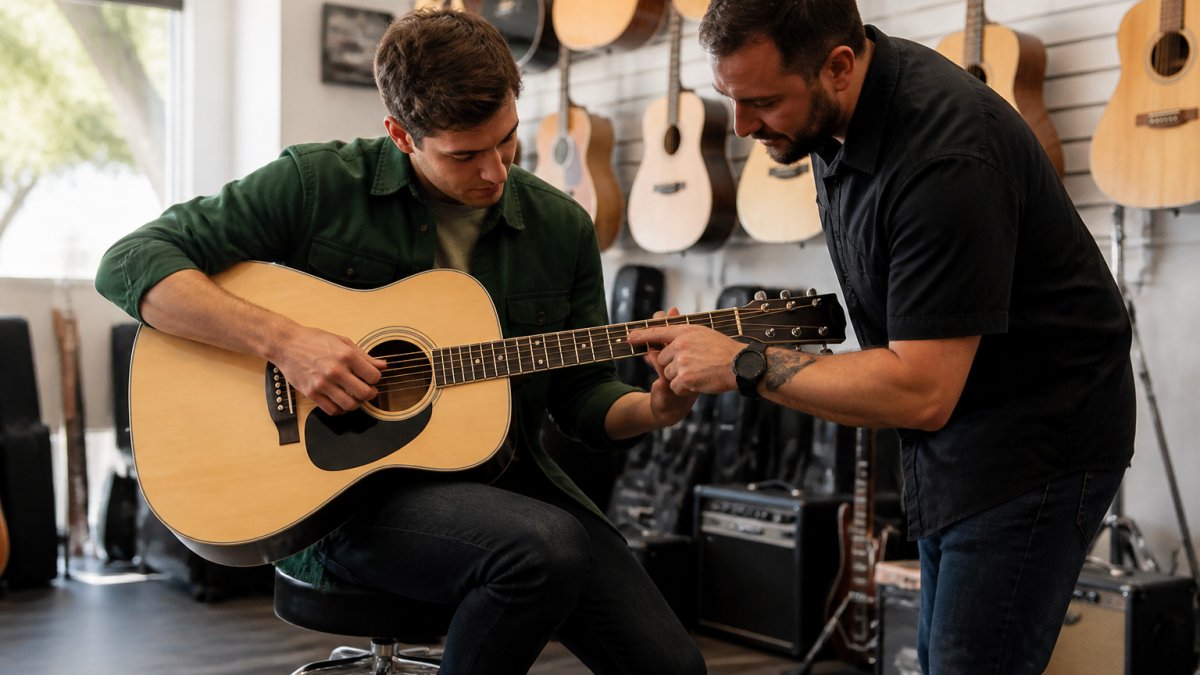
Listen for questions. A staff member who asks about your experience level, what music you want to play, and your budget is gathering information to help you.
Ask a question you already know the answer to.
Repair, Setup and Maintenance: Comparing Turnaround Times Locally
Local repair turnaround varies widely, and it's the question most buyers forget to ask until something goes wrong. Local repair turnaround varies widely, and it's worth asking about before you book.
What Actually Drives Turnaround
Turnaround is not one number. It's the sum of four stages, and knowing them lets you ask sharper questions:
- Intake and assessment, the bench looks at the instrument and confirms the fault. A truss rod adjustment and a refret both start here, but the second takes far longer to diagnose.
- Parts lead time, a standard set of strings or a common nut blank is usually on the shelf; a specific pickup, bridge or tuning machine may need ordering in, which adds days before work even starts.
- Bench time, fretwork, electronics and structural repairs are skilled, sequential jobs. A setup might be an hour; a refret is a multi-session job with drying time between stages.
A Practical Comparison Framework
Use this table to compare local services on the things that actually affect how long you're without your instrument:
| Question to Ask | Why It Matters | What to Listen For |
|---|---|---|
| What's the current turnaround? | Sets realistic expectations | A specific number of days, not "soon" |
| Is a quote given before work starts? | Avoids surprise costs | A clear yes, with contact before proceeding |
| Do you do setups on instruments bought elsewhere? | Keeps your options open | A straightforward yes |
| Are parts in stock or ordered in? | Parts lead time is the hidden delay | Honesty about what needs ordering |
| Is there a queue or a booking system? | Walk-ins and booked jobs move at different speeds | A clear intake process |
| Do you do a final setup and QC? | Skipped QC is the most common cause of a return visit | A named final check |
Matching the Job to the Right Service
Not every job needs the same provider. A quick action adjustment or a string change is a routine in-store task. Fretwork, a neck reset or structural crack repair is specialist luthier work, and the best move is to ask the shop who they send that work to rather than assume the counter handles it. Electronics faults, a scratchy pot, a dead pickup selector, sit in between: many shops handle them in-house, but a full rewire is bench time.
Maintenance That Prevents the Repair
Most repair bookings are preventable. Humidity is the quiet killer of acoustic guitars in Queensland, and the swing between a humid summer and a dry, air-conditioned room is what cracks tops and shifts necks. Humidity control helps protect an acoustic guitar between setups. On the electric side, the two habits that save the most bench time are keeping the fretboard conditioned and changing strings before they corrode, a corroded string wears frets faster and throws intonation out.
Lessons, Workshops and the Local Music Scene in Robina
Lessons and workshops are where a music shop earns its keep beyond the sale. A good local scene gives beginners a place to play with others, and that's often what keeps them going through the frustrating first year. Beginners on the Gold Coast can choose from several tuition formats, but the options are not interchangeable. Choosing the wrong format is the most common reason a beginner quits in the first term.
Private vs Group Lessons: A Decision Guide
The private-versus-group question is the one every beginner asks, and the honest answer depends on your goal, your budget and your temperament:
| Format | Best For | Trade-off |
|---|---|---|
| Private one-to-one | Players chasing a specific goal, or anyone who needs correction on technique | Higher per-session cost; you carry the full momentum |
| Small group (two to four) | Beginners testing the water who want accountability | Pace is set by the group, not you |
| Academy or school program | Structured curriculum and progress tracking | Less flexibility on repertoire and timing |
| Online tuition | Remote players or irregular schedules | Harder to correct posture and hand position remotely |
A useful rule: group formats suit the first few months, where the goal is habit and confidence. Private tuition suits the point where a player wants to fix a specific weakness, barre chords, timing, or picking accuracy, because that's where individual correction pays off.
What Separates Good Tuition from Wasted Time
Good tuition usually has a clear curriculum, tracks student progress, and mixes theory with actual playing. Beyond that, look for three things:
- A named goal per term, not "get better", but "play this song cleanly" or "pass this grade". Progress you can hear is what keeps students returning.
- Playing from lesson one, theory matters, but a teacher who front-loads notation before the student has made a sound loses most beginners.
- A performance outlet, open mics, school concerts or a shop workshop. Playing for someone else, even once, accelerates progress more than an extra practice hour.
The Local Scene as a Practice Engine
A local music scene offers more than a stage, it offers a deadline. A player with a monthly open mic to prepare for practises differently from one with no audience. Ask in-store which teachers and local nights staff recommend.
Matching the Instrument to the Lesson
One overlooked point: the instrument you buy should suit the lessons you plan to take. A student starting group ukulele classes does not need a full-size acoustic, and a student starting classical guitar needs a nylon-string instrument, not a steel-string. If you're still deciding, our guide to the easiest instrument for a beginner to learn compares ukulele, keyboard, harmonica and more on cost and difficulty, and it's worth reading before you book a term of lessons, not after.
Book a Hands-On Demo at the Robina Shop
The best way to judge advice is to test it. Pick up the instrument, play it, and see whether the person helping you can answer the questions that matter to you.
At Muzic Man, we combine a physical shop in Robina with an online store and Australia-wide shipping, so you can try gear in person or order from wherever you are.
Get in touch with our team to arrange a hands-on demo at the Robina shop and find an instrument that fits how you actually play. You can find our contact details to arrange a visit.
Frequently Asked Questions
Is it better to buy musical instruments in a shop or online?
Neither option wins outright. Playing an instrument in person tells you how the neck feels, how heavy it is and whether the setup suits you, which no photo or spec sheet can show. Buying online suits buyers who already know the model they want, or who live far from a store. A hybrid approach works well: try in store, then order the exact model online if that is where stock and delivery are easier. Check the returns policy either way.
Can a music shop help me choose an instrument for a beginner?
Yes, and this is where music shop expert advice earns its keep. Staff who play can match an instrument to the student's age, hand size and the music they actually want to play. Ask them to demonstrate the difference between two models rather than just describing it. For a child, check the instrument can be held comfortably and that a smaller scale length is available. Ask what setup work is included before you leave.
What accessories do I need when buying a new instrument?
Budget for the essentials at the same time as the instrument: a case or gig bag, a tuner, a spare set of strings, a strap and a stand. Electric players also need a cable and a practice amp. Ask whether the shop includes a setup, a tuner or a first set of strings in the deal. Picking these up together usually saves a second trip and means you can start playing the day you get home.
Can I get music equipment delivered across Australia from a Gold Coast retailer?
Yes. Muzic Man ships Australia-wide from its Gold Coast base, so buyers outside Queensland can order the same stock available in the Robina shop. Before you pay, confirm the item is genuinely in stock rather than backordered, check the estimated delivery window against any deadline you have, and read the returns policy for instruments. For anything fragile, ask how it is packed. Check the Muzic Man website for current delivery details.
Finding the right instrument shouldn't feel like a gamble. Whether you're a parent buying a first guitar, a hobbyist upgrading, or a professional after reliable gear, Muzic Man stocks quality brands, ships Australia-wide, and gives you real advice before you buy. Get started with Muzic Man and play something you'll actually keep playing.