


Best Drum Practice Pads for Quiet Practice Australia
29th Sep 2026
Table of Contents
- What Makes a Drum Practice Pad Quiet
- Best Quiet Practice Pads in Australia: Quick Comparison
- Top Quiet Practice Pads Reviewed
- Sabian Quiet Tone Mesh Pad: Best Overall for Realistic Feel
- Remo Silentstroke Practice Pad: Quietest Option for Late-Night Practice
- Evans RealFeel 2-Sided Practice Pad: Best for Beginners and Students
- RTOM Moongel Workout Pad: Best for Building Wrist Strength
- Vic Firth 6-inch Single-Sided Practice Pad: Best Budget Portable Option
- Drum Mute Pads vs Practice Pads: What's the Difference?
- Beginner Drum Rudiments Exercises to Try on Your Pad
- Best Drum Sticks for Practice Pads
- How to Choose the Right Quiet Practice Pad for Your Setup
- Frequently Asked Questions
Last Updated: September 28, 2026
What Makes a Drum Practice Pad Quiet
A quiet drum practice pad reduces noise through its surface material and its base construction, not through volume knobs or electronics. Mesh heads and soft gel surfaces absorb stick impact far better than hard rubber, and a non-slip base stops the pad rattling against a table or snare stand.
Surface Material and Acoustic Noise
Mesh and gel surfaces produce the least impact sound. Rubber pads are louder but last longer and cost less.
The three main surface types behave very differently:
- Mesh heads absorb impact and produce a soft tap rather than a crack. Tension is often tunable, so you can adjust rebound.
- Gel surfaces kill rebound almost entirely, which forces your wrists to work harder.
- Rubber pads give the most consistent stick response but transmit more impact sound into whatever they sit on.
Best Quiet Practice Pads in Australia: Quick Comparison
The table below compares the quietest options available in Australia, with surface type, size, mounting, and best use for each. Pricing depends on quantity, dates, and delivery, so check current listings before you buy.
| Pad | Surface | Size | Mounting | Quietness | Typical AU Price | Best For |
|---|---|---|---|---|---|---|
| Sabian Quiet Tone Mesh | Tunable mesh | 25 cm | 8mm threaded base | Very quiet | ~$120-$150 | Realistic snare feel |
| Remo Silentstroke | Single-ply mesh | 20 cm | 8mm threaded base | Quietest | ~$80-$110 | Late-night sessions |
| Evans RealFeel 2-Sided | Gum rubber / recycled rubber | 30 cm | Non-slip base | Moderate | ~$90-$120 | Beginners, students |
| RTOM Moongel Workout | Gel | 25 cm | Non-slip base | Very quiet | ~$70-$95 | Wrist strength |
| Vic Firth 6-inch | Soft rubber | 15 cm | 8mm threaded base | Moderate | ~$40-$60 | Budget, portability |
Top Quiet Practice Pads Reviewed
Sabian Quiet Tone Mesh Pad: Best Overall for Realistic Feel
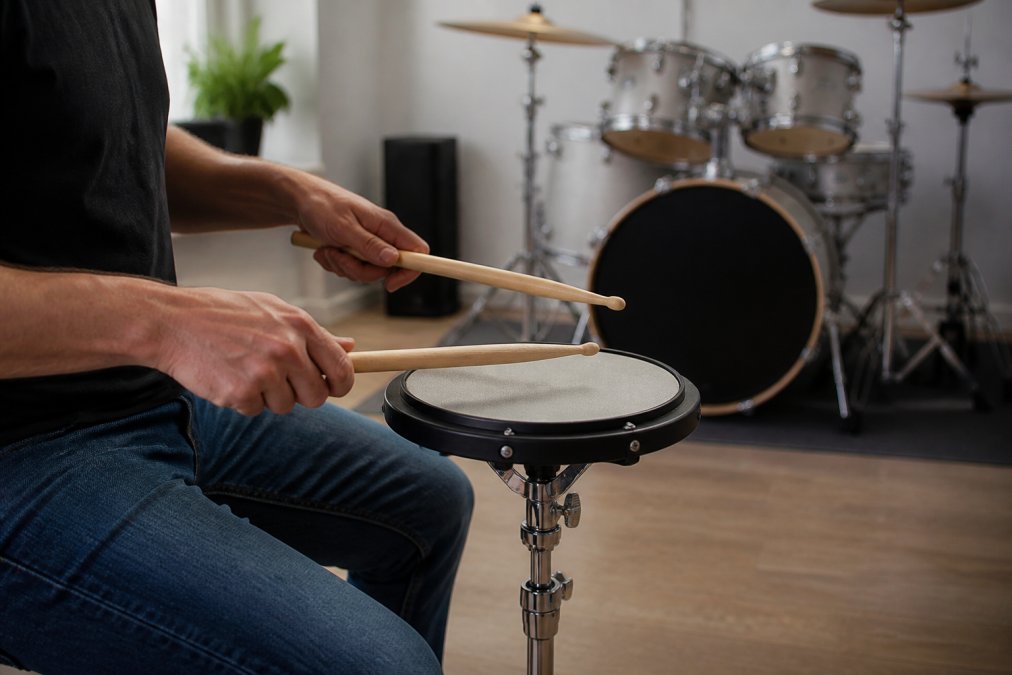
The Sabian Quiet Tone is the closest thing to practising on an actual snare without the volume. Its tunable mesh head lets you dial tension up or down, so stick response changes with your needs rather than being fixed at the factory.
Remo Silentstroke Practice Pad: Quietest Option for Late-Night Practice
If noise is the only thing that matters, this is the one. Remo's single-ply mesh produces the lowest volume of anything in this list, and the pad is light enough to move between rooms or take to a mate's place.
Evans RealFeel 2-Sided Practice Pad: Best for Beginners and Students
Two surfaces in one pad: gum rubber on one side, recycled rubber on the other. Beginners get a durable, consistent surface for rudiment work, and the non-slip base keeps it planted on a desk or table.
RTOM Moongel Workout Pad: Best for Building Wrist Strength
The Moongel Workout Pad uses a gel surface that returns almost no energy to the stick. Every stroke becomes work, which is exactly the point: you build the muscles and control that a bouncy pad lets you coast on.
Vic Firth 6-inch Single-Sided Practice Pad: Best Budget Portable Option
Small, light, and cheap to replace. The 15 cm soft rubber surface is quiet enough for a bedroom and the wooden base keeps it stable on a flat surface. It also mounts on an 8mm cymbal stand if you want it at playing height.
Drum Mute Pads vs Practice Pads: What's the Difference?
Drum mute pads sit on top of an acoustic drum to reduce its volume while you play the actual kit. Practice pads are standalone surfaces you play instead of a drum. They solve different problems.
Beginner Drum Rudiments Exercises to Try on Your Pad
Start with the single stroke roll, then the double stroke roll, then the paradiddle. Those three cover most of what a beginner needs for the first few months, and all three work on any pad surface.
A simple 15-minute routine:
- 5 minutes: single stroke roll, slow, with a metronome. Focus on even volume between hands.
- 5 minutes: double stroke roll. Keep the second stroke as strong as the first.
- 5 minutes: paradiddles, then accent the first note of each grouping.
Best Drum Sticks for Practice Pads
Medium-weight 5A or 7A sticks in wood tips suit most practice pad work. Heavier sticks build strength faster, but they also change your technique, so use them deliberately rather than by default.
How to Choose the Right Quiet Practice Pad for Your Setup
Match the pad to your living situation first, then your playing goals. Noise tolerance decides the surface; technique goals decide the rebound. But the decision does not stop at the pad itself, the two factors most buyers overlook are how vibration travels through your floor and how quickly you can get the pad in your hands.
Step 1: Acoustic Vibration Isolation (The Gap Most Guides Miss)
Airborne sound from a practice pad is only half the problem. The other half is structure-borne vibration, the low-frequency thump that travels through your floor, into the building frame, and into the unit below. This is the usual reason a downstairs neighbour complains, even when they cannot hear the stick impact itself.
- Foam isolation pads under the practice pad or snare stand break the direct contact between the stand and the floor. Closed-cell foam or dense acoustic foam works better than soft sponge.
- A DIY riser, a sheet of MDF or plywood on top of four tennis balls or isolation feet, decouples the whole setup from the floor. This is the same principle used under washing machines and subwoofers.
- A thick rug or drum mat helps with high frequencies but does little for low-frequency thump on its own. Use it in combination with foam or a riser, not instead of one.
- Rubber feet on the stand reduce rattling but do not isolate vibration. They are a starting point, not a solution.
Step 2: Match the Pad to Your Living Situation
- How loud can you be? Units, shared walls, or late-night practice point to mesh or gel. Detached house with tolerant housemates opens up rubber.
- What is your level? Beginners want medium rebound and a surface at least 20 cm across. Advanced players can go smaller or lower-rebound.
- Where will it sit? Tabletop use needs a non-slip base. Stand mounting needs a pad with a threaded underside (8mm is the common Australian standard).
- Do you travel with it? A 15 cm pad or a strap-on knee pad fits a gig bag; a 25 cm mesh pad does not.
- What is your budget? Rubber pads cost less and last longer. Mesh and gel cost more and run quieter.
Step 3: Local Logistics for Queensland Buyers
If you are hunting the best drum practice pads for quiet practice Australia has to offer in Robina or the wider Gold Coast, the practical question is not just which pad, but how fast you can get it and whether you can try it first. Rebound is a personal thing, and ten seconds with a stick tells you more than any product description.
- Click-and-collect from a Gold Coast music shop means you can order online and pick up the same day, avoiding shipping delays.
- Australia-wide shipping from Queensland-based retailers typically reaches Brisbane, Sydney, and Melbourne in a few business days, but regional and remote areas can take longer.
- In-store testing lets you compare a mesh pad against a rubber pad side by side, which is the only reliable way to judge rebound and noise for your own playing style.
Frequently Asked Questions
What is the best drum practice pad for quiet practice?
Mesh-head pads like the Sabian Quiet Tone or Remo Silentstroke are the quietest options, producing very little acoustic noise compared to rubber pads. They also offer adjustable tension for realistic rebound. For apartment dwellers or late-night practice, a mesh pad on a snare stand is the best choice for quiet practice pads.
Is there a way to practice drums quietly?
Yes. Use a practice pad with a mesh or soft rubber surface, which reduces impact sound significantly. You can also mount it on a snare stand for better ergonomics. Pairing a quiet pad with lighter drum sticks further lowers volume. These methods let you work on rudiments and technique without disturbing neighbours.
What are some good quiet pads for drum sets?
For drum set practice, consider mesh-head pads like the Sabian Quiet Tone or Remo Silentstroke. These mimic the feel of a snare while staying very quiet. The Evans RealFeel 2-Sided pad offers two surfaces for varied rebound. Gel pads such as the RTOM Moongel Workout Pad are extremely quiet but have low rebound, ideal for strength training.
What is the quietest drum practice pad available in Australia?
The Remo Silentstroke Practice Pad is among the quietest, thanks to its single-ply mesh head. The Sabian Quiet Tone Mesh Pad is also very quiet and tunable. Both are available from Australian retailers. For the absolute lowest volume, a mesh pad combined with light sticks works best.
How can I practice drums quietly in a Gold Coast apartment?
Choose a mesh practice pad and place it on a stand with a non-slip base to reduce vibration transfer. Avoid practicing on hard floors directly; use a rug or mat. Keep sessions to reasonable hours. For local advice, visit Muzic Man in Robina to try pads in person.