


First Piano for Kids Age 5: Australia Buying Guide 2026
3rd Oct 2026
Table of Contents
- Quick Comparison: First Piano Options for 5-Year-Olds
- Why Age 5 Is the Sweet Spot for Starting Piano
- Digital Piano vs Acoustic for Beginners: Which Suits a 5-Year-Old?
- The Benefits of Weighted Keys for Children
- A Piano Practice Routine for 5-Year-Olds That Actually Sticks
- Vetting a Local Music School and Choosing a Teacher
- Common Mistakes Parents Make Buying a First Piano
- Frequently Asked Questions
Last Updated: October 2, 2026
Quick Comparison: First Piano Options for 5-Year-Olds
Choosing a first piano for kids age 5 in Australia comes down to three realistic options, and the right pick depends on your budget, floor space and how long you expect the instrument to last.
| Option | Best For | Key Feature | Watch Out For |
|---|---|---|---|
| 61-key digital keyboard | Tight budgets, small flats | Light, portable, headphone jack | Unweighted keys limit technique |
| 88-key digital piano | Long-term learning | Weighted, touch-sensitive keys | Heavier, needs a stand |
| Acoustic upright | Committed families | Real string resonance | Tuning, volume, footprint |
For most five-year-olds, an 88-key digital piano with weighted keys is the strongest long-term buy.
Below, we'll show you exactly how to weigh up space, volume and maintenance before you commit, plus how to vet a teacher and avoid the mistakes that leave an unused keyboard gathering dust.
Why Age 5 Is the Sweet Spot for Starting Piano
Age five sits in a genuine sweet spot for beginner piano lessons because it's when a child's hands are big enough to reach the keys and their attention span is long enough to sit through a short session.
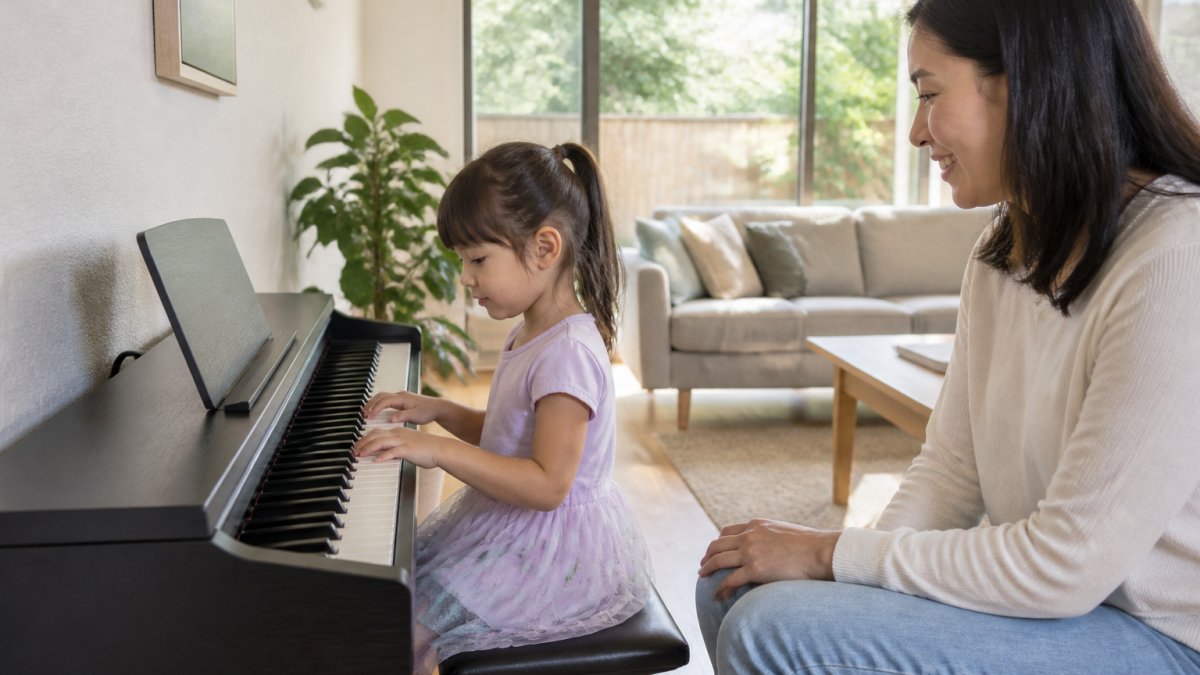
Motor Skills, Memory, and Confidence: What Piano Develops at Five
Music pedagogy research consistently points to the same cluster of gains. Playing piano at five develops fine motor skills, because each finger moves independently.
A common mistake is treating these as abstract benefits. In practice, they show up in concrete ways: a child who can coordinate two hands on a simple tune often finds handwriting and ball skills easier too.
Digital Piano vs Acoustic for Beginners: Which Suits a 5-Year-Old?
For most five-year-olds, a digital piano beats an acoustic for the first two or three years. A digital instrument stays in tune permanently, can be played silently through headphones, and costs far less to own and maintain. An acoustic upright only wins once a child is genuinely committed and the household can live with the noise, the footprint and the tuning schedule.
The gap most buying guides miss is that "digital piano" covers a wide spectrum, and the differences matter enormously for a five-year-old's technique.
The three digital categories that matter
- Portable keyboard (61 keys, synth action). Light, cheap, runs on batteries or a power point. Keys are springy and unweighted, so a child learns to tap rather than press. Fine as a trial instrument for a term, but it will hold back hand development if it becomes the long-term piano.
- Portable digital piano (88 keys, weighted or graded hammer action). The sweet spot for most families. It has the full key range, a realistic action, and can sit on a stand or a furniture-style cabinet. This is the category most teachers will steer you towards for a five-year-old.
- Cabinet digital piano (88 keys, weighted action, built-in stand and pedals). Looks and feels closest to an acoustic upright, with three pedals and a proper music rest at the right height. Heavier and less portable, but it removes the "it's just a keyboard" objection some children raise.
Acoustic uprights: when they make sense
An acoustic upright is the right call when the child is already practising without being asked, the household has a dedicated spot away from windows and heating, and someone is prepared to book a tuner at least once a year. In coastal Queensland, humidity swings push that towards twice a year in some homes. A piano that drifts out of tune teaches a five-year-old to accept wrong pitch as normal, which is the opposite of what you want in the first two years.
Space, volume and maintenance in an Australian home
Australian homes vary enormously, from compact Brisbane units to Queenslanders with a spare room. An acoustic upright needs roughly a metre and a half of wall, clearance behind for the soundboard, and a stable spot away from direct sun, air-conditioning vents and heaters.
A digital piano sidesteps most of that. It needs a power point, a stand and about the footprint of a small desk.
What to test in the shop
Take your child with you and watch three things. First, can they reach an octave comfortably? Most five-year-olds cannot, and that is normal, but the keys should not feel so wide that a five-finger position strains the hand. Second, does the action return quickly enough for repeated notes?
If you cannot try before you buy, look for a retailer that offers a change-of-mind or trade-in path.
The Benefits of Weighted Keys for Children
Weighted keys matter for children because they build correct finger strength and control from the very first lesson. A weighted action mimics the resistance of an acoustic piano, so a child learns to press rather than tap. On a light, springy keyboard, bad habits form fast and are hard to undo.
The benefits of weighted keys for children come down to three things:
- Finger strength. Resistance trains the small muscles in the hand and forearm.
- Dynamic control. A child learns to play softly and loudly on purpose, which is the basis of musical expression.
- Transfer. Skills built on weighted keys carry over to any acoustic piano later.
A useful middle ground for a five-year-old is a graded, hammer-action digital piano. It's heavier than a synth-action keyboard but lighter than a full acoustic action, which suits small hands while still building strength.
Key Count: Is 61 Keys Enough or Do You Need 88?
Sixty-one keys is enough for the first year or two of beginner piano lessons, but 88 keys is the better long-term investment. Most beginner method books stay in the middle of the keyboard, so a 61-key instrument covers early repertoire fine.
If you're buying once and want it to last, choose 88 keys. If space or budget is tight and you expect to upgrade later, 61 is a reasonable starting point.
A Piano Practice Routine for 5-Year-Olds That Actually Sticks
A practice routine for 5-year-olds works best when it's short, predictable and daily rather than long and occasional. Ten to fifteen minutes, five days a week, beats a single 45-minute session.
Structure each session the same way so the child knows what's coming:
- Warm-up (2 minutes). Five-finger exercises or a simple scale.
- Review (3 minutes). Play last week's piece once, slowly.
- New material (5 minutes). Work on the current piece in small chunks.
- Free play (2 minutes). Let them improvise or play a favourite tune by ear.
Keep a sticker chart or a simple tally. Five-year-olds respond to visible progress, and a full week of stickers is its own reward. Sit nearby for the first few weeks, then step back as the routine takes hold.
Vetting a Local Music School and Choosing a Teacher
Vetting a music school comes down to three checks: qualifications, teaching style and a trial lesson. Ask what training the teacher holds, whether they've worked with five-year-olds specifically, and whether they teach music theory alongside playing. A teacher who only teaches by rote will leave gaps in reading and ear training.
What qualifications actually mean in Australia
Australia does not license private music teachers, so anyone can hang out a shingle. That makes the qualification question more important, not less. Useful signals include:
- A degree or diploma in music or music education from an Australian university or conservatorium.
- A teaching qualification (for example a Bachelor of Education) alongside musical training, which usually means the teacher has studied how young children learn.
- Membership of a professional body such as the Australian Society for Music Education, or registration with a state-based music teachers' association.
- For exam-focused teaching, familiarity with the Australian Music Examinations Board (AMEB) syllabus and its graded structure.
None of these guarantees a good fit with a five-year-old. What they do is separate a trained teacher from someone who plays well and has decided to teach.
Lesson formats for a five-year-old
At five, lesson length matters more than most parents expect. A 30-minute private lesson is the standard starting point; 45 minutes is usually too long for a child who has not yet built the attention span.
Ask how the school handles the first term. A good early-childhood teacher will spend the first few weeks on rhythm games, singing, clapping and keyboard geography before expecting a child to read notation at the piano.
The vetting checklist
Use this before you enrol:
- Does the teacher hold a recognised music qualification or pedagogy training?
- Do they have experience with early childhood music education, not just adult beginners?
- Is there a trial lesson or a short introductory term?
- How many students per lesson, and is it private tutoring or a group class?
- Do they prepare students for AMEB exams, or teach for enjoyment, or both?
- Can you sit in on the first few lessons?
- What is the make-up lesson policy if a child is sick?
- Do they require a minimum term commitment, and what happens if the child wants to stop?
Watching a lesson
If you're searching for a music school near me in Robina or the wider Gold Coast, visit in person and watch a lesson if you can. You're judging the teacher's patience and how they keep a five-year-old engaged, not just their playing. Look for a teacher who gets down to the child's eye level, who uses movement and singing, and who praises effort rather than talent.
Common Mistakes Parents Make Buying a First Piano
The biggest mistake parents make is buying a toy keyboard with unweighted, undersized keys. It looks like a bargain, but a five-year-old learns the wrong finger pressure and has to relearn everything on a real instrument. The second most common error is buying an acoustic piano before you know the child will stick with it.
Other traps worth avoiding:
- Ignoring the action. A keyboard that plays only loud or soft, with no in-between, limits expression from day one.
- Skipping the stand and bench. Playing at the kitchen table wrecks posture and hand position.
- Buying for the child you hope they'll become. Match the instrument to the next two years, not the next ten.
- Forgetting headphones. In a shared house, silent practice is what keeps the habit alive.
If you want to compare options in person, visit the Gold Coast shop to try the keys yourself before you commit.
Frequently Asked Questions
Is a digital piano or acoustic piano better for a 5-year-old beginner?
For most five-year-olds, a digital piano with weighted keys is the more practical first instrument. It stays in tune, has a volume control for shared living spaces, and costs less to maintain than an acoustic. An acoustic piano suits families who already own one or want the fullest tone from day one. Either way, the keys should feel weighted so your child builds proper finger strength from the start.
What features should I look for in a first piano for a child?
Prioritise weighted or hammer-action keys, a minimum of 61 keys (88 is ideal for long-term progress), a headphone jack for quiet practice, and a sturdy stand at the right height. Touch sensitivity matters too, so quiet and loud playing produce different sounds. Brands like Yamaha and Roland make beginner-friendly digital pianos that meet these criteria and are widely stocked across Australia.
Do I need a full-sized 88-key piano for a 5-year-old?
Not immediately. A 61-key digital piano covers the range most beginner methods use in the first year or two. However, if you want an instrument that lasts through to intermediate grades, an 88-key model avoids an upgrade later. Weighted keys matter more than key count at this stage, because they shape technique from the very first lesson.
Are weighted keys necessary for a child just starting piano lessons?
Weighted keys are strongly recommended. They mimic the resistance of an acoustic piano, so your child develops finger strength, control, and dynamics rather than pressing light, springy keys. Children who practise on weighted keys transition to an acoustic piano without relearning their touch. The benefits of weighted keys for children show up most clearly once formal lessons begin.
What are the benefits of starting piano lessons at age 5?
At five, children are developing fine motor skills, memory, and the ability to follow structured instructions. Piano lessons tap into all three, building hand coordination, listening skills, and confidence through small, achievable wins. A short daily practice routine of 10 to 15 minutes is enough at this age, and the habit pays off as pieces get more complex.
How much space do I need for a beginner piano at home?
A compact digital piano on a stand needs roughly 1.3 to 1.5 metres of wall space, plus room for a stool and for your child to sit comfortably. Acoustic uprights take up more depth and should sit away from direct sunlight and heating vents. Measure your intended spot before buying, and check the assembled dimensions listed for the model you are considering.
Finding the right first piano for a five-year-old is really about matching the instrument to your home, your budget and your child's attention span, not chasing the most expensive model on the shelf. Muzic Man stocks a wide range of branded digital pianos and keyboards, ships Australia-wide, and gives you the chance to try before you buy at the Robina shop. Get started with Muzic Man and give your five-year-old an instrument they can grow into, backed by expert advice and reliable delivery.