

Convenient Online Shopping for Music Education Supplies
5th Oct 2026
Table of Contents
- Why Online Shopping for Music Education Supplies Saves Time and Money
- What Belongs on a Music Classroom Instrument Checklist
- Matching Music Classroom Supplies to Curriculum Requirements
- A Step-by-Step School Music Equipment Ordering Guide
- Choosing an Online Musical Instrument Shop in Australia
- Delivery, Collection and Order Support in Robina
- Checking Product Suitability, Quality and Returns Before You Buy
- Frequently Asked Questions
Last Updated: October 5, 2026
Why Online Shopping for Music Education Supplies Saves Time and Money
A convenient online shopping experience for music education supplies is the practice of browsing, comparing and ordering classroom instruments and resources through a retailer's website, then having them delivered to the school or collected locally. A 2026 report from the OECD's Education at a Glance notes that schools increasingly expect staff to source learning materials outside traditional paper catalogues, and music departments feel that pressure most when instruments must be replaced mid-term.
The time saving is not about the clicking. It is about what you stop doing: chasing quotes by phone, driving between stores, and re-keying the same order into three systems.
What Belongs on a Music Classroom Instrument Checklist
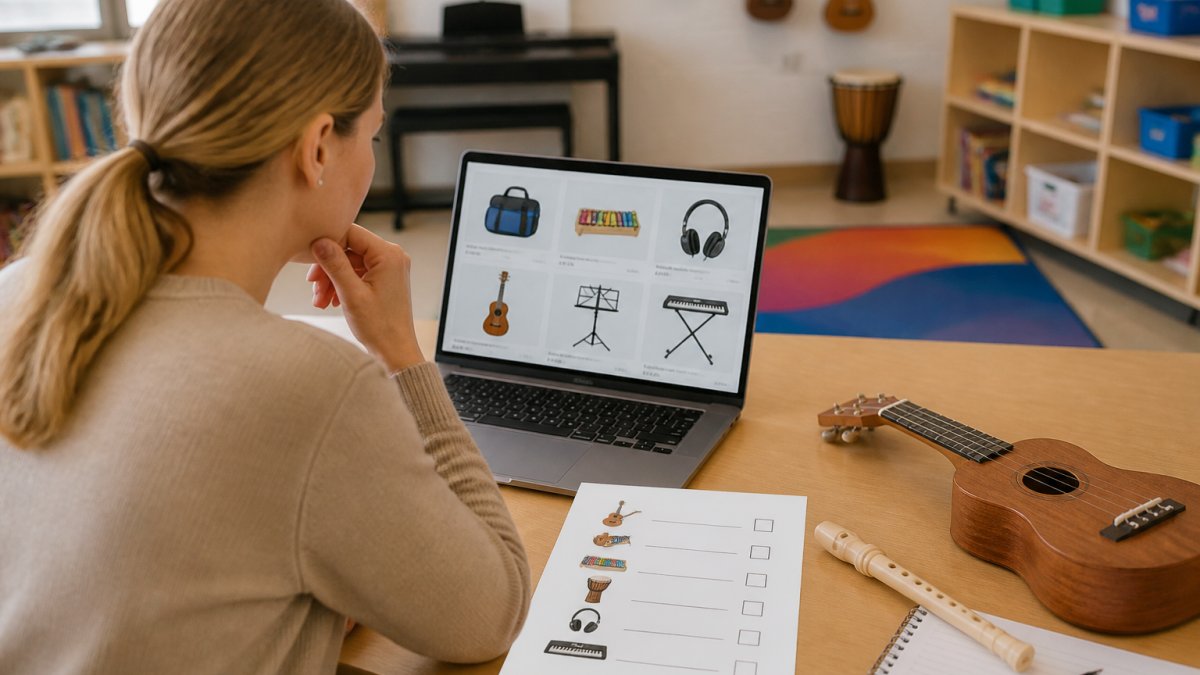
A music classroom instrument checklist is a term-by-term list of the instruments, consumables and accessories a school needs, grouped by year level and curriculum unit. Build it once, review it each term, and ordering becomes a fifteen-minute job.
Core Instruments for Primary and Secondary Classes
Primary programs lean on classroom sets: ukuleles, recorders, xylophones and glockenspiels, hand percussion, and tuned tubes. Secondary programs shift toward ensemble and individual instruments: guitars, keyboards and digital pianos, orchestral strings, brass and woodwind, plus amplifiers and PA gear. The right mix depends on student numbers and storage.
Consumables and Accessories Teachers Reorder Every Term
These are the items that quietly run out mid-lesson: reeds, strings, valve oil, rosin, drumsticks and mallets, cleaning cloths, music stands, manuscript paper, tuners and metronomes, and instrument cases for loan sets. Reorder them in one batch at the start of term.
Matching Music Classroom Supplies to Curriculum Requirements
Music classroom supplies should be chosen to serve the units your students actually study, not the other way around. The Australian Curriculum, Assessment and Reporting Authority publishes the content descriptions that tell you which skills each year level must develop, whether that is keeping a steady beat, reading notation, or performing in an ensemble.
Read those descriptions before you buy. If Year 4 focuses on rhythm and ensemble playing, a class set of percussion and a few ukuleles does more work than one expensive instrument. If senior students are preparing performance assessments, invest in the instruments they will play on stage.
| Year Level | Curriculum Focus | Priority Supplies |
|---|---|---|
| Prep to Year 2 | Beat, pitch, singing | Hand percussion, recorders, tuned tubes |
| Years 3 to 6 | Ensemble, notation basics | Ukuleles, xylophones, music stands |
| Years 7 to 10 | Instrument technique, performance | Guitars, keyboards, orchestral strings |
| Senior (QCAA) | Performance and composition | Ensemble instruments, amps, PA gear |
A Step-by-Step School Music Equipment Ordering Guide
A school music equipment ordering guide removes the two biggest sources of delay: unclear approvals and incomplete paperwork. These steps work for a single classroom order or a whole-department restock.
- Build your list against the curriculum. Note year levels, quantities and any instrument sizes or models already in use.
- Confirm your budget and approval path. Most schools require a purchase order raised before an order is placed, so check who signs off and at what threshold.
- Browse the online store and compare products. Check specifications, materials, availability and delivery timeframes for each item.
- Save and review your cart. Confirm quantities, check that accessories match the instruments, and look for anything on backorder.
- Submit your purchase order details. Provide the PO number, school name, delivery address and a contact for delivery day.
- Confirm payment and receive order confirmation. Keep the confirmation email for your finance records.
- Track delivery and check items on arrival. Open boxes promptly, test instruments, and report any damage or shortage straight away.
Purchase Orders, Approvals and Payment Security
School purchase orders are the standard mechanism for school music program purchasing, and most online retailers accept them alongside card payment. Before you commit, confirm three things: that the retailer accepts school purchase orders, the delivery timeframe for your area, and how they handle returns or damaged items. Check that the checkout uses an encrypted connection and that the privacy policy explains how your details are stored.
Choosing an Online Musical Instrument Shop in Australia
An online musical instrument shop in Australia should be judged on range, stock accuracy, delivery reliability and support, not homepage design. A store with a real shopfront offers hands-on selection and expert advice a warehouse-only operation cannot. For a school program, you need a supplier who understands purchase orders, term-time deadlines and the instruments Queensland classrooms actually use.
Use these criteria to compare options, and treat each as a question you can put to the retailer directly:
- Product range and availability. Does the store carry the brands and sizes your program needs, and does it show live stock? A site that cannot confirm a dispatch date is a risk during term-time restocking.
- Educational pricing and value. Ask about education pricing, bulk purchasing and wholesale instruments for larger school orders. For class sets, 25 ukuleles, 30 recorders, a full percussion trolley, the per-unit difference between retail and education pricing is where the real saving sits.
- Purchase order support. Can they process a school purchase order, invoice the school directly, and quote a PO number on the invoice so your finance team can reconcile it?
How to Verify a Retailer Before You Commit
A short verification routine saves a term of frustration. Before placing a school order:
- Confirm the business is Australian. Check for an Australian Business Number (ABN) and a physical address. An Australian presence matters for warranty claims, returns freight and consumer guarantees under the Australian Consumer Law.
- Read the returns and warranty policy in full. Australian Consumer Law guarantees apply to goods bought online, including your right to a remedy if an item is faulty, not as described, or unfit for purpose (Repair, replace, refund, cancel).
- Check the privacy and payment pages. Confirm the checkout uses an encrypted connection and that the privacy policy explains how school and staff details are stored. Never send card details by email.
- Ask a curriculum question. A supplier who can talk about year levels, ensemble needs or instrument sizing is more useful than one who only quotes a price.
- Request a written quote for larger orders. A quote locks in pricing and lead time, and gives your finance team something to attach to the purchase order.
Muzic Man stocks many branded musical instruments and equipment, offers Australia-wide shipping, and runs a physical music shop on the Gold Coast for customers who want to try before they buy. For schools, that means browsing online, ordering against a purchase order, and still sending a staff member to inspect an instrument in person if a decision is tight.
Delivery, Collection and Order Support in Robina
Delivery, collection and order support in Robina come down to two questions: how fast can it arrive, and who do you call if something goes wrong? For schools in Robina and across the Gold Coast, a local retailer shortens both the delivery window and the distance to a real counter. Robina sits roughly 15 to 20 minutes by car from the coast's main retail and education precinct, so a Gold Coast-based supplier can often reach a Robina school campus faster than a national warehouse dispatching from interstate.
Delivery to Robina Schools
Delivery timeframes vary by destination and stock status, so confirm yours at checkout before you rely on a date. A few practical points for Robina orders:
- Dispatch versus delivery. Ask whether the timeframe quoted is dispatch (when the item leaves the warehouse) or delivery (when it reaches the school). The two can differ by several days for bulky items such as digital pianos or PA gear.
- Bulky and fragile items. Large instruments and amplifiers may ship by a freight carrier rather than a parcel service, which can mean a booked delivery window rather than an unattended drop-off. Confirm whether someone needs to be on site to receive it.
- Term-time timing. Stock on popular classroom items moves quickly at the start of each Queensland school term. Order at least a few weeks ahead, and build in a buffer for backordered items.
Collection from the Gold Coast Shop
If you are close enough, collection from the Gold Coast shop lets you pick up the same day and check the instrument before it goes into a classroom. For a Robina school, collection is worth considering when:
- You need an instrument urgently and cannot wait on freight.
- You want to inspect a class set, checking ukulele sizing or recorder tuning, before committing to a bulk order.
- You are ordering a single high-value item and would rather carry it yourself than risk transit damage.
Before travelling, confirm the item is in stock and ask the store to hold it under your name or purchase order number. A quick call avoids a wasted trip.
Order Support After Checkout
Order support matters most when something is missing or faulty, so save your order number and confirmation email, and raise the issue as soon as boxes are opened. A routine for Robina schools:
- Check the delivery against the packing slip on the day it arrives, not at the end of the week.
- Test instruments promptly. Play a few notes, check tuning hardware and confirm accessories are present.
- Report damage or shortages immediately by phone or email, quoting the order number and purchase order.
- Keep the packaging until you are satisfied, in case an item needs to be returned.
- Record the outcome against your purchase order so your finance team has a complete paper trail.
Australian Consumer Law guarantees apply to goods bought online, including your right to a remedy if an item is faulty, not as described, or unfit for purpose. A retailer who explains how they handle these claims up front is easier to work with.
Checking Product Suitability, Quality and Returns Before You Buy
Product suitability checks separate a good order from a return. Before you buy, read the full specification: materials, dimensions, weight, recommended skill level and what is included in the box.
For instruments handled by students, prioritise build quality over appearance: reinforced joints, quality tuning hardware and a finish that will survive a school term.
Returns are where online buying earns its reputation.
Music programs run on tight budgets and tighter timetables, and a missed order can mean a term without instruments. Browse the online store to compare products and place your order, or get in touch with our team for help matching supplies to your curriculum.
Frequently Asked Questions
How can teachers choose suitable music education supplies online?
Start with the age group and the skills you are teaching, then filter by instrument type and size. Check that listings state the materials, recommended student age and what is included in the pack. Read the product description for curriculum links and look for clear photos of the actual item. If a listing is vague about dimensions or contents, contact the retailer before ordering. A convenient online shopping experience for music education supplies depends on listings giving you enough detail to judge suitability without handling the item first.
What should schools check before placing an online music equipment order?
Confirm the purchase order number, approved budget and delivery address before you start. Check stock status on each line item, because an item showing as available can still sell out between ordering and dispatch. Review the returns window and whether opened instruments can be returned. For a school music equipment ordering guide, the practical checks are: quantities against your class list, whether consumables need reordering each term, and who on staff will receive the delivery.
How can you confirm instruments and classroom resources suit students' ages?
Match the instrument to the year level rather than the student's enthusiasm. Recorders, ukuleles and small percussion suit primary classes; larger brass, woodwind and full-size guitars suit secondary students who can manage the weight and reach. Check listed dimensions in centimetres and weight in kilograms, and look for adjustable straps or stands where relevant. Where a listing gives a recommended age range, treat it as a starting point and confirm with the retailer if you are ordering for a mixed-age group.
What should you check about delivery and returns when ordering music supplies online?
Check the dispatch timeframe, the delivery options available and whether shipping costs are calculated at checkout or quoted separately. For school orders, confirm whether someone needs to be on site to receive the delivery. Read the returns policy for change-of-mind and faulty-item conditions, and note the timeframe for lodging a return. If you are ordering for a specific term start or event, ask about order support and confirm the expected arrival date in writing before you pay.