


Stratocaster vs Telecaster Playability Differences
4th Oct 2026
Table of Contents
- Stratocaster vs Telecaster: Quick Playability Comparison
- Stratocaster vs Telecaster Bridge Feel: Tremolo vs Fixed
- Fender Guitar Neck Profiles Explained: Which Fits Your Hand?
- Body Contours, Weight and Comfort Over a Long Set
- How the Body Shape Changes Your Playing Technique
- How to Choose Your First Professional Grade Instrument
- Conclusion: Which Fender Suits Your Hands and Style?
- Frequently Asked Questions
Last Updated: October 3, 2026
Stratocaster vs Telecaster: Quick Playability Comparison
The Fender Stratocaster vs Telecaster playability differences come down to body contours, bridge design, and neck shape: the Stratocaster's carved body and tremolo bridge suit players who move around the instrument, while the Telecaster's slab body and fixed bridge reward players who want stability and resistance.
Pick up both in the same sitting and the difference is physical before it is tonal: the Stratocaster curves against your ribs and forearm, while the Telecaster sits flat and solid. Neither is better, they ask different things of your body.
Below, we cover bridge feel, neck profiles, body contours, and how each shape changes your technique.
| Feature | Stratocaster | Telecaster |
|---|---|---|
| Body contour | Carved belly and forearm cuts | Flat slab body |
| Bridge type | Synchronised tremolo | Fixed string-through-body |
| Pickup selector | 5-way blade | 3-way blade |
| Neck profile | Modern 'C' | Modern 'C' |
| Best for | Movement and versatility | Stability and simplicity |
Stratocaster vs Telecaster Bridge Feel: Tremolo vs Fixed
The Stratocaster's synchronised tremolo is a six-screw, spring-balanced system: strings pull against two or three tension springs in a rear cavity, and the bridge plate pivots on those screws. That balance point changes everything under your picking hand. The Telecaster's bridge is a fixed, string-through-body plate, strings pass through ferrules and anchor at the saddles, with no springs and no pivot.
String tension and picking resistance
On a floating Stratocaster tremolo, the springs absorb part of your picking energy, giving a softer, more elastic feel, and the bridge plate dips toward the body when you strum hard or rest your palm on it. The Telecaster's string-through-body design anchors each string into the wood, so the same force meets a rigid response, percussive attack rather than bloom. If you play with a heavy right hand, that resistance feels reassuring rather than restrictive.
Tuning stability and palm muting
Tuning stability favours the Telecaster: with a fixed bridge, bending one string does not pull the others sharp, because there is no shared spring tension to redistribute. On a floating Stratocaster, a big bend on the G string flattens the other strings slightly, audible when you hold a chord and bend a note inside it. Palm muting is also more predictable on the Telecaster, since your hand rests on a solid plate rather than a spring-loaded one.
The Australian climate factor
Queensland and northern New South Wales experience high humidity through summer, and humidity swells timber. On a floating tremolo, that swelling can change the bridge plate angle and throw the spring balance out, so a guitar set up in a dry winter drifts sharp or flat once the wet season arrives. A fixed Telecaster bridge is far less sensitive because there is no spring balance to upset.
Fender Guitar Neck Profiles Explained: Which Fits Your Hand?
Fender guitar neck profiles explained simply: the profile is the shape of the back of the neck, and it determines how much of your hand wraps around the wood.
The modern 'C' suits most hands because it fills the palm without forcing your thumb into an awkward position.
Fretboard radius matters just as much. The Player series uses a 241.3 mm (9.5-inch) radius, flat enough for bending without fretting out, curved enough for comfortable open chords.
Body Contours, Weight and Comfort Over a Long Set
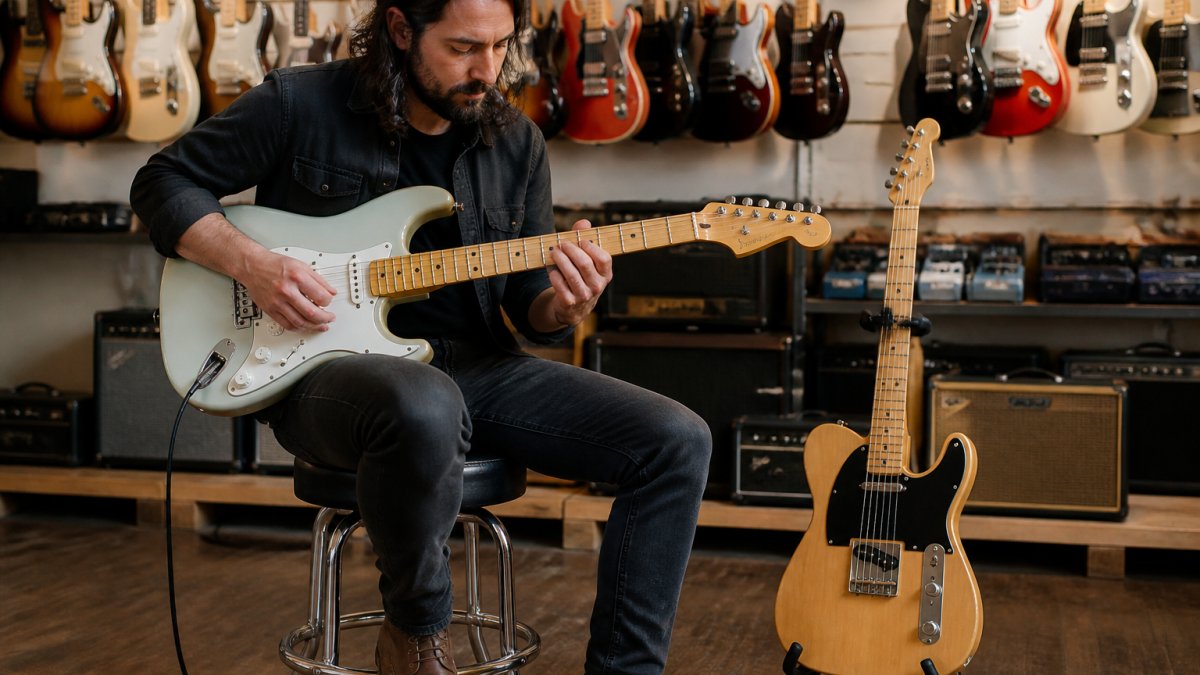
Body contours decide how a guitar feels after an hour, not after five minutes. The Stratocaster's carved belly cut and forearm contour let it sit closer to your body without digging into your ribs or strumming arm.
Weight and balance
Weight is broadly comparable, both typically sit around 3.2 to 3.8 kilograms depending on body wood and hardware, so the deciding factor is shape and balance rather than mass. The Stratocaster's contours and slightly offset waist sit more naturally when standing, reducing the sense that the guitar pulls forward on the strap. The Telecaster's flat slab feels more planted, but its straight edges mean the whole body contacts you rather than just the contoured areas.
How contours change your hand position
The Stratocaster's forearm contour lets your strumming arm rest at a natural angle, encouraging a relaxed, open hand position.
The Telecaster's slab body pushes the guitar slightly further from your torso, which many classical-position players prefer: the straighter wrist angle and firm, flat contact give a stable reference point for the fretting hand. Thumb-over players, by contrast, often find the Telecaster's edge digs into the forearm during long passages, forcing them to adjust their arm angle.
Long-set comfort and the Australian gigging context
Over a three-hour gig, that forearm contour makes a measurable difference in fatigue. Players who stand for long sets commonly report less arm and rib discomfort with the Stratocaster, while seated players may not notice at all.
There is a trade-off. The Telecaster's flat body is more resonant in some players' hands because more wood contacts the body, adding sustain and unplugged volume.
How the Body Shape Changes Your Playing Technique
Body shape quietly steers your technique. The Stratocaster's contours and cutaway let your hand sit closer to the strings, encouraging hybrid picking, wide strumming, and moving between rhythm and lead positions without repositioning the guitar.
Strumming, hybrid picking and lead positions
The forearm contour makes aggressive strumming more comfortable because your arm rests on a curved surface rather than an edge. Hybrid picking, combining a pick with your fingers, is easier when your hand floats naturally over the strings.
The Telecaster pushes you toward a different style. Its flat top and single cutaway keep your hand anchored, which suits percussive rhythm work and country-style picking. Reaching the highest frets takes more effort because the cutaway is smaller, a limitation that rarely bothers players who stay in the lower and middle registers.
How to Choose Your First Professional Grade Instrument
Choosing your first professional grade instrument starts with one question: which guitar makes you want to pick it up every day? Specifications matter, but the instrument you reach for is the one you will actually learn on.
Here is a practical checklist we use when helping customers decide:
- Play both sitting and standing for at least ten minutes each
- Test bending strings at the 12th fret to check fretboard radius comfort
- Try palm muting on both to feel bridge resistance
- Check whether the body edge digs into your forearm
- Confirm the neck profile fills your palm without strain
- Ask about setup services before you buy, not after
Setup, maintenance and long-term ownership
The Telecaster is the simpler instrument to own. Fewer moving parts mean fewer adjustments, and string changes are quicker with a fixed bridge.
For players in regional areas, local setup access matters. If the nearest technician is hours away, a guitar that holds its tuning without fuss saves real inconvenience, where the Telecaster's fixed bridge earns its reputation as a dependable workhorse.
If you are shopping near Robina, visiting a physical store lets you test both models side by side before committing.
Conclusion: Which Fender Suits Your Hands and Style?
Neither guitar wins outright. The Stratocaster suits players who move across the instrument, use a tremolo, and value body comfort over long sets. The Telecaster suits players who want tuning stability, percussive attack, and a straightforward instrument that never fights back.
If you are still unsure, the honest answer is to play both.
Both guitars will serve you well, which makes the decision feel bigger than it is. Muzic Man stocks the Fender Player and American Performer series with reliable Australia-wide shipping, so you can compare both models without guesswork.
Frequently Asked Questions
How does the body contour of a Stratocaster affect playing comfort compared to a Telecaster?
The Stratocaster's belly cut and forearm contour let the body sit closer against you, which reduces pressure on the ribs and forearm during long sessions. The Telecaster's slab body sits flatter against your torso, and some players find the squared top edge digs into the forearm after an hour or two. Neither is wrong, but if you practise standing for long stretches, the contoured body usually feels easier. Trying both in person at a shop is the fastest way to feel the difference.
Do the bridge designs on a Strat and Tele impact string tension and playability?
Yes. The Stratocaster's synchronised tremolo floats on springs, so bending one string can slightly pull others out of pitch, and the springs add a softer, springier feel under your palm. The Telecaster's fixed, string-through-body bridge anchors strings firmly, giving a stiffer, more direct response and better tuning stability. If you bend heavily or use dropped tunings, the Tele's fixed bridge holds pitch more predictably. If you want pitch modulation, the Strat's tremolo is the trade-off.
Is the Telecaster neck profile generally different from the Stratocaster?
Both the Player Stratocaster and Player Telecaster use a Modern "C" neck profile, so the two feel very similar in the hand at that price point. Where they differ is fretboard radius and fret size across models. For example, the American Performer Stratocaster uses a 241.3 mm (9.5-inch) radius with jumbo frets, which makes bending and chording easier. Always check the spec sheet, because neck profile is the single biggest factor in how a guitar feels to play.
Which Fender model is better suited for fast lead playing?
The Stratocaster generally has the edge for fast lead work. Its contoured body, deeper cutaway for upper-fret access, and tremolo bridge make it comfortable for extended solos. The American Performer Stratocaster adds jumbo frets and a 241.3 mm (9.5-inch) radius, both of which help with string bending and quick position shifts. That said, plenty of players shred on a Telecaster, especially ones with a satin neck finish like the American Performer Telecaster. Technique matters more than the model.
How do pickup configurations influence the playability of these guitars?
Pickups affect tone and how you react to the instrument, not physical feel. The Stratocaster's three pickups and five-way selector give you more tonal positions, which encourages experimentation with volume and tone knobs while playing. The Telecaster's two pickups and three-way switch keep things simple, so you focus on picking dynamics. Neither is harder to play, but the Strat's extra options suit players who like to switch sounds mid-song, while the Tele rewards a straightforward approach.