



How to Choose a Child's First Guitar: A Parent's Guide
Posted by Editorial Team on 3rd Nov 2026
Last Updated: November 2, 2026
Quick Summary
The best starting point for how to choose a child's first guitar in Australia is the child's size and comfort, not their age. Check that the body rests against the chest, the fretting hand reaches the first fret with a relaxed elbow, and the neck width lets fingers press strings cleanly. Most young beginners fit best on a half or three-quarter size.
- Sit the child down and check whether the guitar body rests comfortably against their chest.
- Most young beginners fit best in a half or three-quarter size guitar.
- Choose the smaller size if the child falls between two guitar sizes.
- A classical or steel-string acoustic is the simplest starting point for most young beginners.
- Run a five-minute fit test and inspect action, fret ends and tuning before buying.
Table of Contents
- Start With Your Child's Size and Comfort
- Best Guitar Size for a Child: Full, Three-Quarter or Half
- Acoustic vs Electric Guitar for Kids: Which Suits a Beginner
- Best Age to Start Guitar Lessons and Judge Readiness
- Guitar Accessories for Beginners Worth Buying First
- Fit Test, Setup Checklist and Budget Before You Buy
- Booking Your Fit Test at Muzic Man in Robina
- Frequently Asked Questions
Start With Your Child's Size and Comfort
Learning how to choose a child's first guitar in Australia starts with the child, not the shop. A guitar that fits the body is easier to hold, easier to press down, and far more likely to keep a young player motivated. Our Best Beginner Acoustic Guitar for Kids guide covers kids' acoustic sizes and string types, which is a useful place to start before you judge fit.
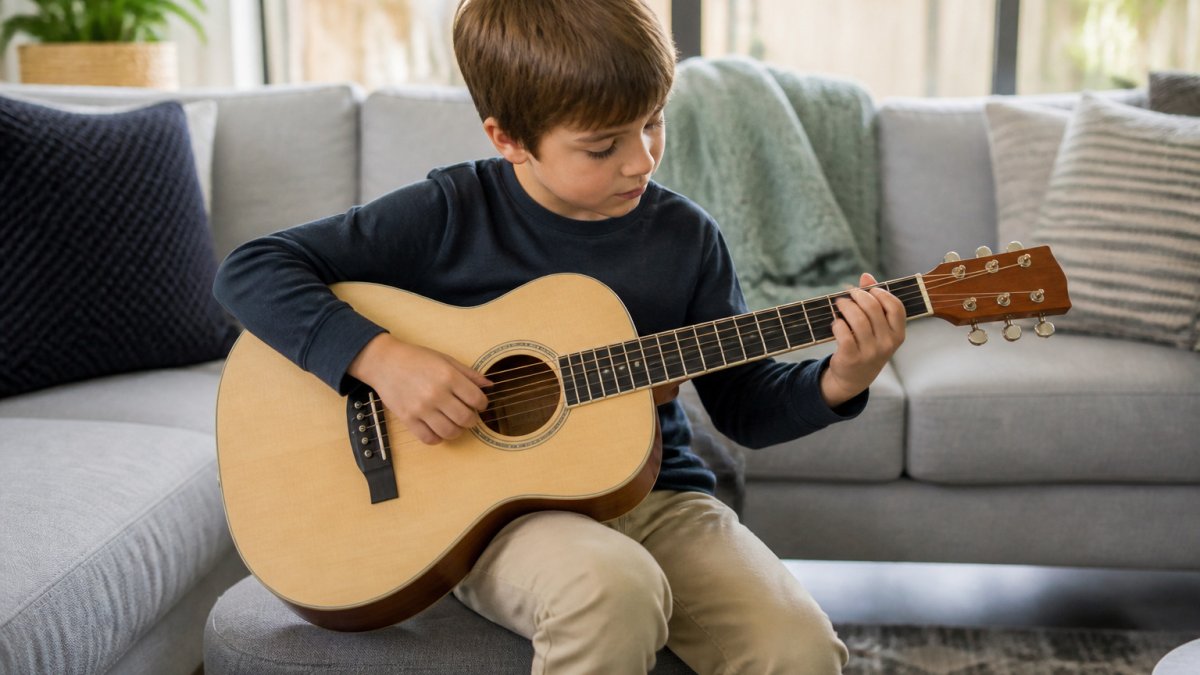
Watch how your child sits and holds an instrument. Comfort tells you more than age does. When you learn how to choose a child's first guitar in Australia, remember that many parents assume age decides the size, but two children of the same age can have very different arm length and hand size.
Checking Reach, Neck Width and Body Fit
Use a few simple checks at home or in a shop:
- Sit the child down with the guitar resting on their right thigh (for a right-handed player), and see whether the body sits comfortably against their chest.
- Check the fretting hand by asking the child to reach the first fret comfortably, with the elbow still relaxed.
- Look at the neck width so their fingers can press strings without straining or cramping.
- Watch for slouching. A child who leans far forward or stretches their arm to reach the neck has a guitar that is too big.
If your child can hold the guitar without tensing their shoulders, you are on the right track.
Best Guitar Size for a Child: Full, Three-Quarter or Half
Guitars for children come in several sizes, usually listed as 1/4, 1/2, 3/4, 7/8 and full size. Most young beginners fit best in a half or three-quarter size. Smaller children often start on a 1/2 size, while older children and taller teenagers usually move up to a 3/4 or full size.
A three-quarter size guitar suits many children aged around 8 to 12, but height, hand size and posture matter more than the number on the label. You can browse a three-quarter classical guitar beginner package with a bag and tuner included. If the child is between sizes, choose the smaller one. A guitar that is slightly small is easier to play than one that is too big.
Acoustic vs Electric Guitar for Kids: Which Suits a Beginner
For most young beginners, a classical or steel-string acoustic guitar is the simplest starting point. It needs no amplifier, costs less to set up, and builds finger strength. Nylon-string classical guitars are gentler on fingertips, which helps children who may quit when their fingers feel sore.
Electric guitars can be exciting for teenagers who want to play rock or pop. If your child is keen on electric, you can review our top beginner electric guitar picks for Australia before deciding.
Best Age to Start Guitar Lessons and Judge Readiness
There is no single correct age to start. Many children begin formal lessons somewhere between about 6 and 9, when they can focus for a short session and follow simple instructions. Readiness matters more than the birthday.
Look for these signs:
- The child asks to play and keeps coming back to the instrument.
- They can sit still for a 20 to 30 minute practice session with a short break.
- They are comfortable with the idea of practising a little each day.
If your child is not ready, a short wait often works better than pushing lessons early.
Guitar Accessories for Beginners Worth Buying First
Accessories can make the first year far more pleasant. Focus on the essentials rather than a long shopping list:
- Guitar cases and gig bags that protect the instrument and make it easy to carry to lessons
- A reliable tuner, so the child can keep the guitar in tune without help
- A capo, once the child begins learning songs in different keys
- Spare strings matched to the guitar type, since beginners often break or wear through them
Pick sturdy, simple items. Accessories should support practice, not distract from it.
Fit Test, Setup Checklist and Budget Before You Buy
Before you buy, run a short fit test in the shop and inspect the instrument itself. Age charts get you close; the child's body and the guitar's setup decide the rest.
The Five-Minute Fit Test
Ask the child to sit on a stool or chair with both feet flat on the floor, then hand them the guitar:
- The body rests against the chest without the child leaning forward to reach it
- The right forearm rests on the top edge of the body, not stretched over it
- The fretting hand reaches the first fret with the elbow still slightly bent, not locked straight
- The thumb can sit behind the neck without the palm clamping the fretboard
- The child can press the first and second strings at the third fret cleanly, one finger per fret
- The headstock does not tip towards the floor when the child lets go with the fretting hand
If the child has to tilt the guitar upwards to see the fretboard, the body is probably too deep for their torso. If their fingers mute neighbouring strings at the third fret, the neck is too wide or the string spacing too generous.
Setup Inspection Checklist
A guitar that fits but plays badly will still defeat a beginner. Check these points before you pay:
- Action (string height): press the low E string at the first and last fret and look at the gap at the seventh fret. A visible gap of roughly a business card's thickness is a reasonable starting point; much more means the strings will be hard to press.
- Fret ends: run a finger along both edges of the fretboard. Sharp or protruding fret ends catch skin and are common on cheaper instruments that have dried out.
- Tuning stability: tune the guitar, play a few chords, then re-check the tuning. If it drifts immediately, the tuners or the nut may need attention.
- Intonation: play the open string and the same string at the twelfth fret. They should sound the same note an octave apart; if the twelfth-fret note is noticeably sharp or flat, the saddle position needs adjusting.
- Buzzes and rattles: play each string open and at the fifth and seventh frets. A buzz usually points to a high fret, a loose saddle or a truss rod that needs a tweak.
- Body and neck joints: look for cracks around the bridge, the soundhole and the neck heel, and check that the neck is not visibly bowed.
A new budget guitar often benefits from a professional setup, so ask whether a setup is included in the purchase price or budget for one separately.
Australian Price Bands and Total Starter Cost
Pricing depends on the instrument, stock and season, so check current pricing on the Muzic Man website or ask for a quote before you buy.
Budget beyond the guitar itself. Before you compare two guitars, add up the accessories you will need, such as a tuner, case, strap and spare strings, because a cheaper instrument that needs extras can cost more than a dearer one sold as a bundle. Check current pricing directly with the shop.
Used, Rented or New?
Second-hand instruments can be excellent value, especially classical guitars that have been lightly used, but inspect them against the checklist above and allow for a setup. If you buy, plan for the next size up in roughly two to three years as the child grows.
Booking Your Fit Test at Muzic Man in Robina
If you are in Robina or anywhere on the Gold Coast, a hands-on fit test is the best way to choose, because the checks above depend on your child's body rather than a size chart.
What to Bring and What to Expect
Bring your child in comfortable clothing and, if they have started lessons, their teacher's book or a song they are learning, it helps to see how they hold the guitar when they are actually playing. Allow around half an hour so there is time to compare two or three instruments rather than rushing the first one. If your child is between sizes, ask to try both so you can feel the difference in reach and posture.
Gold Coast Climate and Instrument Care
South-east Queensland's heat and humidity are hard on beginner guitars, and a neglected instrument quickly becomes hard to play. A few local habits make a difference:
- Store the guitar in its case or bag when it is not being played, away from windows and direct sun.
- Keep it out of hot cars and garages; heat softens glue joints and can warp necks.
- Watch for fret ends protruding in dry spells and for swollen tops or lifting bridges in humid spells.
- Keep a clip-on tuner handy, because humidity shifts tuning more often than you might expect.
- If the guitar lives near the coast, wipe the strings after playing to slow corrosion from salt air.
Lessons and Staying Motivated
Most children do best with a short, regular practice routine, ten to fifteen minutes a day beats one long weekend session, and with a teacher who matches their musical interests. The first three months are when most children stop, so keep the guitar visible and in tune, celebrate small wins, and resist the urge to push practice when the child is tired.
You can contact Muzic Man to arrange a fit test, ask about setup, or check what is currently in stock for your child's size.
Frequently Asked Questions
What size guitar should I buy for my child?
Choose by physical fit rather than age alone. Have your child sit with the guitar resting on their right thigh, and check that they can reach the headstock comfortably with their left arm while keeping a relaxed elbow. Fingertips should reach the strings without strain. Common beginner sizes include 1/4, 1/2, 3/4, 7/8 and full-size instruments. If your child stretches awkwardly or the body presses into the chest, move down a size. Many parents find a three-quarter size suits children in the middle primary years, but measured comfort is the deciding factor.
Should a child start with an acoustic or electric guitar?
For most young beginners, an acoustic guitar is the simpler starting point. Its nylon or steel strings are paired with a body that needs no amplifier, so practice is easy at home. Industry guidance commonly suggests children are around 13 before moving to an electric guitar, mainly because electric instruments are heavier and steel-string tension can be demanding for smaller hands. If your child is set on electric, look for a lightweight model with a short scale length and low action, and check that it feels comfortable during a fit test.
What is the best age for a child to start learning guitar?
There is no single correct age, because readiness depends on attention span, finger strength and motivation more than the calendar. Many teachers accept children who can focus on a short lesson and practise regularly with a parent's support. Smaller children may benefit from a nylon-string or three-quarter size guitar with lighter tension. Ask your child whether they want to learn and whether they can sit through a 20 to 30 minute practice routine. Trial lessons are a practical way to judge readiness before committing to an instrument.
What accessories does a child need to start learning guitar?
Beginners usually need a tuner, a capo, a padded gig bag, a set of spare strings, a strap if the instrument is used standing, and a method book or lesson plan. A clip-on tuner is quick for parents to use at home. Keep a spare set of strings and a cleaning cloth on hand, since strings wear and need replacing. Pricing for accessories varies by retailer and bundle, so check current prices with Muzic Man directly before buying.
Guitar sizing guidance for Australian beginners