




Best Budget Acoustic Guitar Strings 2026: Australia Guide
1st Oct 2026
Table of Contents
- Quick Comparison: Best Budget Acoustic Guitar Strings for 2026
- D'Addario EJ11 80/20 Bronze: The Everyday Value Pick
- Martin Authentic Acoustic 80/20: Clarity on a Budget
- Ernie Ball Earthwood 80/20: The Easy-to-Find Workhorse
- D'Addario EJ16 Phosphor Bronze: Warmth That Lasts Longer
- Ernie Ball Aluminium Bronze: Extra Projection for Performers
- Acoustic Guitar String Gauges Explained
- How to Change Acoustic Guitar Strings
- Frequently Asked Questions
Last Updated: September 30, 2026
Quick Comparison: Best Budget Acoustic Guitar Strings for 2026
Finding budget acoustic guitar strings for 2026 Australia players can trust comes down to matching alloy, gauge and lifespan to how you actually play. At Muzic Man, we see three alloys dominate the affordable end of the market: 80/20 bronze for brightness, phosphor bronze for warmth, and aluminium bronze for projection. This guide from Muzic Man compares five sets that deliver serious value, explains which gauge suits your hands, and shows Robina and Queensland players how to restring without wasting a set.
| String Set | Alloy | Gauge | Best For |
|---|---|---|---|
| D'Addario EJ11 | 80/20 Bronze | 12-53 | Everyday value |
| Martin Authentic Acoustic | 80/20 Bronze | 12-53 | Tonal clarity |
| Ernie Ball Earthwood | 80/20 Bronze | 11-52 | Easy local availability |
| D'Addario EJ16 | Phosphor Bronze | 12-53 | Warmth and longevity |
| Ernie Ball Aluminium Bronze | Aluminium Bronze | 12-54 | Live projection |
D'Addario EJ11 80/20 Bronze: The Everyday Value Pick
D'Addario EJ11 strings are the safest first upgrade for a beginner, pairing 80/20 bronze wrap wire with a hexagonal core for bright, crisp projection. The set is non-coated, so expect oxidation sooner than premium strings, especially in Queensland humidity. Still, consistent manufacturing and corrosion-resistant packaging make this the set most players should try first. Buy two sets at once and keep one sealed.
Martin Authentic Acoustic 80/20: Clarity on a Budget
Martin's Authentic Acoustic 80/20 set targets players who want professional-grade clarity without stepping up in price. A high-tensile core wire adds durability, while the 80/20 composition keeps the tone brilliant and crisp. The trade-off is lifespan: without a coating, these strings settle into a duller voice after a few weeks of heavy playing. For recording or a gig you want to sound sharp at, they punch well above their tier.
Ernie Ball Earthwood 80/20: The Easy-to-Find Workhorse
Ernie Ball Earthwood strings wrap 80% copper and 20% zinc around a hex-shaped steel core, producing a bright, balanced tone with pleasing overtones. Their real advantage is availability: most Australian music shops stock them, so a snapped string never ends your week. Tension and feel stay reliable set to set. Heavy players will notice brightness fading faster than coated alternatives.
D'Addario EJ16 Phosphor Bronze: Warmth That Lasts Longer
D'Addario EJ16 is the phosphor bronze benchmark, trading 80/20's sparkle for a warmer, more mellow voice that holds its character longer. Balanced tension keeps the set comfortable under the fingers, and corrosion-resistant packaging protects it before installation. The slightly higher price over entry-level 80/20 sets buys you longevity, which matters if you play daily. Fingerstyle players and singer-songwriters tend to prefer this tonal profile.
Ernie Ball Aluminium Bronze: Extra Projection for Performers
Ernie Ball Aluminium Bronze uses a unique alloy blend that resists corrosion and pushes more volume than traditional bronze. The result is a wider dynamic range, crisp highs and defined lows, which suits performers who need their acoustic to cut through a room. The texture feels slightly different under the fingers at first. If you play unplugged gigs, the extra projection is worth the adjustment.
Acoustic Guitar String Gauges Explained
Gauge is the diameter of each string measured in thousandths of an inch, so a "12-53" set runs from a 0.012-inch high E down to a 0.053-inch low E.
For most players, the practical ladder looks like this:
- 10-47 (extra light): very easy to fret and bend, popular on shorter-scale guitars and for beginners, but thinner and quieter under a hard strum.
- 11-52 (custom light): the sweet spot for many beginners, noticeably easier than 12s while still holding a full chord voicing.
- 12-53 (light): the de facto standard set on most steel-string acoustics sold in Australia, and the gauge the majority of factory setups are intonated for.
- 13-56 (medium): more volume and headroom for flatpickers and open tunings, at a real cost in comfort.
A note for Queensland players: humidity, not gauge, is what usually kills a set early here. Coastal and south-east Queensland rooms swing between damp summer air and air-conditioned dry winter air, and that cycle accelerates corrosion on the plain steel strings first, you will hear the top two strings go dull before the wound ones do. Wiping down after playing and keeping spares in a sealed bag slows that considerably, whatever gauge you choose.
How to Change Acoustic Guitar Strings
- Loosen and remove. Detune the string until it is slack, then pull the bridge pin straight up. Never lever a pin sideways, the pin is tapered and seats by friction, and rocking it can crack the bridge plate. Once the pin is out, the ball end lifts free.
- Feed the new string. Drop the ball end into the bridge hole, then push the pin back in so the string's ball sits against the pin's slot, not on top of it. If the pin pops back out under tension, the ball is sitting wrong, reseat it before you wind.
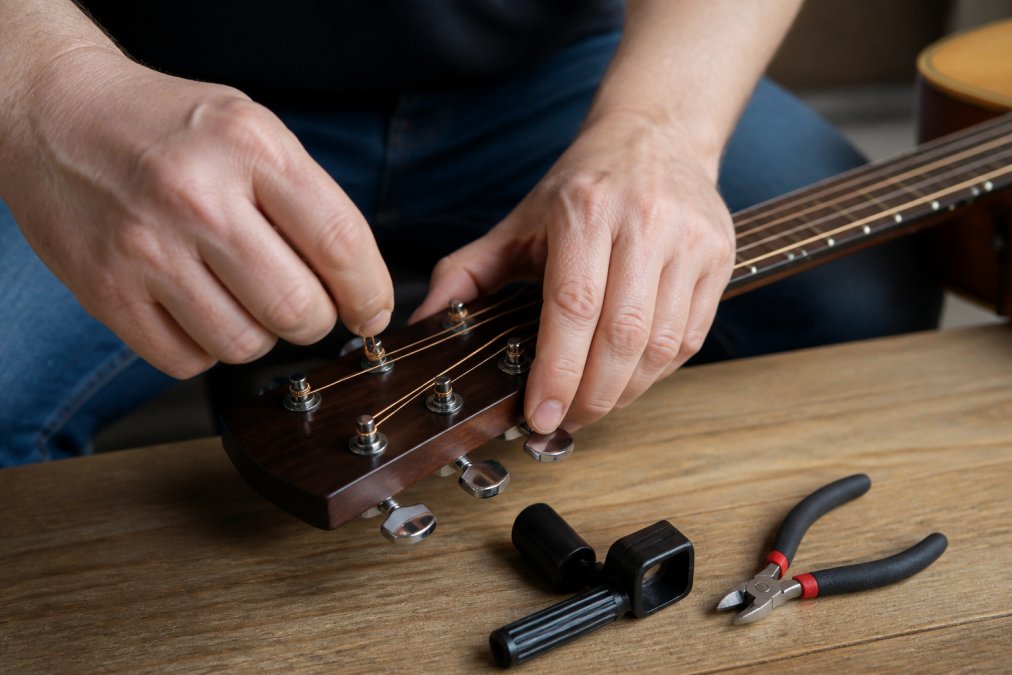
- Wind onto the peg. Thread through the tuning post leaving enough slack for two to three wraps around the post. Wraps should go down the post toward the headstock face, which increases the break angle over the nut and helps tuning stability. Too few wraps and the string slips; too many and it bunches and drifts out of tune.
- Tune up to pitch. Bring the string up gradually rather than cranking it. Tune slightly below pitch, stretch, then bring it up, this is the step most beginners skip.
- Stretch every string. With the string at pitch, grip it gently around the 12th fret and pull it a few centimetres away from the fretboard, then retune. Repeat two or three times per string. New strings stretch for the first hour or so; stretching them manually means they settle before you play rather than drifting mid-song.
- Trim and settle. Snip the excess leaving about a centimetre past the post, then retune the whole set and check intonation at the 12th fret.
Queensland-specific care. Humidity is the main enemy of string life here, and it works on two fronts. First, moisture in the air accelerates corrosion on the plain steel strings, so wipe the whole set down with a dry cloth after every session, sweat and skin oils are acidic and do most of the damage in the first hour. Second, humidity swings affect the guitar, not just the strings: a soundboard that swells in a damp Queensland summer raises the action slightly, which can make a freshly strung guitar feel stiffer than it did last month. If your action changes noticeably with the seasons, that is the wood moving, not your strings.
Frequently Asked Questions
How often should I change my acoustic guitar strings?
For regular practice of around an hour a day, most players change strings every four to six weeks. In humid conditions, non-coated sets can dull or discolour within two to three weeks. Signs it is time include a dull tone, visible discolouration, rough texture under your fingers, and tuning that slips constantly. If you play less often, inspect monthly and change at the first sign of corrosion rather than waiting for a string to break mid-song.
What is the difference between 80/20 bronze and phosphor bronze strings?
80/20 bronze is 80 percent copper and 20 percent zinc, giving a bright, crisp tone that suits strumming and recording. Phosphor bronze adds a small amount of tin and phosphorus, producing a warmer, more balanced sound with better resistance to corrosion. On a budget, 80/20 sets such as D'Addario EJ11 or Martin Authentic Acoustic cost less, while phosphor bronze like D'Addario EJ16 lasts longer in humid conditions.
Do coated guitar strings last longer in the Australian climate?
Coated strings place a thin polymer layer over the wrap wire, which slows moisture and oils from reaching the metal beneath. In humid regions they typically outlast uncoated sets, but they also cost more, which stretches the definition of budget. A practical middle ground is a phosphor bronze set such as D'Addario EJ16, combined with the storage and wiping habits covered in our humid-climate maintenance section.
What gauge of acoustic guitar strings is best for beginners?
Light gauge sets, usually 12-53, are the standard starting point for acoustic guitars. They need less finger pressure than medium gauge, so chords are easier to hold while your fingertips build calluses, and they put less tension on the guitar's neck and bridge. Extra light sets, around 11-52, feel even softer but can sound thin on a dreadnought. Try light gauge first and adjust once you know how your guitar responds.
Are budget guitar strings worth it for recording?
Yes, provided the strings are fresh. A new set of budget strings such as Ernie Ball Earthwood or Martin Authentic Acoustic will record better than an old premium set, because tone degrades with corrosion and stretched windings rather than with price. Change strings the day before a session, let them settle overnight, and stretch them properly before tracking. For bright, ringing acoustic parts, 80/20 bronze is a reliable studio choice.
Choosing budget acoustic guitar strings is really a question of matching alloy and gauge to your playing, then buying from a retailer that ships fast and stocks what it lists. Muzic Man carries many branded strings with Australia-wide delivery, so players in Robina and across Queensland can restring without the wait. Browse the online store or visit the Gold Coast shop for hands-on advice. Get started with Muzic Man and keep your acoustic sounding its best.