



Is Buying Musical Instruments Online Safe? A 2026 Guide
14th Sep 2026
Table of Contents
- Online vs In-Store Instrument Shopping: Pros and Cons
- How to Spot Fake Musical Instrument Websites
- What to Look for When Buying a Guitar Online
- Australian Consumer Law Online Shopping Rights
- Secure Payment Methods and Buyer Protection
- Shipping, Packaging and What to Do If Your Instrument Arrives Damaged
- Setup, Calibration and Local Support for Gold Coast Musicians
- Conclusion: Buying Instruments Online with Confidence
- Frequently Asked Questions
Last Updated: September 14, 2026
Online vs In-Store Instrument Shopping: Pros and Cons
Is buying musical instruments online safe? For most Australian shoppers, yes, provided you buy from a reputable retailer with secure checkout, clear warranty terms and a physical presence you can hold accountable. At Muzic Man, we ship instruments Australia-wide every week, and the risks that trip people up are avoidable: unfamiliar sellers, unclear return terms and no plan for after delivery.
Online shopping wins on range and price transparency: compare models, read reviews and order a guitar your local store may never stock. In-store shopping wins on touch and feel, you can play the instrument, check the fretwork and hear it through a real amplifier. The trade-off is time and travel.
| Factor | Online | In-store |
|---|---|---|
| Range | Wider, national stock | Limited to floor stock |
| Price comparison | Easy across retailers | Harder, store by store |
| Hands-on testing | Not possible before purchase | Immediate |
| Delivery | Shipped to your door | Take home same day |
| Returns | Governed by policy and consumer law | Often simpler to resolve in person |
The practical answer for most buyers is a hybrid: research and order online, but choose a seller with a Gold Coast shopfront or a proven Australia-wide returns process, a real business behind the website.
How to Spot Fake Musical Instrument Websites
Fake instrument sites share recognisable traits. Learning how to spot fake musical instrument websites takes about two minutes of checking before you enter any payment details.
Red flags to watch for:
- Prices far below every other retailer for the same branded model
- No physical address, ABN or phone number anywhere on the site
- Payment only by bank transfer or cryptocurrency, with no card option
- Stock photos instead of real product images, and no serial number policy
- A domain registered recently, with no reviews outside the site itself
- Pressure tactics: countdown timers, "only one left" on every item
Check the seller's Australian Business Number, search for independent reviews, and look for a secure checkout with SSL encryption. A legitimate retailer will answer questions about warranty coverage and authorised dealer status before you commit.
What to Look for When Buying a Guitar Online
Buying a guitar online comes down to four checks: the exact model and finish, the condition (new, ex-demo or second-hand), what is in the box, and who handles warranty claims. Ask the retailer to confirm stock before you pay, so your order is not cancelled after checkout.
For beginners, an entry-level instrument from a known brand is a sound investment. For semi-professional players, confirm the retailer stocks the same branded gear the major stores carry, not budget-only lines.
Verifying Product Authenticity and Serial Numbers
Serial number verification is the most reliable authenticity check. Ask the seller to photograph the serial number on the headstock or back plate before shipping, then verify it against the manufacturer's records or the brand's Australian distributor. On second-hand listings, a serial number that has been obscured, sanded or "worn away" is a deal-breaker. A digital receipt naming the exact model and serial number also protects you for warranty or insurance claims.
Australian Consumer Law Online Shopping Rights
Australian Consumer Law online shopping rights protect you whether you buy in a Robina storefront or from a website interstate. The Australian Consumer Law (ACL), set out in Schedule 2 of the Competition and Consumer Act 2010, is enforced by the ACCC alongside state bodies such as NSW Fair Trading and Queensland's Office of Fair Trading (Buying products and services). It applies to online sellers carrying on business in Australia, including overseas sellers targeting Australian consumers.
The consumer guarantees that matter most for instruments are:
- Acceptable quality, the instrument must be safe, durable and free from defects, given its price, age and description. A second-hand guitar sold as "excellent condition" that arrives with a warped neck is unlikely to meet this guarantee.
- Match the description, the model, finish, year and included accessories must match what was advertised. A listing showing a hard case that arrives with a gig bag is a mismatch.
- Fit for purpose, if you told the seller you needed a left-handed bass for gigging and they sold you a right-handed one, this guarantee applies.
- Express warranties, any extra warranty the seller offers sits on top of, and cannot replace, the consumer guarantees.
Remedies: Repair, Replacement or Refund
The remedy depends on whether the failure is major or minor.
- For a major failure, you choose: a refund, a replacement, or compensation for the drop in value (Repair, replace, refund, cancel). A major failure is one a reasonable consumer would not have bought had they known about it, where the item is significantly different from the description, or where it cannot be fixed within a reasonable time.
- For a minor failure, the seller may choose to repair, replace or refund within a reasonable time, if they don't, you can escalate.
A common pattern with instruments is a minor failure that becomes major after two or three failed repair attempts. Keep records of every repair request in writing.
What ACL Does Not Cover
- Change of mind, if you simply decide the guitar is not for you, ACL does not require a refund. Any change-of-mind policy is voluntary and may include restocking fees.
- Damage you caused, dropping the instrument after delivery is not a consumer guarantee issue.
- Normal wear on second-hand goods, a used instrument sold with disclosed cosmetic wear is not automatically faulty.
- Buying from a private seller, the consumer guarantees generally do not apply to private sales, which is why buying second-hand from a licensed dealer or a platform with buyer protection is safer.
Shipping Damage and ACL
If an instrument arrives damaged, the ACL and the seller's freight obligations overlap. The seller must deliver the goods in acceptable quality, so if the courier damages them in transit, that is the seller's problem to resolve, not yours. The seller must lodge the freight claim with the courier. Do not let a retailer tell you to chase the courier yourself.
Evidence to Keep
- Order confirmation and tax invoice showing the seller's ABN
- The product listing or screenshots of it at the time of purchase
- All email and chat correspondence
- Tracking number and delivery confirmation
- Photos and video of the unboxing and any damage
- Serial number records
If a dispute cannot be resolved directly, you can contact the ACCC or your state consumer affairs body. The ACCC guide to consumer guarantees sets out the full remedies framework and is worth reading before you buy anything expensive.
Secure Payment Methods and Buyer Protection
A secure payment gateway and buyer protection matter more than a slightly lower price. Pay by credit card or a recognised platform like PayPal, both of which offer chargeback rights if goods never arrive or arrive damaged. Avoid sellers who only accept direct deposit.
Before checkout, confirm the site uses SSL encryption (look for the padlock and an https address) and keep the digital receipt. Third-party platforms such as eBay and Reverb add their own payment disputes process, which helps with second-hand purchases. If a deal looks too good, treat it as a scam until the seller proves otherwise.
Shipping, Packaging and What to Do If Your Instrument Arrives Damaged
Freight damage is the most common post-purchase problem, and it is almost always a packaging issue. A guitar shipped in a hard case inside a double-walled box with padding at the neck joint survives courier handling; one shipped in a soft bag with no bracing often does not.
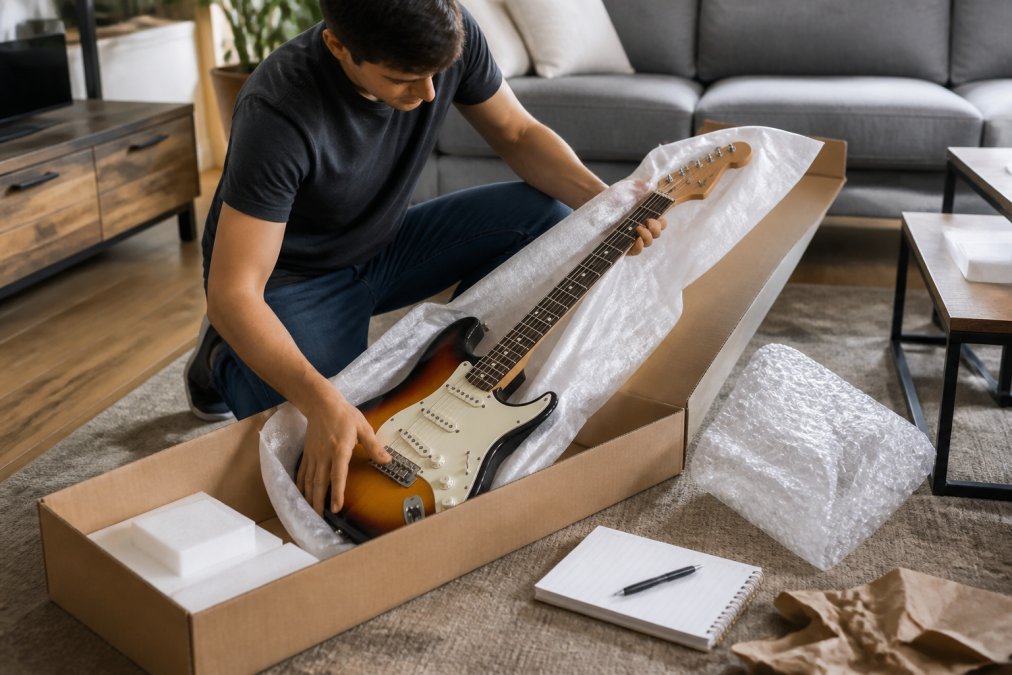
If your instrument arrives damaged, stop and document everything before you assemble or play it. Photograph the box, packaging and damage, then contact the retailer the same day. Reputable sellers carry shipping insurance and will lodge a freight damage claim on your behalf. Do not attempt repairs yourself, as this can void warranty coverage.
Unboxing and Inspection Checklist
Use this checklist the moment your delivery arrives:
- Photograph the box before opening, including any visible dents or tears
- Film or photograph the unboxing as you open the packaging
- Check the serial number against your receipt and the manufacturer's records
- Inspect the body, neck, frets and hardware for cracks, chips or movement
- Test electronics: pickups, switches, knobs and output jack
- Tune the instrument and check for fret buzz or dead notes
- Report any issue to the retailer within 24 hours, in writing
Setup, Calibration and Local Support for Gold Coast Musicians
A new instrument rarely plays its best straight out of the box, the part of online buying most safety guides skip. Shipping a guitar, bass or keyboard across Australia exposes it to temperature swings, humidity changes and vibration. Even a well-packed instrument can arrive with the neck relief out of spec, the action too high, intonation drifting up the fretboard, and pickups at the wrong height.
What a Setup Actually Involves
A professional setup on a guitar or bass typically covers:
- Truss rod adjustment, setting neck relief so the strings sit at the correct curve for the player's tuning and string gauge.
- Action height, adjusting bridge saddles and, on some models, the nut, so strings sit comfortably without buzzing.
- Intonation, moving each saddle so the note at the 12th fret matches the open string, keeping chords in tune across the neck.
- Pickup height, balancing output and tone between pickups.
- Fret check, identifying high frets, sharp ends or dead spots.
- Nut and hardware check, tightening tuners, checking the output jack and switch, and lubricating contact points.
For acoustic guitars, setup may also involve saddle height adjustment and humidity assessment. For keyboards and digital pianos, setup is usually limited to assembly, firmware checks and testing every key and pedal.
Why Shipping Makes Setup More Likely to Be Needed
A guitar set up in a Brisbane warehouse in summer can arrive on the Gold Coast after a week in a courier van with the neck relief noticeably changed. Humidity swings across south-east Queensland can move a neck by a fraction of a millimetre, often the difference between comfortable action and fret buzz. This is not a defect but normal wood movement, and it means a fresh setup is often part of the true cost of buying online.
Local Support in Robina and Across the Gold Coast
For musicians in Robina, Burleigh Heads, Southport and the wider Gold Coast, a local option changes the calculation. If something is not right, you can walk into a physical shop, have a luthier inspection on the spot and get the instrument calibrated without shipping it back interstate. That is why a hybrid approach works here: buy online for range and price, but from a retailer with a Gold Coast presence you can visit for hands-on help.
Questions to Ask Before You Buy Online
- Does the retailer include a basic setup before shipping, or is it an extra service?
- Do they have a local workshop or partner luthier on the Gold Coast?
- What is the turnaround time if the instrument needs adjustment after delivery?
- Will a setup void the warranty, or is it expected?
If you are searching for a music shop near me that backs its online sales with real service, that combination is worth prioritising over a marginally lower price.
Conclusion: Buying Instruments Online with Confidence
The risks of buying instruments online are real but manageable: verify the seller, pay securely, inspect on arrival and know your consumer rights. Do those four things and online shopping is as safe as walking into a store.
Muzic Man exists to make that straightforward. We offer high-quality branded instruments and supplies, reliable Australia-wide shipping, and a physical Gold Coast shop for hands-on advice and local support. Get started with Muzic Man and buy your next instrument with confidence, whether you order online or visit us in person.
Frequently Asked Questions
Is it better to buy a guitar online or in-store?
It depends on your priorities. In-store lets you try the instrument and check its feel and sound before paying, which suits beginners who want guidance. Online offers more choice, competitive pricing and convenience, especially for branded models. Many buyers research online then visit a local shop like Muzic Man in Robina to test before ordering. Both routes are safe when you use reputable retailers, secure payment and understand your rights under Australian Consumer Law.
What consumer rights do I have when buying musical instruments online in Australia?
Under Australian Consumer Law, online purchases come with the same guarantees as in-store ones. Products must be of acceptable quality, match their description and be fit for purpose. If a guitar or keyboard arrives faulty, damaged or not as advertised, you can request a repair, replacement or refund from the retailer. Keep your digital receipt, tracking number and any correspondence. These rights apply to both new and second-hand items bought from Australian businesses.
How can I verify if an Australian music retailer is legitimate?
Check for a physical address, an ABN, clear contact details and a published return policy. Look at independent customer reviews and confirm the site uses SSL encryption and a secure payment gateway. Be wary of prices far below market rate, stock photos instead of real product images, and pressure to pay by bank transfer. A reputable retailer will answer questions about warranty coverage, shipping insurance and stock availability before you commit.
What should I check before buying a musical instrument online?
Confirm the exact model and condition, ask about setup and calibration, and read the return policy and any restocking fees. Verify the seller is an authorized dealer so warranty coverage applies. Check shipping costs, courier handling and whether shipping insurance is included. After delivery, inspect packaging integrity, look for freight damage and test the instrument. For guitars, check the neck, action and electronics; for keyboards, confirm all keys and outputs work.